The Annotated Nightstand: What Ed Park is Reading Now, and Next
Featuring Jack Finney, Jason Rekulak, Rachel Aviv, and More
The beloved novelist, journalist, short story writer, and editor Ed Park is continuing to put out excellent work at a startling clip. After having his recent novel Same Bed Different Dreams named a Pulitzer finalist (which, he explains in a lively interview, was largely written while sitting sentinel during his sons’ hockey practices), Park published the short story collection An Oral History of Atlantis and, this fall, The Repairer of Reputations—a “work of weird horror” according to the author. Three Tenses: A Transmission from the Nineties, is delightfully sandwiched between these two volumes. Three Tenses is born from a draft Park had written, saved on a floppy disc, then plum forgot about for a couple decades.
Park adeptly took up the effort he began in his twenties and developed it into something remarkable, melding autobiography with fiction through 1,500 pithy dispatches. These describe everything from seeing a man carrying an aquarium filled with books to the experience of selecting the prettiest nail clipper from the shop. The starred review in Publishers Weekly for Three Tenses explains: “Park wisely downplays narrative arc in favor of stray ruminations and insights that coalesce to illuminate his endlessly curious, mordantly funny worldview. It adds up to an engrossing and beguiling trip through the consciousness of a budding wordsmith.” Park also generously annotated his to-read pile with the spirit of someone lovingly walking you through his eclectic art collection, so I’m going to get out of the way for you all to enjoy the tour.
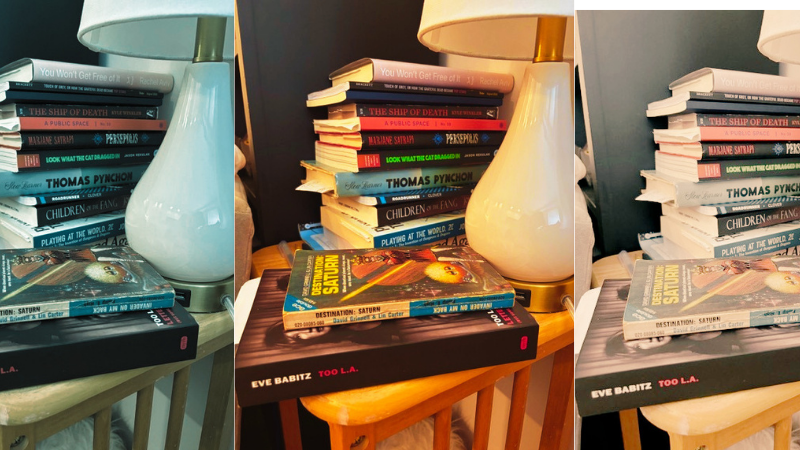
Park says of his TBR pile, “This stack is taller than normal, though not by much. The nightstand itself is a modest thing I’ve had through many apartments—I don’t know where it originated. When I read in bed, I sometimes use a small reading light that clips on to the back cover. (I also read on Kindle, though I don’t know where it is at the moment.) Also, there are some pens here, which (in theory) I use to jot down dreams while they’re fresh in my head. Usually I’ll tell myself the dream is so interesting that there’s no way I’ll forget it, and go back to bed, and forget.”
*

The New Yorker – March 2, 2026
On the bottom of this stack is an old issue of The New Yorker. This one’s from March; it has Rachel Aviv’s wrenching piece on Gisèle Pelicot, which I read, so I think it’s safe to toss it.
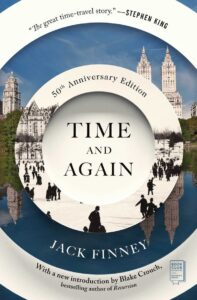
Jack Finney, Time and Again
Next we have Jack Finney’s 1970 novel Time and Again, which I’d sent to my dad for his 59th birthday, back in the ’90s. I don’t know if he ever read it. I brought it back from Buffalo (where my parents live and where I was born) to New York on a recent trip, and just cracked it open two weeks ago. Interestingly, the narrator, a commercial artist, mentions that he came to New York from Buffalo. (Had I known this five years ago, I would have shoehorned an allusion into Same Bed Different Dreams.)
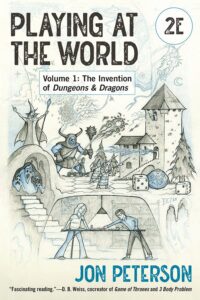
Jon Peterson, Playing at the World Volume 1: The Invention of Dungeons and Dragons
Playing at the World is the first volume of Jon Peterson’s study of Dungeons & Dragons and the world of role-playing games. I’ve been working on a piece about RPGs for the past two years or so, mainly in my head. This book has a lot of detail about various miniature warfare enthusiasts, their newsletters and meet-ups, and how these subcultural forces led to the invention of D&D. Incredible scholarship! I have the second Peterson volume somewhere but I haven’t started it.

John Langan, Children of the Fang
Above this tome rests a John Langan’s 2020 collection Children of the Fang. Horror fans revere him as the author of The Fisherman; I’m also fond of “On Skua Island,” a perfect story from his first collection.
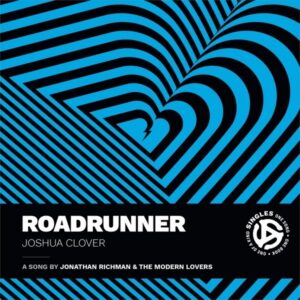
Joshua Clover, Roadrunner: A Song by Johnathan Richman and the Modern Lovers
Next is a book from Duke University Press about the Modern Lovers’ song “Roadrunner.” It’s by the late Joshua Clover, who used to write for me when I was an editor at The Village Voice. Here he untangles the various versions, presents a psychogeography of Massachusetts, and places the song inside and outside of history—just genius. I have fond memories of Clover. For some reason, we went to see The Da Vinci Code together in New York. He also came to my first and only Berkeley reading, for Personal Days. It was nice to see a familiar face, so far from home. (Interestingly, he was the first person I took a picture of on my very first flip phone.) We lost touch over the years. I was a huge Jonathan Richman fan in college, and I was aware that this book was coming out, but I missed it. I’m grateful to my friend David, who gave this copy to me recently.
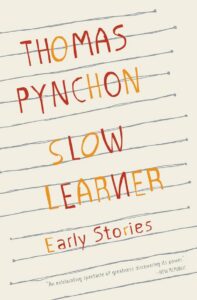
Thomas Pynchon, Slow Learner
Another buddy, Lucas, sometimes brings me books he finds on a big table in Queens. It’s famous in Queens. Just a guy who puts out books every day. Look at this great edition of Pynchon’s Slow Learner. I remember reading the intro years ago—wonderful, but also so self-deprecating that it makes you worry that the stories themselves won’t be worth reading. (I believe Nicholson Baker mentions this in U and I.) I jumped to the last story, “The Secret Integration,” which is good. I also love the narrow trim size and the quality of the paper.
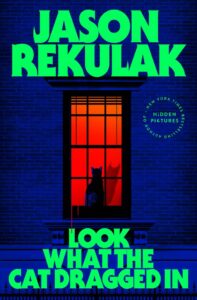
Jason Rekulak, Look What the Cat Dragged In: A Novel
I’m a Jason Rekulak completist—I’ve been a fan ever since (unsuccessfully) trying to acquire his debut novel, when I was an editor—so I’m excited for his forthcoming Look What the Cat Dragged In. (It’s designed by the great Will Staehle, who did the covers for Three Tenses and my previous two books.) This one has a comic-book element—the adventures of an enigmatic feline named Godfrey—integrated into the regular text.
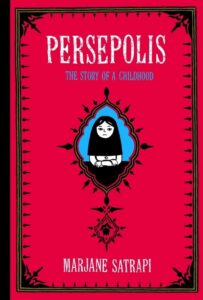
Marjane Satrapi, Persepolis
Speaking of comics, I dug up Marjane Satrapi’s Persepolis after her untimely death earlier this year. It’s great from the first page, the first panel. She wields such authority in the drawing, such precision and emotion in the writing. Even though it was her tragic end that led me back to Persepolis, I’m glad to be reminded of the immensity of her achievement. It’s one medium’s landmark works for a reason.

Next up is the recent issue of A Public Space—I’ve only dipped in. Good line from Astrid Seme: “In Ancient Greece, there was no segmentation between words and sentences…This made reading out loud quite difficult as the reader had to work out from the context where the gaps and pauses should be. Aristophanes of Byzantium, who worked at the library of Alexandria, invented a system of dots that indicated how long a pause to leave.”
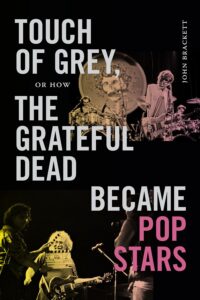
John Brackett, Touch of Grey, or How the Grateful Dead Became Pop Stars
Thinner than the issue, like a blanket resting atop, is John Brackett’s monograph Touch of Grey, or How the Grateful Dead Became Pop Stars. I guess this is the part where I tell you that, to my surprise, I’ve become a pretty rabid Deadhead over the past year. One unusual thing about the Dead is that the bulk of their oeuvre was penned by non-performing songwriters, chiefly Robert Hunter, who collaborated mainly with Jerry Garcia. (John Perry Barlow wrote for/with the recently departed Bob Weir.) “Touch of Grey” is a Hunter song, which he performed solo for years, before it became part of the Dead’s repertoire, where it underwent further transformation.
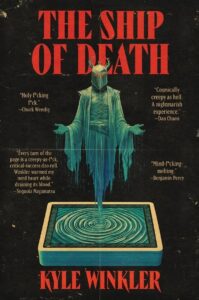
Kyle Winkler, The Ship of Death: A Novel
Kyle Winkler’s The Ship of Death continues the RPG theme—it’s a novel presented as a series of documents involving a rare, weirdly malevolent role-playing game by a shadowy designer. It reminds me of Harry Stephen Keeler’s dossier novels, e.g. 1936’s The Marceau Case. Every chapter is a different document. Sometimes this seems like the only honest way to present a piece of fiction: it should consist of words that might conceivably be written down for nonliterary purposes. Does that make sense? You can ask me about it later.
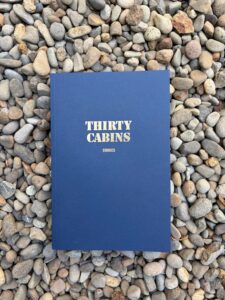
Thirty Cabins: Stories Anthology, ed. Josh Riedel
Thirty Cabins (title not visible on the spine) is an anthology chapbook put together by Josh Riedel and inspired by cabin designs published in the 1920s. He invited me and 29 other writers to contribute a story based on one of the plans. I chose “Cabin in the Clouds,” because I thought it would be a good way to force myself to finish a story I’d been toying with, part of a larger fictional project I’m working on—I thought my cabin would be a haunted ski lodge, a portal to some Lovecraftian ice-entities. I made six (at least) different starts to this story, but then I scrapped it and just banged out something that feels like an ominous preface to the collection as a whole (my story comes first): a nameless visitor approaches the titular cabin, perhaps programmed like the Manchurian Candidate. There’s a Grateful Dead song on the car radio, “Dire Wolf,” in which they sing, sweetly: “Please don’t murder me.”

Rachel Aviv, You Won’t Get Free of It
I picked up the aforementioned Rachel Aviv’s You Won’t Get Free of It at her book launch last month. She’s revised some of her best-known New Yorker pieces for this collection (including her masterful feature on Alice Munro), revisiting and revising them from the point of view of being a mother. It’s hard to believe, but over 20 years ago, Rachel was my intern when I was an editor at the Voice. She wrote a lot for me there—book reviews, as well as articles for the EdSupp, which was not named for me but was short for “Education Supplement”—and elsewhere.
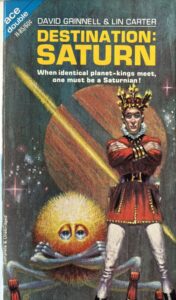
Philip E. High, Invader on My Back / David Grinnell & Lin Carter, Destination: Saturn
In the foreground is a mini-stack. On top is an “Ace Double” found by the aforementioned Lucas at the aforementioned Queens table. (I am enamored of this s-f flip-book format, having included a fictitious version in Same Bed Different Dreams.) This specimen has Philip E. High’s Invader on My Back on one side (“They dared not look at the sky!”), and Destination: Saturn by David Grinnell and Lin Carter on the other. I hesitate to say I’m in a Lin Carter phase, but I’ve been teaching a very short story of his that I think is great (“The Doom That Came to Sarnath”), and I also recently bought a book he wrote on Lovecraft’s Cthulhu mythos and Conan of Aquilonia, which he cowrote with L. Sprague de Camp. Anyway, Carter’s contribution here bears a goofy Kelly Freas painting and an irresistible, barely grammatical tagline: “When identical planet-kings meet, one must be a Saturnian!”

Eve Babitz, Too L.A.: Letters Never Sent (But Some Were)
Below this we have Eve Babitz’s Too L.A., with the confounding subtitle Letters Never Sent (But Some Were). I wish we knew, more clearly, which were and which weren’t, but it’s a pretty addictive read. As Deborah Shapiro pointed out on Substack, it’s like a West Coast companion piece to my late friend Duncan Hannah’s diaries of the ’70s, 20th Century Boy. I don’t personally like to gossip, but I like reading old gossip. It doesn’t hurt anyone.

Diana Arterian
Diana Arterian is the author of the recent poetry collection Agrippina the Younger (Northwestern UP, 2025), which received the 2026 William Carlos Williams Award from the Poetry Society of America. She is also editor and co-translator of Smoke Drifts (World Poetry Books, 2025), a collection of Nadia Anjuman's poetry. A Poetry Editor at Noemi Press, Diana has received fellowships from the Banff Centre, Millay Arts, and Yaddo. She writes “The Annotated Nightstand” column at Lit Hub and lives in Los Angeles.