The Accidental Discovery of the Most Valuable Shipwreck in History
Julian Sancton on Roger Dooley and His Search for an Eighteenth-Century Treasure Ship
Roger Dooley’s quest, the one that would come to consume him and indeed to define his life, began in Seville, on a typically torrid day in July 1984. The thirty-nine-year-old archaeologist left his hotel after breakfast and made his way toward the Plaza del Triunfo, the city’s central square. He relished his morning walks through the Barrio Santa Cruz. Shops were closed, tourists were sleeping in, and the sun had not yet risen high enough to illuminate the narrow, labyrinthine streets. It would soon become too hot to remain outdoors for long. He checked his watch, a battered Rolex Sea-Dweller he never took off his wrist, not even when showering or when exploring shipwreck-strewn waters of the Caribbean. There was no time to dawdle: The doors of the archive would open soon.
Tall and wiry, with deep-set eyes and a conquistador beard, Dooley looked like a young Don Quixote and was imbued with a similar sense of purpose. He hurried through Seville’s medieval maze and found himself at the foot of the cathedral, one of the largest in Europe, where the weight of Spanish history was as oppressive as the sun. Before him on the cobblestoned Plaza del Triunfo, past a minefield of horse droppings and a perimeter of palm trees, his destination: the General Archive of the Indies.
There were two ways to hunt for a colonial Spanish shipwreck in the Americas.
A stately, two-story, seventeenth-century edifice, the archive stood as a temple to Spanish bureaucracy, containing four centuries’ worth of records from the Americas—more than sixty million documents dating back to the time of Columbus, accounting for every conquest, every ounce of gold and silver stripped from the New World, every ship sent across the Atlantic, and every one that didn’t return.
Dooley entered the palatial building, his footsteps echoing between the marble floor and the arcaded ceiling. He flashed his researcher’s card to the guard on duty. Though he was born Roger Edward Dooley, in New Jersey, the document identified him under the more dashing alias of Roger Montañés Caballero, as he was known in Cuba. Caballero was his Cuban mother’s surname, Montañés his stepfather’s.
As it happened, Dooley was in Seville on Cuban government business. He was the chief archaeologist for a state entity called Carisub, newly formed on orders from President Fidel Castro in part to track down the many historic ships thought to have wrecked against the island’s treacherous shores over the centuries and to pry out their riches.
To many archaeologists around the world, the organization’s emphasis on recovering treasure amounted to piracy, flouting international standards for the preservation of cultural heritage. Dooley himself had misgivings about the practice, which he feared would make him a pariah among legitimate archaeologists. But he felt he had little choice. He was raising two daughters in Cuba, where Castro ultimately controlled every sphere of human activity. The dictator had set his mind on claiming all the sunken treasure off his country’s coast and would brook no competition. For Dooley, who had dedicated his professional life to finding shipwrecks, Carisub was the only game in town.
When he joined the company, in 1983, Dooley insisted to his colleagues that they should focus their efforts on finding a lost treasure galleon that was rumored to have wrecked in the shallows east of Havana in the late seventeenth century, in the clear waters just off the postcard-perfect white sands of Guanabo Beach. There were two ways to hunt for a colonial Spanish shipwreck in the Americas. You could start in the water, blindly towing a magnetometer or a side-scan sonar and investigating every hit, or you could start here, at the General Archive of the Indies, where many historic wrecks were thoroughly documented.
In theory, the research approach was more efficient. In practice, though, it could be just as difficult to find clues in the Byzantine archive as it was to find treasure on the seabed, especially for the uninitiated. The classification system had hardly been updated since the 1700s. There was no comprehensive catalog, no index. “It’s not like there’s a shipwreck section,” Dooley would later tell me. “You could spend twenty years there and not find what you’re looking for.”
For most of its existence, the archive had been a resource for scholars of Spanish colonialism. But recently, a more swashbuckling caste had begun to infiltrate its stacks. American treasure hunters—and Spanish researchers in their employ—had increasingly come seeking information that might lead to multimillion-dollar troves.
Dooley did not fit neatly into either camp. He had been tasked with locating a valuable wreck, but even if he found chests full of gold, he stood to gain nothing himself. All treasure would go to Carisub, and ultimately into state coffers. What Dooley dreamed of instead was the chance to excavate a galleon, a type of warship that for almost three centuries traversed the ocean, carrying men and merchandise to the New World and Asia and bringing unfathomable wealth back to Europe, forever altering the course of civilization on several continents.
With their imposing bulk, elegant curves, colorfully painted sterns, and ornate decorations, the vessels were among the most distinctive and beautiful ships on the seas. of the many galleons believed to have sunk in the Caribbean, only three had ever been found and identified, all of them ransacked by treasure hunters before they could be properly studied. Dooley had been calling himself a maritime archaeologist for more than a decade but had yet to conduct a by-the-book excavation of any kind. If he could lead the first thorough study of a Spanish galleon, it could help fill in an all-important missing chapter in world history. More importantly, it would make Dooley’s name, a prize more precious to him than gold.
Dooley climbed the archive’s grand staircase to the second floor and walked through a curtain to an area where desks were arranged under the high vaulted ceiling. He requested a file from the archivist and took his seat. Over the course of several years, the archaeologist had begun to understand the archive’s chaotic ways. He was less intimidated by its befuddling organization and had grown accustomed to the antiquated spellings and the nearly illegible, unpunctuated scribblings of harried seventeenth-century officials. He came to recognize their various handwritings. “The king’s scribe’s was always beautiful, perfect,” he said. “But most wrote like drunken doctors filling out prescriptions.”
Since he’d begun delving into the archive the previous year, Dooley had confirmed that the galleon he was after was no fiction. Its name was Nuestra Señora de las Mercedes, the vice-flagship of the Caribbean treasure fleet, known as the Tierra Firme Armada. on the moonless night of March 13, 1698, its hold abounding with silver, the Mercedes struck a reef east of Havana and sank, according to records, “in four fathoms of water, a musket’s shot from land.”
The demise of the Mercedes and the investigations that followed generated reams of paperwork, which now told Dooley the rest of the story. He learned that all crew and passengers made it safely ashore, that much of the galleon’s treasure was salvaged over several years, and that the unsubmerged top of the wreck was deliberately torched to prevent pirates from finding and looting it. Dooley believed there was little silver left. He also suspected that three centuries’ worth of storms had fragmented the hull and dispersed its remaining contents over a large area.
He nevertheless resolved to learn everything he could about the ship, its history, and its afterlife in order to inform a possible excavation. To that end, he searched for references to the Mercedes stretching from ten years before its sinking to ten following the tragedy, beyond which point the collective memory of the event would have begun to fade.
These letters were indeed about a shipwreck. But as he read deeper, he realized that it couldn’t have been the Mercedes.
The archivist handed him a heavy file—or legajo—labeled 377, from a section dealing with Caribbean affairs. Dooley untied the cord that held the bundle together like a Christmas present. He opened the hard, threadbare cover and was immediately transported to the early 1700s. Under the watchful eye of the archivist, he began to read.
The documents that Dooley was now handling were barely yellowed, their edges lightly frayed, the oak gall ink ranging from brown to black. With their high linen content, the sheets exuded no mustiness, only the faint sweet smell of aged paper. Summer temperatures in Andalusia routinely exceeded one hundred degrees, and though the underbudgeted archive lacked air conditioning, the dryness of the air in Seville had a preservative effect. (“It’s why restaurants can leave a pata negra ham out in the open for days and it won’t rot,” Dooley hypothesized.)
For hours, in the suffocating heat, Dooley sifted through endless accounts of mundane colonial matters—church records, itemizations, legal disputes, petty complaints. His eyes strained to decipher the hurriedly ornate calligraphy, which often bled to the other side of the sheet, making the documents even harder to read.
Midway through the legajo, by which point the dullness of the pages would have discouraged all but the most obsessive of researchers, he discovered a packet of letters that would change his life. He noticed that they had been sewn together in a kind of booklet, an odd detail he would never forget. Reading through them, he understood that they had been sent to Havana from Santiago de Cuba, a city on the southeastern tip of the island. The missives dated back to 1708, the last year of Dooley’s search. He expected to sort through it quickly, since little relevant information about the Mercedes was likely to have been withheld that long.
But as he scanned the papers, words and phrases called out like siren song from the deep: “galleons,” “battle,” “English warships,” “gold,” “silver,” “His Majesty’s treasure,” “everybody drowned” . . .
These letters were indeed about a shipwreck. But as he read deeper, he realized that it couldn’t have been the Mercedes. The letters had been dispatched from Cartagena de Indias, the rich port city on the coast of what is now Colombia, just days after what appeared to have been a horrific tragedy. Dooley was perplexed: How, then, had the documents wound up in the records of Havana?
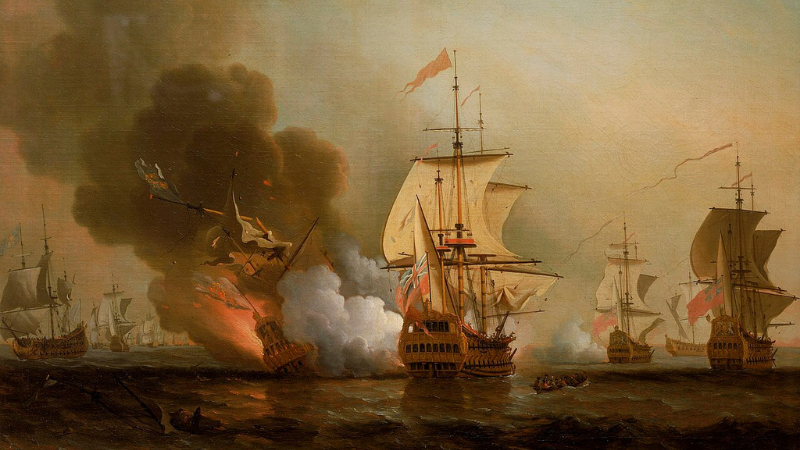
At the risk of getting sidetracked, Dooley couldn’t resist reading on. The story the letters told was more dramatic than any adventure novel he’d ever read. The reports, he learned, had been smuggled past an English blockade of Cartagena in a small, inconspicuous sloop with the instructions that the governor of Havana should immediately send them across the Atlantic ocean to Spain’s Felipe V, to inform him of the loss of three of his ships and a literal king’s ransom in gold and silver. Well versed in the period, as well as in the literature of treasure hunting, Dooley realized then that he had stumbled upon critical clues to the whereabouts of the most valuable shipwreck in history: the mythical San José.
__________________________________
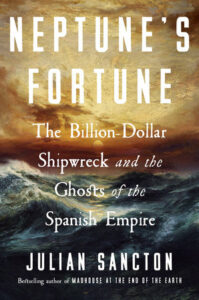
Excerpted from Neptune’s Fortune by Julian Sancton. Copyright © 2026 by Julian Sancton. Published in the United States by Crown, an imprint of the Crown Publishing Group, a division of Penguin Random House. All rights reserved.

Julian Sancton
Julian Sancton is a senior features editor at Departures magazine, where he writes about culture and travel. His work has appeared in Vanity Fair, Esquire, The New Yorker, Wired, and Playboy, among other publications. He has reported from every continent, including Antarctica, which he first visited while researching this book.