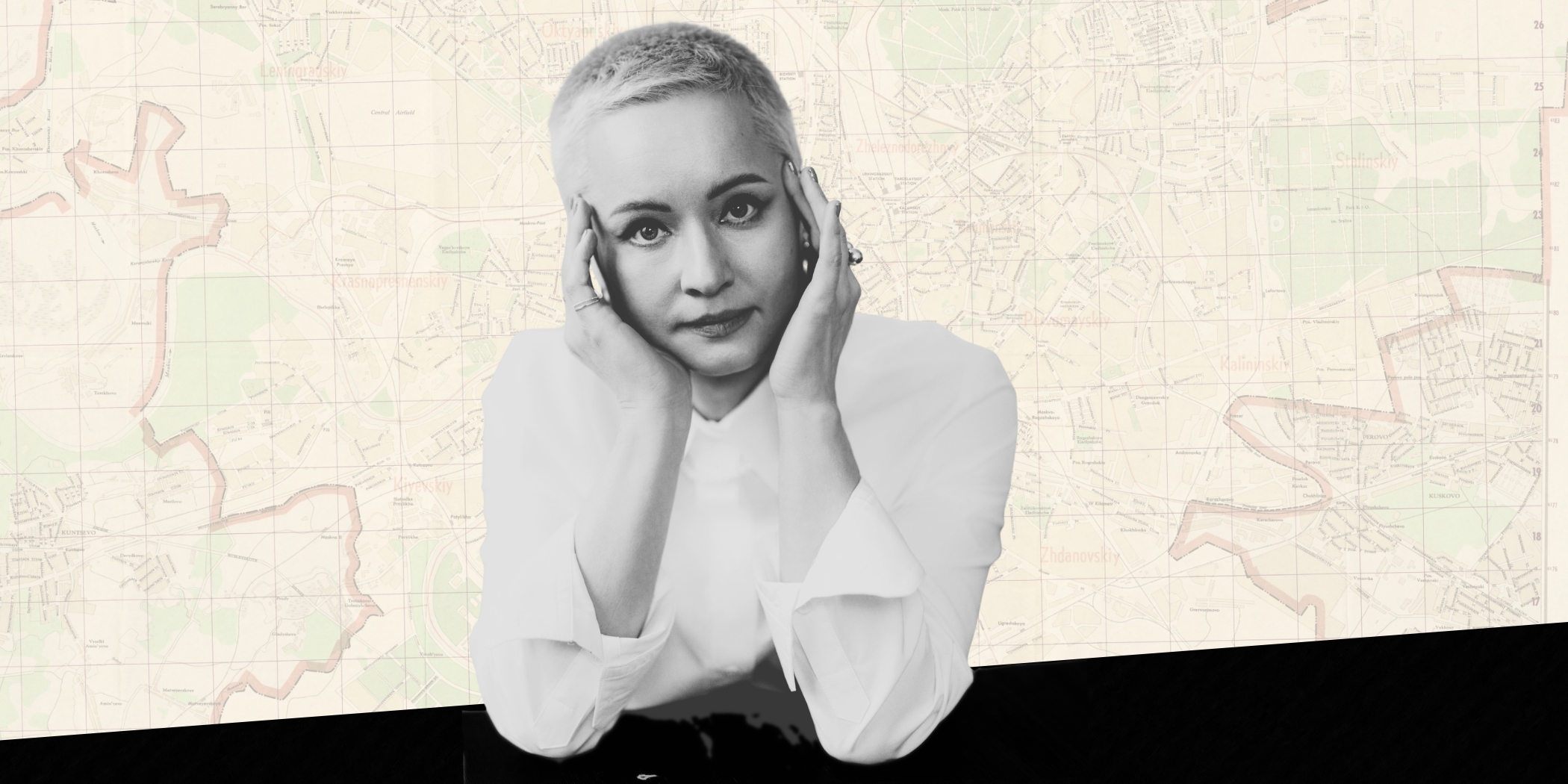
The Absurdity of Authoritarianism: A Conversation With Svetlana Satchkova
Virginia Marshall Discusses Art, Repression and Exile With the Author of The Undead
When Svetlana Satchkova set out to write The Undead, her novel about a young filmmaker targeted by the Russian state, she had to make negotiations between truth and fiction because the true events she based her story on were almost too absurd. “A lot of writers mention this,” Satchkova said when I sat down with her just after the book’s release in January, “that when you take something from real life and put it onto paper, it just becomes unreal.”
At the time, Satchkova was following the trial of Evgenia Berkovich and Svetlana Petriychuk, a playwright and a director whose 2024 conviction for “justifying terrorism” landed them in a Russian penal colony. “At every step of the way, the absurdity was just staggering because the truth didn’t matter,” Satchkova said. “The prosecutors could say basically anything. They didn’t listen to witnesses. It was just mind-blowing.” She weaved in facts from that case into her fictional story about Maya, whose script gets picked up by a Russian production company right out of graduate school. The result is a surreal, almost breathless novel that follows the protagonist’s improbable rise as the Russian film industry’s directorial ingénue. A famous actor signs on to star in the film, a horror movie set in Moscow featuring a zombified Lenin rising from the dead; Maya gets to call the shots, manage the budget, and attend parties with the crew. Then, in a horrifying shift that is becoming all too real for Satchkova’s American readers—agents of the state show up at Maya’s door.
This marks the turning point for the novel, the second half of which slips into Kafka territory as Maya’s apartment is raided and she’s taken in for questioning. She’s accused of inciting protest with her as yet un-released film; her work is labeled anti-government and far too radical. For a person who staunchly stayed out of politics, who professed to be able to make art without a political stance—this comes as a shock. The remainder of the novel transforms into a kind of horror film of its own as Maya contemplates a prison sentence in a Russian penal colony where conditions are unsanitary, frigid, and inhumane.
The Undead: A Novel of Modern Russia (Melville House, January 2026) is Satchkova’s fourth novel, her first in English. She was an arts and culture journalist in Moscow for many years before she fled Putin’s regime in 2016 to re-start her career in the United States. At the time, she could see the writing on the wall. She watched from afar as her country clamped down on free speech, persecuted artists, and attacked people she knew.
*
Virginia Marshall: I’d like to start the interview with a scene in the beginning of the novel, where Maya’s talking to international artists in Italy and they press her to comment on what’s happening in Russia. And she really deflects, she says she doesn’t read the news. Throughout the book, people ask her again and again to weigh in on current events or take a political stance. And she just continuously claims ignorance. I think one of the interesting things about living in an oppressive regime in a wealthy nation is that it is possible to ignore politics, right? Was that what were you seeing in Russia in 2016, when you left?
Svetlana Satchkova: There were a lot of people like that around me—successful professionals who enjoyed travel, great restaurants, and the cultural life Moscow offered. They were decent people, honestly. But I kept trying to have these conversations with them, because I was always troubled by what was happening in the country. And the conversations went nowhere. This always puzzled me, the stance of “I don’t pay attention to politics. I’m just enjoying my life, making my art, whatever.”
While I was in the process of writing, the political theme kind of inserted itself, because that’s all I’m thinking about, as a person who left their country because of the regime.
Over the years, though, I noticed that some of those people would start thinking about politics only after something happened to them, or to someone they loved. For instance, a friend of mine who worked at a luxury conglomerate barely paid attention to what was happening in the country until her sister came out as gay. Suddenly, she started following the anti-LGBTQ legislation being passed in Russia. And once she saw that, she began noticing other terrible things, too.
VM: You depicted that so effectively in the book because for Maya, it’s this kind of slow realization that she’s living in an oppressive regime. She watches the film industry start to get censored, and then her artistic friends begin to leave. First, the famous actor in her movie, and then her film friend flees to Germany because he’s gay. Maya herself even gets an opportunity to flee, right? But she refuses. So I guess I was wondering, how pressing was that question in Russia, of whether to leave or stay?
SS: For most people in my circle, the option to leave was always there. They could travel to European countries and find jobs abroad, or start an immigration process through their relatives, or even ask for political asylum. But the thing was, not a lot of people thought about that because life was great. Maybe not in Russia, but at least in Moscow. Moscow was and still is a very affluent city. I don’t think people here can even imagine the level of technology, the level of comfort that Moscow affords. Like for example, the famous Moscow subway that I’m describing in the novel.
Basically, every station looks like a palace. It’s spotlessly clean, and the trains come every three minutes. You can order any delivery 24/7; you can do an MRI at midnight. So maybe when people are surrounded by this level of comfort, it takes precedence over everything else. They have a great job and they realize that if they leave, they will probably have to start their lives over, like I did.
When I came here in 2016, I knew I would never reach the same level of comfort that I had in Moscow. I worked at Condé Nast Russia at one of the top positions. I had a great salary. And now I live in a rent-stabilized apartment, and most of my clothes come from H&M and Uniqlo. I’m not complaining, I’d like to stress this. It was something I knew right away, that I would never be able to come here in my forties, go to the American Condé Nast and say, “Okay, I’m going to try and get one of those positions here.” I just knew it would not happen. And I was prepared for that, but many people aren’t.
VM: It’s so interesting to me that you sort of track your own story in the character of Lena in the novel. She’s a secondary character, she’s Maya’s best friend, actually, and she emigrates to the States before the novel ends. I just want to hear a little bit more about that decision not to focus on your own story, but to focus on someone else’s story, Maya’s story, a person who decided to stay.
SS: I have to preface this by saying that I didn’t start out to write a political novel. Maya’s character is based on a friend of mine from Moscow, whom I met when we both worked in magazines. She decided to go after her life’s dream, applied to and completed the best program in screenwriting and film directing. Right away, she signed a contract with a producer and began making her own movie. But after she finished filming, the producer started stalling on the money for post-production for no apparent reason. This went on for a very long time, maybe two years, and all the while she was stuck in limbo, which drove her crazy.
Then, after a nasty scandal with one of the actors, just like in the novel, it became clear that the film would never come out. And my friend never recovered from that. She abandoned the film industry and never wrote anything else. She got married, had a child, and dissolved completely into family life. For me, that was baffling, because I couldn’t understand her. In my writing career, I experienced epic failures. There were periods when I quit writing for two years because a project fell through in a particularly traumatic way. But I always pulled myself together and started again, because to me, that was the only way. I wanted to understand her, which is why I decided to explore that story.
While I was writing it, I had no idea where the novel would go. The real-life ending didn’t seem satisfying. There wasn’t enough story in it, so I knew I had to do something. And while I was in the process of writing, the political theme kind of inserted itself, because that’s all I’m thinking about, as a person who left their country because of the regime. I keep thinking about what it’s doing, and I keep writing journalism about it: how it tightens repression against free speech, and how the number of political prisoners only keeps growing. Alexey Navalny wasn’t just my hero, he was almost like a family member, despite the fact that I’ve never met him in real life.
Maybe that tells you something about my outlook on life, but I don’t believe in purely happy endings.
When I learned about his death, I cried for days. And because I was writing about my friend, who was incidentally apolitical, I started exploring that topic little by little. Then the novel grew organically into what I have now. The political trial that takes place in the book is based on real events. It just didn’t happen to my friend. But as a fiction writer, I could combine those two things: her personal story, and the larger political story.
VM: I understand you based a lot of Maya’s trial on what happened to Evgenia Berkovich and Svetlana Petriychuk in 2024. Can you tell me more about that?
SS: Svetlana is a playwright, and Evgenia is a theater director. They’ll be in jail for a long time, unless they’re released in something like a prisoner swap. What happened is that they put on a play based on stories of Russian women who were lured into marrying ISIS fighters and traveled to Syria. The play had a clear anti-terrorism message and even received awards from the Russian state. And then, absurdly, the prosecutor’s office started claiming that the play promoted terrorism. It was obvious they were using the play as an excuse. What they were really going after was Evgenia’s anti-war writing. At the beginning of the full-scale invasion in 2022, she started publishing anti-war poems on Facebook. She had a lot of followers, and people reposted them hundreds, if not thousands, of times. I remember reading those poems and thinking, “Oh my God, what are you doing? They’re gonna come for you.”
VM: I couldn’t help but think about what’s going on right now in America as I was reading The Undead. I know you wrote the novel just over a year ago, but were you thinking about what we’re going through here while you were working on the book?
SS: At the time, I wasn’t thinking about the American context at all. But now I am, of course, especially because at parties, or when I’m doing an interview, people invariably ask me the same question: “Do you see any parallels?” Of course I do. It’s impossible not to. I wasn’t expecting to find myself in this situation again, where I’m not sure I’m free to say what I think. I’m worried again for my own safety. When I see these news items about people being pulled out of cars or snatched on the street, I know it’s not just about them. Any one of us could be next.
VM: You have this moment in the novel where Maya is talking to her lawyer, and she’s processing what’s going on in her trial. You write, “When you witnessed the ruling class amassing staggering wealth, treating the country as their personal property and killing citizens, including children by the hundreds, all the while lying about it, you learned to ignore what was actually happening. And then your brain lost the ability to tell what was real from what wasn’t.” I wanted to ask you about that surreality. You’ve said when some people are reading this book, they can’t believe that some of the things you’re writing about actually came from reality.
SS: I remember Joshua Henkin, the director of our MFA program, saying that fiction has to have a higher standard of believability than real life, or something to that effect. Because when we encounter something that seems unrealistic in a book, we immediately jump to the conclusion that the writer invented it. I was conscious of that while working on the novel, wondering if I should change this or that to make it more believable. But in the end, I stuck with the facts. All of it was outrageous, and also representative of what happens in Russia. Some of my editor’s comments on the manuscript said, “Too implausible.” For example, the scandal that happens to one of my principal actors in the novel—when videos emerge of him having sex with a dog—that’s taken from real life. I tended to respond to those notes with proof links.
VM: I want to ask you about your decision to start your career over in the United States. Because you made the huge leap that Maya is not able to make—you left Russia and you started writing and publishing in English. What was that transition like for you?
SS: I’m actually at a very happy stage of my life, because while I lived in Russia, as I mentioned, I was a successful media professional, but at the same time I had no time to write fiction. I published three novels in Russian, the first two in the early 2000s, and then for a long while I didn’t publish anything at all, and I struggled even to think of myself as a writer. When we came here, my husband found a job right away because he’s a software developer, but since I knew I wouldn’t be able to apply for the same kind of jobs I had in Russia, I was thinking of becoming a barista. And my husband said, “You’ve always wanted to be a fiction writer. You don’t have to get a full-time job. We’ll live modestly, but you’ll be able to write.” I’m so grateful to him, because first of all, he validated me as a writer—essentially, he said he believed that what I wanted to do was something of value.
And then a couple of friends of mine asked me, “Why don’t you start writing in English? You’re here, and you probably have something to say that people will want to hear.” I translated a short story from Russian into English, then started another novel in Russian, which I partly translated into English. I wasn’t satisfied with the result, so I rewrote the whole thing in English from the beginning. That manuscript is unpublished and might never be, but it was definitely a learning process. And The Undead is the first long-form text that was born in English and exists in English.
VM: Will The Undead be translated into Russian?
SS: I won’t publish anything in Russia on ethical grounds. Even the publishing industry ultimately participates in the war economy, if only by paying taxes. Now there are also about thirty Russian-language publishers all over the world, and most of them appeared after the invasion, when new laws were passed in Russia that essentially eliminated free expression. So maybe my novel could be published by one of them. But I’m not going to take any steps in that direction. If somebody asks for it, we’ll talk about it.
VM: What’s the hesitation there? Like, why not?
SS: Maybe it’s because I lost touch with a lot of people who could be my Russian-language audience. Most of my friends have actually left Russia, and with those who stayed, I became less close over the years. Like the friend who became Maya in my novel, we just stopped talking. We text sometimes, but it feels like we have nothing to talk about anymore. When I was just starting to write this novel, that was the last time we spoke on the phone, and I said, “I’m writing a novel about you and me.” If I heard something like that, I’d be like, “OMG, tell me about it. Can I read it?” But she wasn’t curious at all and just changed the subject. Was it because she closed the door on her own story? Or maybe we grew apart because every time we spoke, I would ask her if she was writing anything. She probably got sick of that, as someone who abandoned that whole creative life.
VM: There’s this part toward the end of your novel where Maya finds herself stuck in this place between being a true dissident and being a loyalist of the Russian state. Basically, both sides shun her and hate her, and she’s sort of beaten out of the idea of creating art at all. That struck me as so sad, perhaps the saddest way for the novel go. Why did you take the story there?
SS: When I was drafting that part, I wanted to be truthful. I’ve heard this expression, and I even used it in one of my previous novels, that if you have a happy end, that’s not the end. Meaning you’ve encountered this character, or this person, somewhere in the middle of their story, because the ending, at least in Russian literature, is nearly always bad. And maybe that tells you something about my outlook on life, but I don’t believe in purely happy endings. I guess, as a writer and as a human being, I think the truth is somewhere in between.
Virginia Marshall
Virginia Marshall is a writer and audio producer. She was a 2023-2024 Emerging Writer Fellow at the Center for Fiction and has an MFA from Brooklyn College. Her writing has been published in journals including Catapult, The Harvard Review, Essay Daily and NPR, and her podcast for Brooklyn Public Library was nominated for a Peabody Award. You can read or hear more of her work on her website: https://vrosemarshall.com/