Terry Tempest Williams on the Plight of the Monarch Butterfly
“Who are we as a species if we allow monarch butterflies, a living symbol of metamorphosis, to cease to exist?”
Tell me what supernatural life / Is painted on your wings, the poet Homero Aridjis writes of monarch butterflies. He knows the migrations, the flaming butterflies, from his childhood when they return each year to the pine and oyamel forests near his home in the mountains of Michoacan, Mexico.
Rey Chin, a student in my class A Wild Promise: Celebrating the Endangered Species Act, reimagines the purpose of the black veins “painted” on the monarch’s wings. She created a three dimensional model of the iconic butterfly made of hand-cut and layered black and orange paper. She called her project Imaginal Migrant. It integrates science data points with artistic expression, whereby the black veins are transformed into the monarch’s migratory paths mapped accurately on the orange wings. Chin used the word homegoing as an Interpretation and Integration of how one species can captivate the Imagination of another species through devotion. A monarch’s “homegoing” becomes a “homecoming” for humans who care enough about the monarchs’ collective wellbeing to plant milkweed along their arduous migratory path.
In 1994, Homero and Betty Aridjis invited Brooke and me to witness the butterfly’s migration, which is threatened by deforestation. We came as part of el Grupo de Cien, an association of artists, writers, and scientists devoted to protecting the environment.
In a miracle it flies. “Ciclo de vida,” she says.
In my journal entry from that excursion, I write:
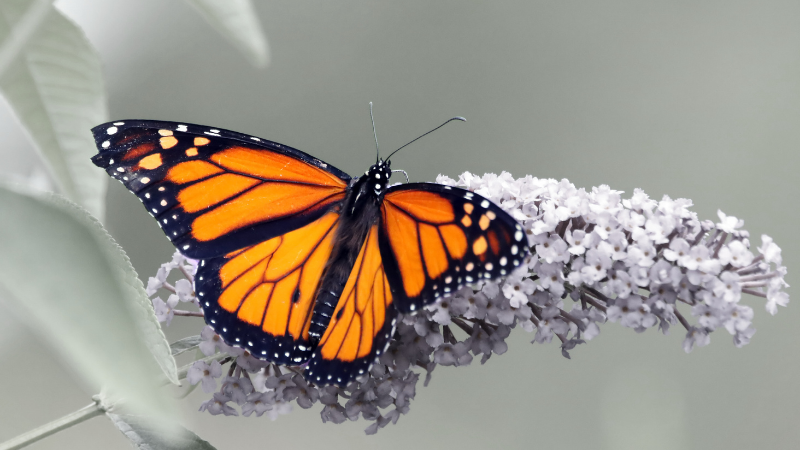
Orange. Black. Monarchs wear the topography of flowing lava on their wings. The butterflies’ final destination was a secret, not discovered by the lepidopterists until 1974. Of course, the locals knew but they never told anyone that 40 million monarchs were perched on the mountain tops above their village opening and closing their wings in private conversations. I am walking up a mountain along a steep, thin path.
The path is dry and dusty. There are burning fields, cleared fields, and farms that appear as quilted squares on the steep hillsides. Gullies cut deep from rains expose red soil. A few monarchs are sipping nectar from roadside flower. We pass men on the trail who remove monarchs from the path; they pick them up, blow the dust off their wings, and place them in sunlight safe from foot traffic. This is their job. This is their work. I stop. I think I hear rain. We continue walking until the forest darkens, cools. Suddenly, we look up through a canopy of wings, wings fanning the air, creating the sound of rain, the sound of wind, it is the sound of wings, butterfly wings. The fir trees are laying down their arms.
Here. Now. Millions of Monarchs hang from the trees like frostbitten leaves the underside of their wings exposed, burnished, and bronzed. We are now dressed in butterflies. The longer we stay inside the winged forest, the more we see and hear, the settling of peace and then the sun appears from behind a cloud, the peace is ruptured in a frenzy of flight. The forest is ablaze with monarchs—
Why must we leave?
We walk back down the mountain. I trip on an exposed root, my foot falls on a butterfly. I have killed a butterfly. A woman from the village walking with me bends down, picks up the still life with cradled hands, brings the monarch to her mouth and with one quick pop of her breath, blows it back to life.
In a miracle it flies. “Ciclo de vida,” she says.
If only it was that simple.
On August 28, 2020, it rained in Fargo, North Dakota. But not the rain predicted by forecasters. It was a rain of thousands of dead monarch butterflies on the sidewalks, streets, and playgrounds of this Midwestern city. Residents awoke to what they called a “monarch massacre” and spoke of picking up hundreds of fallen monarchs. Children were being asked at their elementary schools during recess to pick up the winged bodies in stacks of twenty five monarch butterflies at a time.
The cause of deaths? A routine mosquito abatement program carried out in the middle of the monarch migration by city officials who said, “There are some insects that are dead. But rest assured there was absolutely no change in the protocol of spraying permethrin . . . Same chemical, same product, same airplane, same process and procedure we have used for the past ten years.” The city official called it an “unfortunate side effect.”
What is the side effect of children stacking the bodies of monarchs on their playground?
Monarchs now flutter on the threshold of extinction.
A generation earlier, children were known to look out the windows of their apartment buildings in Manhattan and witness the wonder and awe of millions of monarchs flying through the city streets. In rural America, children were accompanied to school by monarch butterflies floating alongside as they walked through fields of milkweed.
In January of 2021, during the twenty fourth Western Monarch Count, nearly a hundred volunteers donned their masks in the middle of the pandemic to carefully survey groves of trees on the California and Northern Baja coast for monarch butterflies. They surveyed 246 sites. To their surprise and dismay only 1,914 monarchs were counted. A shocking 99.9 percent decline since the 1980s.
Counts from 2017 to 2019 were around thirty thousand—now in the years of the pandemic barely two thousand individuals remain. Monarchs now flutter on the threshold of extinction. A migration of millions of monarchs reduced to two thousand in a few decades.
My questions remain the same: Where is our outrage? Where is our grief? How do we put our love into action?
Who are we as a species if we allow monarch butterflies, a living symbol of metamorphosis, to cease to exist? They are torchbearers of beauty who still fly above us.
Homero Aridjis continues his musings on monarchs in News of the Earth:
I have often felt like Sisyphus, confronting the same environmental problems over and over again, or Cassandra, prophesying disaster, or Don Quijote, because we sometimes seem like madmen tilting at windmills. Although the plant and animal species we defend, or the rivers and forests, will never know we defended them, often at risk to our lives, “in dreams begin responsibility,” as William Butler Yeats wrote, and for me there is nothing more tyrannical than a dream.
In 2022, the International Union for the Conservation of Nature added the migrating monarch butterfly to its Red List of threatened species and classified the iconic species as endangered. I heard the news on July 21, the day we were shin deep in a flash flood following an afternoon monsoon. As the flood was beginning to wane, a monarch was crossing the valley, momentarily dipping down to sip nectar from a patch of penstemons still standing. The red-orange butterfly whose wings opened like stained glass windows letting light pour through felt like a grace note in the midst of chaos.
They have been on the waiting list since 2020. What is the federal agency waiting for? Extinction?
A year later, the IUCN upgraded the status for the monarchs from endangered to vulnerable after a University of Georgia research scientist petitioned against the endangered classification, arguing that monarch populations are thriving more than the IUCN’s “over-cautious models showed.”
They went on to say, The levels of migratory monarchs in their wintering homes in Mexico were 59% lower in January compared to last winter, Mexico’s National Commission for Protected Natural Areas recently revealed.
The most recent monarch Species Status Assessment posted by the U.S. Fish and Wildlife Service on December 12, 2024, reveals:
By 2080 the probability of extinction for eastern monarchs ranges from 56 to 74% and the probability of extinction for western monarchs is greater than 95%. Threats to the species include the loss and degradation of breeding, migratory and overwintering habitat, exposure to insecticides and the effects of climate change.
The United States Fish and Wildlife Service, which oversees the Endangered Species Act, has said that the migratory monarch will be added to the endangered species list “if it meets the criteria” in 2025. They have been on the waiting list since 2020. What is the federal agency waiting for? Extinction?
The butterflies, which migrate from Canada and the U.S. to Mexico and back again, aren’t counted individually. Rather, their annual count is measured by the number of acres they cover when they rest on tree branches in forests west of Mexico City.
Homero Aridjis writes a poem, “To a Monarch Butterfly”:
You who go through the day like a wingèd tiger
burning as you fly
tell me what supernatural life
is painted on your wings so that after this life
I may see you in my night
__________________________________
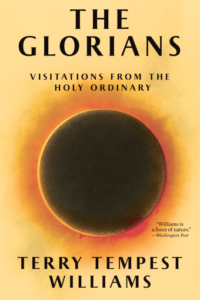
From The Glorians by Terry Tempest Williams. Run with the permission of the author, courtesy of Grove Press, an imprint of Grove Atlantic. Copyright (c) 2026 Terry Tempest Williams.

Terry Tempest Williams
Terry Tempest Williams is the author of numerous books of nonfiction, including Leap, Red, and the environmental classic Refuge. She is a fierce advocate for freedom of speech and environmental justice, and her writings appear frequently in journals and newspapers worldwide.