Television to the Rescue! Camille Acker on the Craft Potential of TV
More Like Literary Box
This first appeared in Lit Hub’s Craft of Writing newsletter—sign up here.
I have always loved television, but as a kid, television was the “idiot box.” According to experts, this device could rot my brain, influence me to commit immoral acts, and even ruin my eyesight. Sitcoms and, in later years, reality television were the lowest common denominators of the genre. Books were the intellectual pursuit, though there were just as many literary pratfalls and seedy dramas to be had between certain bookcovers. As an adult, writers I knew would boast they never watched television. If I wanted to be a writer, and a serious writer at that, it seemed television should be only my guilty and secret pleasure.
After completing an MFA and publishing a short story collection, I was determined to finish a novel. After years of labor stalled by, among other things, economic realities and depression, I turned back to my ilicit love: Television to the rescue. I thought about character tropes, sitcom hijinks, and all those “very special episodes” about drug and alcohol use, stranger danger, and getting involved with the “wrong crowd,” I had watched on 1980s and 1990s television shows.
Television also helped me think about pace and plot. As a literary short story writer, plot was more inconvenient than useful. I could write characters all day and conversations between characters, but to have things happen? To have a lot of things happen? I barely knew where to begin. Books only helped me so much in that regard. Many of the books I loved hewed to the highbrow, the challenging, and occasionally esoteric. Once I realized I was writing a social commentary, a satire as biting as I could muster, I knew it also needed to be fun. I wanted it to be irresistibly consumable, a binge of a book, and television was the medium that demonstrated what was possible.
To get an audience to go to the next episode, I plotted out cliffhangers. I mapped out questionable alliances, the introduction of unexpected characters, the culmination of will they/won’t they romance at the end of chapters that I named, naturally, Episodes. It was only after a finished draft that I realized I also needed commercial breaks. I felt like I was moving the dementia patients around like furniture in the novel. They were disembodied, which in one way was necessary for the plot, but to advance the larger themes, the novel needed to not treat them that way. I wondered who my grandmother had been beneath the layered silence of Alzheimer’s and when my father, in the throes of cancer, began to take hallucinatory excursions in his mind, the necessity of my formal choice was even clearer. The commercial breaks gave me a chance to make the characters with dementia self-possessed and multi-dimensional. It also allowed me to be a short story writer again. Each interstitial piece became flash fiction, where each of the characters took over the narration of their own stories.
When I reread the novel before sending it off to my agent and editor again, I spotted both the “serious” writer and the girl who couldn’t wait for the next episode of her favorite show. When I teach, I tell my students that the only unique work they’ll create encompasses their specific experience, their taste, and their perceptions. A few years ago in a conversation with a writer friend, I was startled to discover that “seeing” the scenes of a novel was not the way that all other writers determined what should go on the page. That aspect of my craft, my love of the visual medium, and my connection with those heady words written by my favorite writers didn’t have to compete, with one winning out over the others. All of those facets could combine to create something wild, weird, and completely me. Television hadn’t ruined me, or my eyesight, instead it became a portal into a more deeply creative writing practice.
______________________________________________
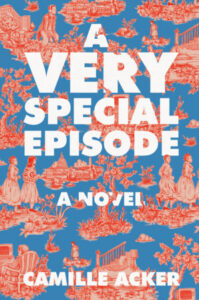
A Very Special Episode by Camille Acker is available via Random House.

Camille Acker
Camille Acker is the author of the short story collection Training School for Negro Girls. She grew up in Washington, D.C., and holds a B.A. in English from Howard University and an M.F.A in Creative Writing from New Mexico State University. Her work has been published in The New York Times Book Review, Publishers Weekly, Electric Literature, and in the anthology On Girlhood: 15 Stories from the Well-Read Black Girl Library. Her writing has received support from the Tin House Residency program, Djerassi Resident Artists Program, Voices of Our Nations Arts, and Millay Colony for the Arts, among others. She was a recipient of a Fulbright Scholarship and named a Fellow by the Pew Center for Arts & Heritage. She lives in Philadelphia, PA with her partner.