Take a Literary Pilgrimage to Jane Austen’s England
Elizabeth Kaye Cook and Melanie Jennings on the Charms of Bibliocentric Travel
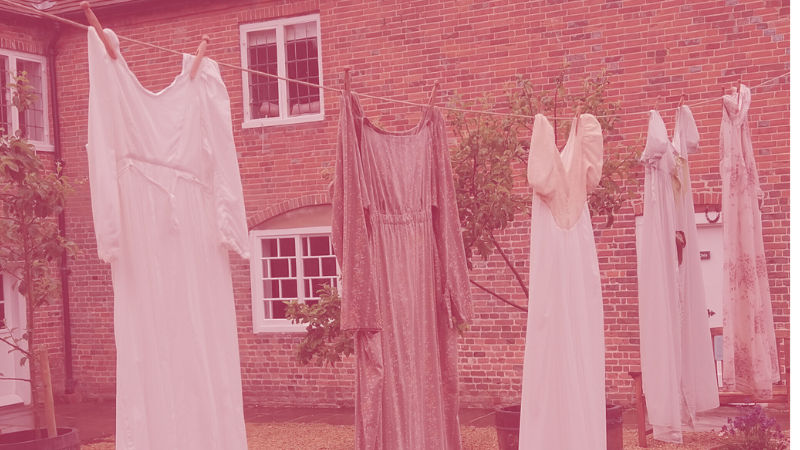
A heavy mist fell as we stood before Jane Austen’s cottage. Pink roses climbed the bricks. Dresses hung on a line in the courtyard. Though tiny, the cottage is a world-class museum, lovingly restored.
Inside, the mood was hushed, reverent. Jane had supped in this dining room. Jane had slept in this bedroom. On this small round table, Jane had penned her masterpieces.
We are two friends and aspiring novelists who consider Jane Austen our literary mother superior which is why, for her 250th birthday, we took a springtime pilgrimage to England.
We began in Bath, at the Jane Austen Centre. A Regency-dressed footman greeted us warmly, then ushered us inside. Sitting in chapel pews, a young woman in a ribboned cap treated us to an overview of Jane’s life: her birth in 1775; her older brother’s adoption by wealthy relatives; the drama and reduced circumstances after her father’s death; the anonymous publication of Sense and Sensibility, Pride and Prejudice, Mansfield Park, and Emma; her own death at 41; and then, the posthumous release of Northanger Abbey and Persuasion. Only the last two books bore her name.
After her biographizing, our guide released us to explore. The Centre was a mix of historical artifacts, quirky crafts, film adaptation memorabilia, and a Jane-themed quilt. High, low, or just plain weird, each received equal love. This made sense to us. Janeites are not Nabokovians. Hers is a more catholic church, one that must seat Mennonite moms, gay professors, searching teenagers, soccer dads, sarcastic childless women like Mel, and hungry art monsters like Liz. In other words, our fellow museum-goers were from all over the world and all walks of life.
The most memorable exhibit was the Jane Austen wax figure. We turned a corner, and Bam! There she was. Despite the initial jump scare, Wax Jane won our hearts. She was made with meticulous attention to the author’s actual measurements and features. Not all kitsch is bad kitsch.
At George Bayntun, the antiquarian bookshop that we hope is at the end of the tunnel when we die, Liz told the bookseller, “We’re on a Jane Austen pilgrimage.” It was like a secret password or Open Sesame. Immediately, the bookseller unlocked a cabinet and spread a collection of Austen editions out onto a table. Several were rare. All were beautiful. One was the iconic “Peacock” edition, the first fully illustrated Pride and Prejudice.
How could the bookseller trust two random plebeians off the street? “Can we really touch and hold these?” She nodded, assuring us that her invitation was genuine. We turned the covers and the pages tenderly. Liz bought a double-edition from 1897 (Northanger Abbey and Persuasion) in a bright red cover to be the crown jewel of her Jane Austen bookshelf.
Our next stop was The Pump Room, the very establishment where Northanger Abbey’s Catherine Morland takes her first steps toward adulthood. We gorged on sandwiches and petits fours, admired the musicians playing era-appropriate tunes, and drank the perfect pot of tea. Sadly, we wore sundresses and Birkenstocks—but we could imagine primping for hours, ready to see and be seen. The staff seemed keenly aware that we and so many others had traveled far to be there. Our teapot was never less than half-full.
We’d always felt a tie to Jane’s England, but now we could see it was not one thread, but a web spanning two-and-a-half centuries: the Austen family, other women writers, and readers from around the world.
We headed south to Chawton, our final stop. We’d visit Jane’s house (that of the pink climbing roses!) and her brother’s manor home. On the train, a dark-haired young man read Marcus Aurelius while the coffee cart trundled past, pushed by a friendly woman offering drinks and snacks. We cut our eyes at one another thinking the same thought: This, my dear friend, is civilization.
Disembarking, however, we faced a conundrum. There was only one taxi driver, and he was stone drunk, eager to take us . . . somewhere . . . or, into a ditch. There were no other cabbies in this remote area, and no Uber, spare bicycles, or old-fashioned hay carts. Rather than drag our luggage behind us for five miles, we threw ourselves on the mercy of a local couple with young kids. It turned out the father’s brother was the chef at the very pub where we were booked—and lo!—he offered us a lift. It was a scene from Emma: decent people saving hapless travelers. If everyone involved hadn’t already been happily married, we’d have been plot-bound to fall in love.
From Jane’s cottage, it was a short walk to her wealthy brother’s mansion. We squeaked our way up old stairs, oo-ed-and-ahh-ed over the William Morris wallpaper, and then had our minds and hearts blown wide open by the exhibit, Sisters of the Pen: Jane Austen, Influence, Legacy.
We knew that Austen had been a reader. In Northanger Abbey, she parodies novels like Mysteries of Udolpho, while hinting that these “horrible” books helped Catherine suss out more commonplace cruelty. In Mansfield Park, when one character talks of cutting down beautiful old trees, Fanny Price quotes poetry in their defense. Jane herself is listed as a subscriber to Frances Burney’s novel, Camilla. Austen was a genius, yes, but she was not alone. Standing in the company of these literary sister-saints, Mel was moved to tears.
At a tiny table in Cassandra’s Cup, the village coffee shop, we bumped knees and swapped stories with Pamela and Dutch Tubman, a retired couple from the American South. Their trip across England celebrated the auspicious anniversaries of their two passions: Jane Austen’s 250th (for Pamela) and 200 years since the first railroad (for Dutch).
Talking with Pamela and Dutch was the perfect ending to our journey. In only a few days, we’d seen and felt so much. We’d crossed green fields to admire springtime lambs and paid our respects to Austen’s father in a wildflower-strewn cemetery. We’d dreamed where Jane dreamed and walked where Jane walked. We’d always felt a tie to Jane’s England, but now we could see it was not one thread, but a web spanning two-and-a-half centuries: the Austen family, other women writers, and readers from around the world.
Back home, we returned to our writing desks with a renewed hue and spirit. Like Austen, we practice our art in a time of massive change and upheaval. Novels mattered to her. They matter to us. When we checked in with Pamela from Cassandra’s Cup about her own Jane Austen pilgrimage, she wrote:
I grew up in a very rural and isolated county of dirt roads in southwest Virginia. Jane had a rural home, too. And a loving family. Sometimes she had new clothes, handmade, of course, just as mine had been. She went to the Assembly Rooms and danced. I danced on Granny’s porch and in the bedrooms that were also sitting rooms, bean stringing rooms, and music making rooms. She sat in the pews of St. Nicholas and listened to the sermons with her siblings; I sat in the pews of Pisgah and sang shape-note hymns with my cousins. Flowers, orchards, gardens the world over . . . Being alive to the places she had been alive to: This means the most.
We’re already planning our next pilgrimage. A transatlantic flight won’t be necessary. There are sites all across America: Melville’s House and Zora Neal Hurston’s grave. Kurt Vonnegut’s museum and Willa Cather’s Great Plains. Stephen King’s Maine and Langston Hughes’s Harlem home. Like Austen, these writers have given us so much. It would be an honor to pay homage to their memory and the places that inspired them. But even beyond that, congregating with fellow bookworms was a spiritual experience we’d recommend to any avid reader. We hope you choose to go. Maybe we’ll meet you there.

Elizabeth Kaye Cook and Melanie Jennings
Elizabeth Kaye Cook is a tender-hearted hater who loves contradictions. Without fiction, life is incomplete. Anti-censorship. Pro-imagination. Sign up for her newsletter for more bookish words. Melanie Jennings’s creative work has appeared or is forthcoming in Ploughshares, Hotel Amerika, Crab Orchard Review, and elsewhere. She lives in Oregon, where she is always working on a novel.