I’ve seen the steppe from the window of an airplane. Do you know what it looks like? The steppe looks like a sinewy piece of yellow meat. Dark-orange lines, like heavy serpents, stripe the sands, gray rivers stripe the sands. The steppe is no desert, you can see the life in it. Gray and blue grasses. Chirring insects, cool eels, darting dice snakes in the Volga delta.
I used to think that the steppe resembled a soft belly. Through the window of my father’s truck I could see its spread, rolling upward in tiny hillocks. The steppe is sand pierced by grasses and little pale flowers. Never pull off the paved road, my father used to say. Just try veering right or left, get your wheels stuck, and that’s the end of you. When you’re driving freight, it’s best not to make any unnecessary moves anyway, particularly if you’re loaded with steel pipe—you’re heavy then, you put on speed quickly, and when you slow down, you roll on for a while out of inertia and you can’t stop.
He was driving to Volgograd like that once, loaded with pipe, just before dawn. Morning in the steppe is blinding, pink. The entire expanse floods with light, because there’s nothing to block it in the steppe. Worn out by his night on the road, my father began drifting off. The truck rolled down the level highway, and sleep spread over him like a large warm palm. Spread over him and shoved him forward, and he was woken by a screech and a howl. The truck was still moving, but slowly. He looked in the rearview mirror: in the road behind him lay a large metal pancake, blue-white in color. Two drunk traffic cops, going two hundred kilometers an hour after a night out, had driven into the oncoming lane. Traveling toward the cops on the empty morning road was a MAZ truck loaded with pipe, my father asleep at the wheel. The speedy little Mercedes slipped beneath the truck, nudging it lightly in the belly, and contracted, crushing within itself two male bodies slack with drink and sleep.
My father faced no consequences, because it was obvious that only a Mercedes could have managed that maneuver. He was nearly deaf by then, and the metallic screech he’d heard in his sleep hardly disturbed him. So now I got back at them for everybody, my father said simply. The demise of two traffic cops beneath his truck seemed like justice to him. He didn’t feel any guilt, and he wasn’t guilty, really: even if he had braked, inertia would’ve kept him moving forward for some time, and there was no place for him to turn. Some other cops drove out to the scene and threw up their hands—it was an accident. They checked his documents and his packing slip for the pipe. With some regret, they noted that if my father had driven by half an hour later, he wouldn’t have met these cops on the road. The Mercedes went under his truck just a few kilometers short of the turn-off for the village where the cops were heading to sleep it off. My father hemmed, thinking that it was their bad luck, because he hadn’t slept at all that night, and also because they were bastards.
*
When you’re transporting chickens, you drive to the sound of ceaseless clucking. The birds get loaded underneath the tarp like that, squat cages stacked one on top of the other. On the road, they start to die and rot in the heat. When they unload the bottom layer of cages, it’s full of little limp orange-and-white carcasses, all dead or about to be, and the floor of the trailer beneath them is covered in dark, stinking stains and gray-white droppings. It’s a mess after driving watermelon, too, because bouncing over bumps, the watermelons crack and leak. Then they spoil and stink. After cargo like that, you have to take a broom and meticulously sweep out the wet wood-plank floor, then blast away, with a high-pressure stream, the ingrained stains of droppings, blood, and fibrous fruit flesh. My father preferred driving pipe. He said that pipe doesn’t croak and doesn’t spoil. You just load it and go, or you stop and don’t bother watching it, no one’s going to steal pipe from you, it’s too heavy. There was a time when his truck got stolen together with the pipe, but I’ll tell you about that later.
*
Once, the steppe was a garden. People built irrigation systems and grew whatever their hearts desired there; the steppe gets a lot of sunlight, so they could bring in three harvests in a single summer. Meaty, crimson oxheart tomatoes, orange pumpkins, cucumbers, wheat. They used to have all that in the steppe. When you look at it now, it seems to be pure salt marsh wasteland, dotted with blue cloudlets of camel thorns. But that’s an illusion: if you give the steppe water, it can do a lot.
Then the people left. Well, not quite left. They stopped working the land. The times had changed. The communal farms blew apart like layers of onion skin. But the pipes from the old irrigation systems remained. They became no one’s. They remained simply as objects, buried in the sand and the steppe grasses.
*
You’re wondering how people got hold of the pipe. They just did, they stole it. The land now belonged to no one, and nothing grew there, only the buried pipes rusting away. So, say some small-time businessmen hire a truck through a dispatcher, the truck drives up to a field, and there, along the perimeter, a forklift crane pulls the pipe up from the sand. It gets loaded onto the truck and sent to Moscow, to be sold via Moscow to Astrakhan. My father once drove a load like that to a depot in Moscow, near the Kashira Highway. He stayed there for a few days, waiting to be told where to transfer the load. They called him one morning and said to drive it back where it came from, to Volgograd. Printed out some new paperwork, added a markup to the invoice, and sent him back to the same place they’d dug up the pipe. That’s how, from nothing and ceaseless motion, money gets made. I asked my father once if he wasn’t bothered by the meaningless of it, driving the pipe to Moscow just to take it back again. He said no, it didn’t bother him, so long as he got paid.
Once Raisa, the dispatcher, called my father to tell him about an upcoming pipe shipment. We drove out to a spot by Kapustin Yar and parked in the middle of the steppe. But our contacts didn’t show up the next day, or the day after that. They called and promised they would be there in two days: something was the matter with their machinery, either it had broken down or they hadn’t stolen it yet. So we drove to the nearest market and picked up vodka, a carton of cigarettes, a few cans of condensed milk, canned stewed meat, two loaves of rye bread, and a little beer. I drank the beer on the way back from the market, while it was still cold.
I asked my father right away how long we would wait. He didn’t know how long we would wait. No one knew how long we would wait. It was all up to chance, and this made time grow enormous, unmanageable, and also totally unnecessary. Waiting became more interesting. I ate the entire crust of one loaf, dunking it in condensed milk. Then I cooked pasta on a camper stove. The steppe is wide open, and it’s as though you are always naked in it. The gray truck stood in a field wild with wormwood and camel thorn, and we lived in that truck for five days, until they brought us a crane to load the pipe.
*
Waiting in this world, the world of sprawling gray space, meant rushing things, forcing your will upon them. Waiting was something forbidden. We simply had to live. Live through every moment, each meal and bodily function. Calmly, thoroughly chew a mouthful of simple food, smoke a Winston Blue crackling with moisture it had absorbed overnight. Everything had to be done with taste. Life’s short, my father said, you come flying from a cunt and you’re headed for the grave already.
*
On the very first day, I hopped out of the cabin and began walking away from the road toward the horizon. I walked, hoping the truck would fade from sight, but it was always there behind my back; I walked and walked, but the truck failed to disappear, and eventually I’d had enough and just squatted, pulling down my pants. The stream of urine rolled between my sandals, sweeping along tiny shards of dried grasses and mealy white dust.
In the evenings the steppe sky is delicate, sometimes blue, occasionally pink, like a tongue. In this lucent sky, long white clouds unfurl like rolls of canvas. There is no wind, and everything grows still. Time does not pass. Clouds hover over the earth. Night comes slowly, and only the darkness indicates that something can change here, in the steppe.
As I walked back, the truck loomed larger and larger. Later I stopped going into the steppe and just squatted behind a wheel, in a spot my father couldn’t see, and peed there.
*
In the steppe everything dies of boredom. We ate overcooked white seashell pasta and drank vodka. It was hot, and in the heat I didn’t get drunk but turned silent and slow. My father was also sullen from the vodka, and after grumbling some would fall asleep on his grungy sleeper berth.
In daytime, the rumbling of the steppe is subsumed by bright, relentless light. Looking out at that vastness, there is nothing to feel but awe. Awe because the steppe is endless and keeps coming and coming at your eyes. And there’s no place in the steppe to hide from it, in the day; it must be endured, acknowledged, and accepted the way it is—great, and a little desolate and monotonous.
*
Night in the steppe is deafening. It’s pitch black, and the chirring in it pierces your body with a thousand needles. It’s hard to sleep; the entire steppe seems to be launching itself in your direction. The nighttime steppe is an army of archers aiming their electric black arrows directly at you.
Meanwhile the grasses keep whispering, whispering about some mortal danger, the crickets shriek, and the heat renders your body all too present to itself. It feels like your heart is breaking to pieces there in the nighttime steppe, with the heady fumes of cooling wormwood and hemlock mingling with the scent of your sweat and other salty secretions. In the nighttime steppe you come to know your own body resting on thin, threadbare sheets. This gives you a terrible, crushing headache. Wind brings the smells of fire and shit. The steppe bombards you, and in the cabin of the truck you lie as though naked, looking through the dark window.
*
The insects in the steppe go on chirring, but you can’t see them. Birds in the steppe fly by, frolicking, and disappear somewhere in the sky, in distant silence. There’s nothing in the steppe to catch your eye; there is only distance. Sometimes the wind brings over a sliver of a plastic cup, you pick it up, and it disintegrates in your hand like ancient parchment. In the steppe everything crumbles and decays. My father tossed his cigarette butts and lemonade bottles right out the window, and when I asked him why he did that, he said that the steppe would take them. The steppe took everything, and it was unclear where all of it went. Everything there fell apart and perished, as though the steppe were a field of deadly frequency, annihilating, on a molecular level, any object that happened into it.
*
My father loved the steppe, probably because it was a wholly forbearing space. The steppe went on and on, and any danger in it could be spotted from afar. There were vipers and little rat snakes, but they were afraid of loud noises and never showed themselves. Sometimes a tumbleweed rolled through. In the wind its movements could look somewhat animated, so that the tumbleweed appeared to be a breathing body. But it was a dead thing, though it sowed dry, white seeds as it went.
*
You know, my father had nothing but the steppe, which he thought of as his home. He loved it for its vastness. He had nothing of his own. Even the truck’s parking spot in the garage wasn’t his; he just used it, it belonged to someone else. In order to park there, he had to pick up his scratched little Samsung and send off a few texts. He didn’t know how to make spaces between words in text messages, just as he didn’t know how to alternate between lowercase and capital letters, so all his texts were lowercase and punctuated by periods. Like a bike chain. If no one responded to him, he’d call to ask whether a spot at the truck stop was available. They never turned him away, and he’d drive the MAZ over to the stop to clean the cabin and make repairs. There was always something that needed fixing, you can take my word for it.
The truck didn’t belong to him, either. He borrowed it from someone to make a few trips and earn some money. To buy a truck of his own he’d have needed a lot of money, but he never saved anything. He loved the spaciousness of the steppe because it cost nothing just to have it and look at it forever. All that space was just there, and my father genuinely did not understand why the rest of the world was so stingy with him.
There were rumors that the Plato system would soon be installed, and then drivers would have to pay not only the truck dispatcher but also the government. Pay them for what, my father wanted to know. They say they’ll use the money to fix the roads, they’re saying that the loads we drive are ruining them. But what are roads for? he asked. Roads are there so you can drive on them. And the road, whose is it, it’s the country’s, meaning it belongs to the common man, the driver and the long-distance trucker. I pay Raisa, and I’m a member of the long-distance truckers’ bureau, I pay taxes there. So why should I also pay for the roads? When we get to Volgograd Oblast—he said to me as we drove—you’ll see what kind of roads they have there. I call Volgograd Dumbograd, because the cops there are dumbasses and they don’t fix the roads right, just wham bam and they’re done. And what happens if I drive on their wham-bam repair job on Brother here? That’s it for their repairs. Because things have to be done thoughtfully, so they last. Not the way those dumbasses do it. Brother was what my father called his truck. Driving into Volgograd Oblast, he began cursing loudly. I could feel the difference with my own ass: the road was so bad that we pulled over every seventy kilometers or so to take a break from the jostling. The rough ride made eating unappealing, and smoking during a drive like that was disgusting, but we still chain-smoked cigarette after cigarette. Not for pleasure, but out of boredom, and our powerlessness before the Volgograd highway.
*
The men at the garage were saying that the long-distance trucking reforms would do more than oblige my father to pay a ruble and a half per kilometer. The reforms would also introduce a system to track truckers’ resting and working hours. A device would be installed to surveil my father: how much time he spent driving, how much time resting. In case of overwork, the system would automatically fine him. But I’m a private contractor, my father said. I don’t have time to rest, I don’t get a salary like the Magnit guys. Those guys drive around in their German MAN trucks, they sleep when they’re supposed to, eat and shit when they’re supposed to. They have cameras in their cabins. They’re like rabbits, they do everything on schedule. And they take their time, I’ll tell you that. They can sleep and still get paid. But I can’t sleep, he said. An hour of sleep for me is pretty expensive. If I sleep less and drive more, I’ll get the cargo there faster and head back sooner. I can call Raisa, ask what else they’ve got. Why should I, a free man, drive when they tell me to drive and stay when they tell me to stay?
He wasn’t greedy, he never held back from spending money on anything. He just didn’t know how to handle it, money. He paid someone fifteen or twenty thousand rubles once a month for the truck and spent just as much on repairs and cleaning. He didn’t even have any documents for that truck, just like he didn’t have any for his Lada Nine. He simply borrowed a car from someone he knew and once a month let that guy drive the car and paid him some money for it.
*
Once, driving home after three consecutive trips, he put his entire earnings under the passenger seat cover and lowered both windows. It was the height of spring. Do you know how the steppe blooms in spring? You inhale all that wormwood and you’re done for, you’re breathing in the steppe. And then those pink shrubs with their little flowers, blossoming like islands of pink mist. Inhale their scent and it’s not freedom you’re breathing in but sorrow. A sorrowful solitude. My father had rolled down the windows in the cabin to breathe in the steppe, feel that solitude. He turned on his cassette player—he never did get a CD player—and found a tape in the glove compartment, Mikhail Krug’s Golden Hits. He played the tape and drove on his own way. Drove and sang. Or rather not sang but yelped along happily. And then, out of the corner of his eye, he saw rust-colored birds fluttering from his window. It was the steppe stealing his wages from beneath the passenger seat. Where was he going to look for those five-thousand-ruble bills? The steppe had taken them for itself.
__________________________________
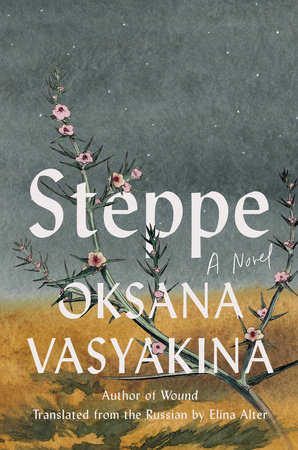
From Steppe by Oksana Vasyakina, translated by Elina Atler. Used with permission of the publisher, Catapult. Copyright © 2026 by Oksana Vasyakina.