New Orleans shimmies: formed from a swamp into a Creole capital, it’s all sweat and longing, the sweet smell of decay and wild, wild wails. Fortunes were amassed on its Cotton Exchange where any crop—sugar, rice, or cotton—was used as a man’s collateral; the Exchange no longer exists, but the cries of the slaves who planted and harvested the crops can still be heard. Now it’s skyscrapers that rise from the Mississippi mud. A crescent dangling from the southern tip of Louisiana, the city should be underwater, but the levee holds the river back. River full of cargo ships loaded with containers from the Middle East, South America, and the Caribbean. New Orleans’s docks line the Mississippi and encroach upon the city’s old French Quarter, a cat’s paw for transient jangle and intransigent corruption, its indigenous inhabitants—members of secret societies or the offspring of illicit unions—are concealed behind fastened shutters and wrought-iron fences. Lush courtyards camouflage the entrances to hidden apartments.
Uptown, west of the Quarter, in the Garden District, gracious mansions shelter New Orleans’ aristocracy. Their homes stand alongside former slave quarters, now shotgun cottages and guesthouses. Daryl Monroe, young scion of the unattainable, a visitor at one of these mansions, wants to inhale it all. And he has been, if one considers “all” to be cocaine. Draped in Salome’s seven veils, silk fluttering over well-formed limbs, eyes lined with kohl, Daryl wears no mask; it would get in the way of his tongue and nose. Golden in daylight, hazel at night, his eyes have seen more than he cares to acknowledge. Daryl entertains one wish: to escape into oblivion. His body is a vessel; three or five presences whir inside him and they’re having a conversation spanning centuries, raving in tongues. He’s privy to their rage—mendicants and prophets haunt his drug-induced frenzies. Through the din he hears a tentative honky-tonk. The piano’s out of tune; he knows this for a fact, screaming, “Throw the miscreant off the balcony—that’ll tune it up!”
His fellow revelers, fraternity brothers from New Orleans society, oblige him, leaving the startled pianist behind. The Steinway is pushed through open French doors out onto the gallery, but the men are too drunk and laughing too hard to lift it over the railing. Daryl starts a countdown, and one concerted shove sends the piano crashing through the banister. A black shadow in the night, it lands on the front lawn, a symphonic crash. Residents of the Garden District, those in white houses with galleries and balustrades, don’t often display anything this dramatic on the outside. Inside’s another matter.
Men costumed in togas or black cloaks redecorate the premises to fit their mood. They’ve lowered sparkling chandeliers to the floor, crystal prisms on Persian rugs illuminate bare legs and feet. It’s October in New Orleans and all evenings are hallowed. Dipping moths flutter and burn in the bulbs. The ceiling’s garland of plaster cherubs, replicas of beaming infants, chattering and effusive in the light, is ghostly in the dark. One sport, a skeleton painted over a black leotard, pulls down the velvet curtains. Daryl yells, “Toss ’em around the room, like they just flew in.”
This is Kappa Alpha, a place to which he no longer belongs, having completed his college sojourn six years ago. The party’s not bad in his estimation—just not high enough. Which is why he’s come back and what they need him for; his experience in matters of excess constitutes his authority. It’s past midnight and the female guests have left or slunk upstairs with their consorts. The men partying with Daryl are the ones who didn’t score. He calls to them from the darkened parlor. Daryl’s tits are fake, preposterous balloons, but he has what they want. He’s a belly dancer, his skirt white tulle, his earrings gold rings. Daryl pops the balloons and his bosom deflates, rubber sticking to little brown vials of glass containing the only snow fully appreciated south of the Mason-Dixon Line. The term has always amused Daryl, calling it “blow” when the real ecstasy is in the inhaling. Eager young men crowd around him. Daryl empties seven vials of cocaine onto the glass-topped bar.
“All manner of gratitude accepted. Just don’t kiss me unless your tits are real.”
The record player blares Dizzy, but the neighbors can’t complain. They’re all here, busy getting educated. The library’s closed and this is Alexandria before it burned. Daryl’s surrounded by the initiated, doling out knowledge in a silver spoon, when someone he calls “The Pedantic Asshole” flits into the parlor. The man’s dressed as Little Lord Fauntleroy, the only one in a mask. To make sure he gets no pleasure from snorting or licking, Daryl has noted this before. His mask is askew. Its pubescent, smiling lips hang below his chin and crop his neck, but a lace collar holds his ensemble together. Fauntleroy acts as if he’s innocence personified, but Daryl’s well acquainted with desperation masquerading as youth. The idiot is waving a pistol as if it were a magic wand claiming he can make Daryl disappear. Daryl’s pretty sure he could, if he were to aim. It’s time to cut more lines, everyone’s snorted them up, but Daryl’s distracted by the gun. All around him, men step away.
Fauntleroy makes a sweeping gesture encompassing the room and its occupants, screaming. “This is my place; you gave it to me!”
“You little ingrate, I set you up.” Daryl’s incensed. “And what I give is mine to take. You want to take what’s mine?”
Lord Fauntleroy doesn’t like conundrums; he flaunts his pistol. “You can’t come back here; you hear me?” A snide reminder, “I have too much on you.”
Daryl saunters up close to Fauntleroy, ignoring the gun, eyes flashing, and snarls. “Listen to me, you son of a bitch. I go anywhere I like, whenever. So lift my veil and kiss my ass.” Daryl turns his back on Fauntleroy but he hears the trigger cock.
“Paradise.”
Hell, thinks Daryl, it’s all the same to me. He turns to see Fauntleroy spinning the pistol chamber.
“You haven’t been there.”
Daryl could argue this point, but Fauntleroy suddenly screws the gun in his own ear Russian roulette style.
Jesus, not this tired old game. Daryl stalls. “Oh, come on, don’t do that.”
But Fauntleroy’s too busy postulating, “The power of God is within me, I can see Him.”
Daryl’s thinking that it’s not a monotheistic universe; something vast is taking up residence inside him, too.
Fauntleroy pulls the trigger: nothing. A collective sigh, opinion is set—the man’s nuts. He hands Daryl the pistol. Daryl is almost certain it’s not loaded, but he’s not in an obliging mood, pride being his other sin of choice, so he spins the chamber, aims at the ceiling, and BAM, blows a hole into the plaster overhead. A cherub drops onto a chintz couch; dust coats the parlor. Behind his rubber mask, Fauntleroy grins. Daryl waits in dead silence as the bedroom contingent mumbles and gropes its way down the stairs. Couples in dishabille, laughing and swearing, step around glittering chandeliers and into the parlor. When his audience is assembled, Daryl empties the chamber and hands Fauntleroy the gun.
“Take it easy, asshole. I’m not spoilin’ your little setup.”
But Fauntleroy, if nothing else, is a showman. He pops another bullet in the chamber, starting his dare all over again, spinning the chamber, aiming straight at his temple this time, gloating. “I told you He’s on my side. I can see Him.”
Fraternal opinion remains firm. Someone yells, “Don’t be a fool!” The room’s breathless. Daryl tries to stare him down, but Fauntleroy presses the barrel to his temple and doesn’t flinch as he fires.
Daryl flinches, wondering if the man has just seen God. Fauntleroy has fallen where he stood, limbs splayed. Blood oozes from his wound, from his ear, pours from his mouth. A woman starts screaming. Daryl kneels down and presses his fingers against the man’s neck searching for a pulse; the skin is warm. Fraternity brothers gather around them; someone murmurs, “Jesus.” The mask has slipped from his face, its grin now lopsided and grotesque. Daryl removes it altogether. The dead man is blond and impish, his face prematurely lined. A quiet hysteria is taking hold. Escorted women wrapped in improvised shawls make furtive exits to escape scandal. Those positioned around the corpse break away, leaving Daryl alone to guard the body. Men huddle, speak in whispers. A preppy in a ponytail, who considers himself Daryl’s friend, comes to his side: “It would be better for us if you were to go, so we can call the cops.”
Easy for him to say, it’s not his fingerprints all over the gun. Daryl yells over their heads. “Sweep this place, I want it cleaned in five minutes. I’ll call the damned cops.”
*
They say that if you make your money by illegal means you must live simply and hide your wealth. Daryl has always ignored this maxim, claiming instead that his wealth was inherited. And if he were to admit that he had to earn a living, Daryl would point out that drug dealing’s no different than selling real estate except that it’s more visionary. There had been a time, not long gone, when he was a fixture in New Orleans society. His privileged friends had accepted him because he was one of them; and back then, when his lifestyle was sanctioned, he flaunted his money, graciously and generously. His original clientele attended the university with him. The privileged inherit the earth by insisting upon their privilege. No one Daryl knows in New Orleans is meek. And none of them discuss their prerogatives or, as time passed and his dealing became more overt, Daryl’s role in their lives. But they wouldn’t mind discussing his minor role in this man’s death—not with the local police—but spitefully, among themselves.
Do not misunderstand. Daryl was born into wealth, and he assumed that that advantage would always be available to him. But he was denied his inheritance. It hadn’t been lost, but rather, it had been lost to him. A few guessed his secret, more and more as time went on—there was no home to return to, no money with which to purchase a future. He had lit upon the quick and ready cash that comes from drug dealing to cover his subterfuge and keep his pride. Daryl mocked privilege by mimicking its presumptions; the common law did not apply to him. Initiating the uninitiated, hanging with the wild boys, none of this was new; it suited him. There was a snobbery attached to drugs, an in-crowd mentality that Daryl mined well. Hard work and scholarship never occurred to him, although he worked hard to maintain his position in society. And while rumor could only hint at his predicament, everyone was aware of his dealing.
After graduation, Daryl’s friends moved on to the business of social standing. He did not fit into this equation. His contemporaries who remained his customers became more covert in their arrangements with him, and he was left to the younger men who could afford that sort of indiscretion. What came next was Daryl’s new reputation—not that of the wild scion of an old Southern family, but a new one defined by the slump of failure: a rudderless albeit spirited man who had become addicted to his excesses.
It takes Daryl no time at all to come to the obvious conclusion: absence, like death, is a negation. It will lessen further damage. There can be no pleasure in talking about him behind his back if no one can see the effect of it all on his face. And while Fauntleroy’s death hastens Daryl’s flight, he has already felt the winds of exclusion. There is no place left for him in New Orleans. There were a few who had seen his core: no angel to be sure but not confined by the lurid gossip that informed his reputation, he longed for more than the self-obsession that absorbed him.
Daryl stayed in town long enough for the death to be declared accidental. Packing was quick, he had few possessions, and his apartment, rented by the week, had come furnished. Everyone Daryl knew he’d already had in one form or another, and vice versa, there was nothing much left to say. No ties had been his rule for some time. What he owned was replaceable. It would seem a sorry state of affairs, to leave the place you’ve lived with no friends left behind, but that’s precisely what Daryl wanted. Mercurial by nature, dogged by design, these are the attributes he carried with him.
__________________________________
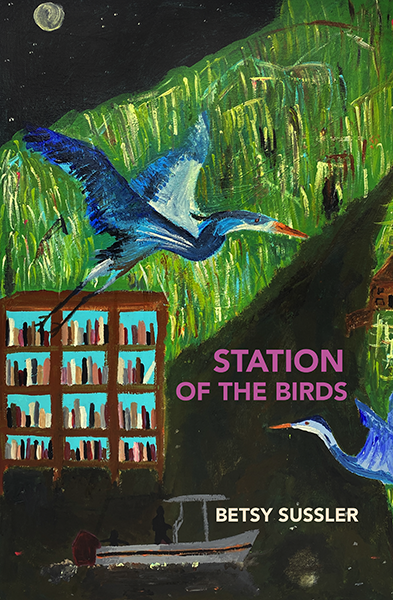
From Station of the Birds by Betsy Sussler. Copyright © 2026 by Betsy Sussler. Excerpted by permission of Spuyten Duyvil Publishing. All rights reserved. No part of this excerpt may be reproduced or reprinted without permission in writing from the publisher.