Sloane Crosley: On the Fine Art of Saying “No”
The Benefits of Bluntly Turning Down Unwanted Requests
Many years ago, right before I quit my job as a book publicist, a coworker knocked on my office door and asked me if I wanted to accompany her to a reading. Stressed, distracted and with one tote bag out the door, I didn’t have the bandwidth to formulate a remorseful reply. “Oh, I would,” I said, breaking a manic typing streak, “but I don’t want to.” A pure response tends to get a laugh. So does a rare one: Honesty may be the backbone of effective book publicity but succinctness is not. Over the course of eleven years, I had learned to cajole on behalf of others, to soften, to transmit passion using a dwindling supply of adjectives. This became my primary style of communication.
The directive for women, in particular, to get comfortable with saying “no” is well-established. Speak up, get a boundary, get several. We get it. But, like an addict redirecting her more destructive predilections to yoga, I used to spend hours on the construction and presentation of those boundaries. Saying “no,” was not my problem. Limiting myself to “no” was my problem. An expert in the wordy decline, I’d type overly precious things like “sorry I can’t do the thing you’d like me to do, now here’s an elaborate story about a goldfish and a link to an article you might like.”
Surely, this was half as charming as I thought and “half” is generous. To my vague credit, a lot of authors are like this; it’s hard to shut off the faucet when you know additional ways to articulate yourself are coming down the pipe. And there’s not an editor in sight.
When I became a full-time author, this habit got worse. That brief moment in my former office (when my sense of obligation was a casualty of stress) had passed. Working in isolation, I was flattered to be asked anything, by anyone. I didn’t want to scare off these points of contact. And was that so bad? It’s a little thing called etiquette. Plus, I wanted to give the impression of someone with a long fuse, no matter how many times a stranger misspelled my name.
Brevity is the soul of politeness. In an industry that traffics in words, it can feel like rudeness. But a couple of considered lines will do the trick.
Several years into this new life, I was contacted by a foreign publishing house. The publishing house had recently declined to publish my new book and one of their editors appeared in my inbox, asking for a blurb for an upcoming title. Because this felt awkward, I made a convoluted show of declining. So convoluted that my reply left several avenues for them to come back and ask again. Rather than isolate the issue in a clear way, I coughed up a blurb. A blurb which was slapped on the book’s jacket without the pesky fanfare of a “thank you” from the author, the editor, or the agent.
Now, I would not advise “they started it” as a professional philosophy. Nor would I advise typing “piss off” and pressing send (except on special occasions). But when the same publisher approached me with a similar favor, one year later, I replied simply, “thank you, but I can’t.” I was unbothered, they were unbothered. We all went on living our lives. I was liberated from thinking about this incident ever again, save for this paragraph.
That’s when I absorbed what I had always known: brevity is the soul of politeness. In an industry that traffics in words, it can feel like rudeness. But a couple of considered lines will do the trick. A lengthily explanation can backfire, leaving the recipient wondering why you didn’t devote the time it took to decline to doing whatever the Hell was being asked of you in the first place. Then there’s obvious ego problem. Most of the time, someone is asking you for an email address, not a kidney. Calm down.
And as for the length of my fuse, I care less and less about who sees it these days. Maybe because we live in a world in which our dramatic expressions cry out for a “literally” afterwards: The world is on fire. We are staring down the barrel of societal collapse. Who has the time to cute-up a rejection? Or perhaps the decision to streamline is not a matter of global trend. Maybe it’s just a sign of aging. I’d keep guessing but, well, I don’t want to.
__________________________________
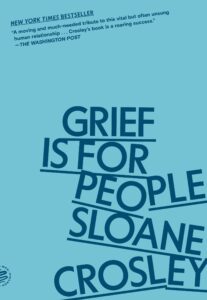
Grief Is for People by Sloane Crosley is available now in paperback from Picador, an imprint of Macmillan.

Sloane Crosley
Sloane Crosley is the author of The New York Times bestselling books Grief Is for People, How Did You Get This Number, and I Was Told There’d Be Cake (a 2009 finalist for The Thurber Prize for American Humor). She is also the author of Look Alive Out There (a 2019 finalist for The Thurber Prize for American Humor) and the novels, Cult Classic and The Clasp, both of which she has adapted for film. She has been featured in The Library of America's 50 Funniest American Writers, The Best American Nonrequired Reading, The Best American Travel Writing<.em> and Phillip Lopate’s The Contemporary American Essay. She has been a columnist for The Village Voice, Vanity Fair, Esquire, The Independent, Departures, Black Book and The New York Observer. Her work has appeared in publications such as The New Yorker, The New York Review of Books, The New York Times, The Paris Review and Vogue. A Guggenheim Foundation Fellow and Yaddo Fellow, she has also been an adjunct professor in Columbia University’s MFA program and The New School’s MFA program, as well as a visiting teacher at Dartmouth College, The Yale Writers’ Workshop, The School of Visual Arts, New York University and Sarah Lawrence College. She lives in New York City.