Six Retellings That Pull Apart Fairy Tales and Stitch Them Back Together in New and Wondrous Ways
Bar Fridman-Tell Recommends Kelly Link, Roshani Chokshi, T. Kingfisher, and More
My love story with fairy tales—and with myths, their sometimes cousins, sometimes siblings, sometimes one and the same (depending on who you ask, and quite possibly the weather)—is long and convoluted. I was enthralled by them pretty much from the moment I learned to read, thanks to an early diet including Italo Calvino’s Italian Folktales, Edith Hamilton’s Mythology, and Lloyd Alexander’s The Chronicles of Prydain, and the fascination lasted throughout (and in many ways, shaped) my years at university.
And the older I got, the more fascinated I became by the way these stories change. Here is what I think: that change is essential to myths and fairy tales, an inherent quality that makes them what they are; and that the way they change functions as a mirror to us—revealing the assumptions that we take for granted, and the ones that no longer fit.
My favorite retellings are ones that take a well-known fairy tale, and unravel it just enough to look at the norms and expectations hiding beneath it, the system of values and morality that designates some characters as wicked and others as good, and—perhaps most of all—dictates what a happy ending looks like.
These are six books that do exactly that: take a fairy tale and pull one thread loose, to see what happens next, or tip the story on its side and see what new shape emerges. Coupled with lush, magnificent writing, these stories stitched themselves into my heart—making me smile and cry and, most importantly, question—and forever changing the way I see each of the fairy tales they retell.
*
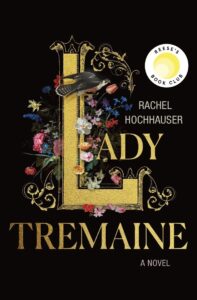
Rachel Hochhauser, Lady Tremaine
Lady Tremaine starts with a fairy tale—Cinderella—and a character—the Wicked Stepmother—and turns it into something so achingly real that the pages seem to breathe and you forget, for full chapters at a time, that you already know how the story goes. Rather than a villain origin story, this is the sort of book that unravels our understanding of “good” and “bad” within the logic of the fairy tale—and perhaps most of all, the assumption that being nice and pretty equals the ultimate happy ending: marrying well.
A heart-piercing story about motherhood, and womanhood, and the bones and assumptions inside the fairy tales we grew up on, Lady Tremaine pauses to ask: what would it really mean to be a newly widowed woman with daughters to care for? How far would you go to protect them in a world where the only possible future for them is to become a wife? And under what circumstances would a prince host a ball open to every eligible woman as a way to find his future queen? None of the answers were what I expected, but they felt so very plausible that it might just be impossible for me to think of Cinderella any other way.
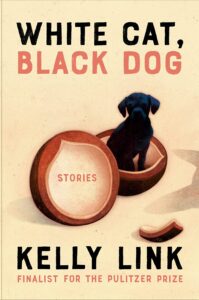
Kelly Link, White Cat, Black Dog: Stories
In White Cat, Black Dog, Kelly Link not so much reimagines fairy tales as shakes them—snow globe-like—to see what happens next. Or maybe more accurate is to say that she pulls them inside out, like a shirt, revealing different patterns, different meanings, on their undersides.
Exquisitely written and full of wonder—the kind with teeth—Link reimagines tales like The Boy Who Did Not Know Fear (“The Girl Who Did Not Know Fear”), Tam Lin (“The Lady and the Fox”), and, perhaps my favorite, East of the Sun, West of the Moon (“Prince Hat Underground”). Transplanting the fairy tales into worlds that seamlessly mix the mundane and the fantastical, these stories ask what it means to love someone, to hold onto the one you love, and what a happy ending would really look like. From a prince of hell who just wants to go back to his Saturday brunch in Manhattan to a son retiring with a white cat to grow artisanal cannabis in Colorado, the answers these stories give are just as surprising and magical as the tales themselves.
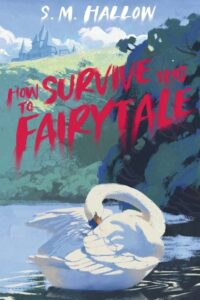
M. Hallow, How To Survive This Fairytale
In How To Survive This Fairy Tale, a novella tiptoeing on the border between fantasy and horror, S. M. Hallow at turns unravels fairy tales and stitches them together. Hallow starts with a question: what happens after the fairy tale ends? After Hansel escaped the forest witch, after the hunter let Snow White go, after the six swans turned back into humans (mostly), and their sister proves her innocence. And what would happen if one character, Hans, tripped through all three of these stories, plus a few more?
From this starting point, Hallow tackles subjects such as the line between villain and victim, the possibility of redemption, living in a body that no longer fits who you are, and what a happy ending really looks like in these circumstances. Tears (the good kind) guaranteed.
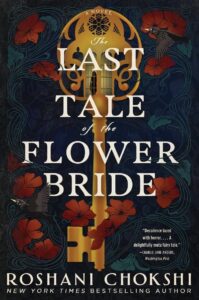
Roshani Chokshi, The Last Tale of the Flower Bride
At its heart, The Last Tale of the Flower Bride is a gender-bent Bluebeard retelling. It whispers about secrets, about the injunction not to look, not to ask, as a condition for a happy ending. About what it means when the condition to hold on to the one you love is to let them remain unknowable. But it is also a love song for myths. Different stories come and go, twining through prose so gorgeous and lush it demands savoring (and quite possibly underlining), creating something that feels like pure magic.
Moving between present and past, Chokshi creates a world that blurs the line between our world and fairyland, never quite allowing us to know in which of the worlds we stand. But the relationships at the heart of the book—between the teenage Indigo and Azure, and between the adult Indigo and the unnamed bridegroom—are vividly, viscerally real.
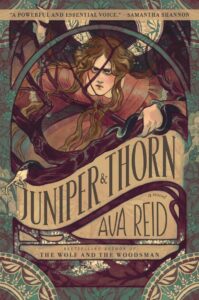
Ava Reid, Juniper & Thorn
Juniper & Thorn starts from one of Grimm’s darkest fairy tales, The Juniper Tree, and from there branches to look at control and abuse, and gender expectations, and what love looks like when trauma is inscribed into one’s skin. Following Marlinchen, the youngest in the last witch family living in a fast-industrializing town, Reid unravels our understanding of what monstrosity really looks like.
And though I passionately love all of Ava Reid’s books, Juniper & Thorn is my favorite. It’s the sort of book that’s beautiful enough to cut—and this is exactly what this book’s beauty does: cuts, slithers under one’s skin, and sets up a house.
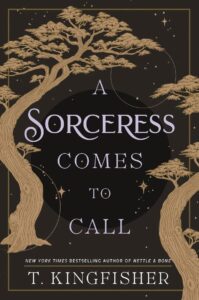
T. Kingfisher, A Sorceress Comes to Call
T. Kingfisher is the master of fairy tale retellings, and though I seem to say it about each and every one of her books, A Sorceress Comes to Call really might be my favorite. Starting with the Brothers Grimm fairy tale “The Goose Girl,” T. Kingfisher unravels the idea of parental expectations in fairy tales—and the ever-present injunction to follow your parents’ commands—sketching an unsettling examination of abuse and power dynamics, with a side of (the best) heroic geese and a demonic, headless horse that really raises the bar for horse-related trauma.
__________________________________
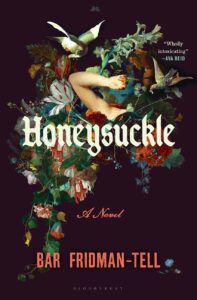
Honeysuckle by Bar Fridman-Tell is available from Bloomsbury Publishing.

Bar Fridman-Tell
Bar Fridman-Tell has a BA in art history and an MA in English literature. (She gleefully wrote her thesis about Victorian vampires.) She has worked as a bartender, a bookseller, a translator, and a library assistant. She is currently studying for a master's in library and information sciences at the University of Toronto, hoping to stay in a library for good. She lives in Toronto with her professor husband and two very fluffy cats. Honeysuckle is her debut novel.