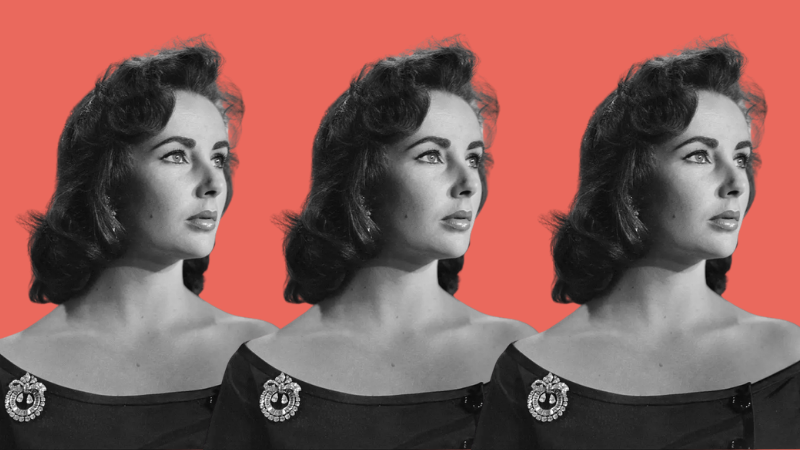
Six Books That Try to Keep Up With Elizabeth Taylor
Stephen Greco Recommends Kitty Kelley, C. David Heymann, John Waters, and More
I first saw Elizabeth Taylor in The VIPs, when I was a moony and impressionable teenager. There were nuances I surely missed, but the movie’s larger premise came through loud and clear: life could be fabulous, dramatic, and shaped—perhaps even redeemed—by love. I was hooked.
Later, in college film courses, I began to understand the broader arc of Taylor’s career, even as I continued to devour the juicy details of her life in gossip columns. Critics, I discovered, had placed her almost everywhere: in the pantheon and in the stocks, sometimes within the same review. Was she a great actress, a great beauty, the ultimate movie star, a creature of vulgar excess, or some magnificent combination of all four?
The six books below offer very different ways of approaching that question. Some are scholarly, some deliciously indiscreet, all are perceptive in one way or another, and one plunges wholesale into obsession. None contains the whole of the real Elizabeth Taylor, nor could it, as I learned when I began to invent a faithful fiction of my own, for my new novel The Woman Who Had Everything. In the best way, Taylor was simply too much. That may be why reading about her remains such fun: a true diva always exceeds the available evidence, trailing some shimmer of the divine that mere reality cannot quite account for.
*
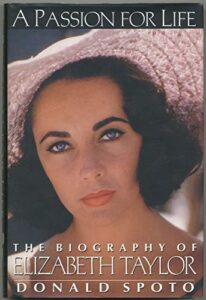
Donald Spoto, A Passion for Life: The Biography of Elizabeth Taylor
If you want to begin with Elizabeth rather than “Liz,” begin with Donald Spoto. His is the most conventionally serious biography of the bunch, and the one with the deepest interest in Taylor as an actress—not simply as the proprietor of eight marriages, several world-famous diamonds, and a medical history that could fill a teaching hospital.
Spoto is particularly good on the strange doubleness of Taylor’s life: she was both the triumphant creator of an extraordinary public self and the first person it consumed. He sees the marriages not as a string of scandals but as attempts at transformation, each offering Taylor another part to play and another possible escape from the part she had been playing since childhood. At times, his psychological explanations may seem almost too orderly for a woman who lived so exuberantly in disorder. But no other biographer I’ve read gets as close to explaining how the vulnerable child, the formidable actress, and the reckless soap opera heroine could all occupy the same five-foot-two-inch frame.
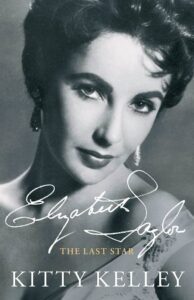
Kitty Kelley, Elizabeth Taylor: The Last Star
Kitty Kelley’s unauthorized biography is the louche pleasure of the group. Kirkus memorably called it a “tacky stroll” through Taylor’s life, and that is not entirely unfair. Kelley is much more interested in Taylor’s appetites—for food, for men, for feuds—than in the nuances of her acting. She assembles gossip with a prosecutorial enthusiasm, often relying on people who seem only too happy to settle an old score.
And yet the book has become fascinating as a period object. Published in 1981, it captures the way Taylor was discussed before her AIDS activism, before the perfume empire, and before the culture reconsidered the courage and generosity of her later life. Here she is still the scandalous, overindulged bad girl of the tabloids, forever arriving late, spending too much, falling ill, falling in love, and making everyone furious.
The best way to encounter this book, by the way, is in a battered vintage paperback like mine, found in a secondhand bookstore. An as-new hard cover or pristine digital edition might violate its spirit.
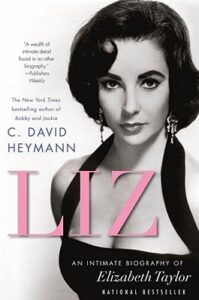
C. David Heymann, Liz: An Intimate Biography of Elizabeth Taylor
C. David Heymann’s Liz is considerably smoother and more intimate than Kelley’s book. It moves with the confidence of someone who seems to have been admitted into every dressing room, bedroom, and hospital suite, and who is never short of the perfect line of dialogue. Taylor’s life unfolds as a grand, breathless narrative, and Heymann knows exactly how to keep the pages turning.
There is, however, reason to approach the most startling details with a raised eyebrow. Serious doubts have surfaced about Heymann’s methods as a biographer, so I would not use Liz as the sole supporting document in a sworn affidavit. But biography is not read only for evidence, is it? I read it also for atmosphere, for the sensation of being carried through another life. On those terms, Liz remains enormously seductive. Heymann conveys both the scale of Taylor’s existence and the extraordinary number of people who wanted to be near her and tell the world what she was really like.
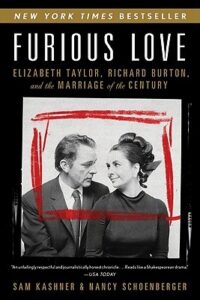
Sam Kashner and Nancy Schoenberger, Furious Love
Furious Love is the book to read when you want not simply Elizabeth Taylor or Richard Burton but “Liz and Dick,” the international weather system they created together in the ‘60s and ‘70s. Kashner and Schoenberger treat the relationship as the great romantic spectacle of the twentieth century: an epic collision between the sublime and the sozzled, sustained by an apparently inexhaustible supply of Bulgari.
The book’s greatest asset is Burton’s correspondence. His letters bring him rushing onto the page—needy and self-mocking, jealous yet helplessly in love. Inevitably, this sometimes makes him the more legible half of the couple. Elizabeth, less inclined to anatomize herself in writing, remains the more mysterious force.
The narrative can become repetitive, but then so did the relationship: passion > quarrel > separation > gift > reunion; repeat. The story’s bagginess is part of its pleasure. Furious Love makes it easy to understand why the world didn’t merely follow the Burtons but believed in them. They made romantic chaos look like a form of destiny, and occasionally like the world’s most expensive traveling repertory production of Who’s Afraid of Virginia Woolf?
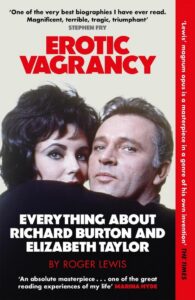
Roger Lewis, Erotic Vagrancy: Everything About Richard Burton and Elizabeth Taylor
The subtitle promises “everything,” and Roger Lewis makes a heroic attempt to provide that. Enormous and exasperatingly unruly, Erotic Vagrancy is intensely personal. Promiscuously, Lewis writes about the Burtons, and about everything within reach of the Burtons, and then about everything within reach of that. He gives you the weekly rent of the yacht where the couple boarded their dogs to dodge British quarantine, and, in exactly the same tone, the papal denunciation and the motion in Congress to bar them from the U.S. Plus a lot more that happens to have crossed Lewis’s live-wire mind.
This is unquestionably the most rambling book on the list, but “rambling” barely does justice to its method. Lewis digresses, contradicts himself, and keeps stopping the biography to tell us what he thinks biography is. You may want to argue with him every ten pages, but in a way that’s part of the fun.
Because the excess feels peculiarly appropriate. A neat, restrained account of Elizabeth and Richard might be the greater distortion. I won’t pretend to be the first to say what several reviewers have noticed about this book: it resembles its subjects and behaves rather like the Burtons themselves. It takes up too much space, stays too long, drinks up everything in the house, hurls the occasional unforgivable insult, and somehow leaves you sorry when it goes.
John Waters, Crackpot: The Obsessions of John Waters
John Waters’s Crackpot is not a book about Elizabeth Taylor but a collection of subversive essays on his many obsessions. Because Taylor is one of the greatest of them, his essay on Boom! belongs in any collection of essential reading about her. Waters turns his attention to Joseph Losey’s 1968 adaptation of Tennessee Williams’s The Milk Train Doesn’t Stop Here Anymore, starring Taylor, Richard Burton, and Noël Coward, featuring a wardrobe of stupendous caftans and one of the most astonishing headdresses ever filmed by a motion-picture camera.
Boom! finds Taylor at the height (or depth) of her most baroque period as a performer. As the dying millionairess Sissy Goforth, she sweeps about shrieking and smoking, while dictating her memoirs, insulting her staff, and presiding over her private Mediterranean island like an empress in exile. The film was widely attacked when it appeared, but Waters loves it (as I do) without attempting to make it respectable. Its extravagance, its miscasting, its nearly operatic hysteria—these are not flaws to be explained away; they are the point.
After five books that try to interpret Elizabeth Taylor, Waters simply surrenders to the vision. Sometimes the most perceptive response to a goddess is not analysis. It is worship.
__________________________________
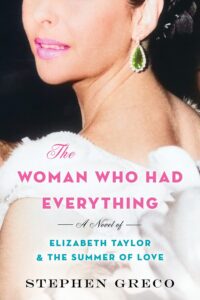
The Woman Who Had Everything by Stephen Greco is available from Kensington Books.

Stephen Greco
Stephen Greco is a novelist, journalist, media executive, editor, dramatist and Executive Director of the Ferro-Grumley Literary Awards, which he co-founded in 1988. He is a regular contributor to the magazine Upstate Diary and has contributed as a feature writer and editor to numerous publications including Interview magazine, New York magazine, Air Mail, The Advocate, American Way, Art News, Dance Magazine, Elle, Harper’s Bazaar, Latina, the London Observer, Stagebill, and The New York Times online. He is currently the Editorial Director of InsideRisk, an immersive experiential event company, and his theatrical writing includes several works produced by the entertainment company and multimedia studio Giants Are Small. He previously served as founding Director of Content for Classical TV and is a frequent panelist and speaker on cultural and branding issues. Stephen Greco lives in Brooklyn, New York and can be found on Instagram at @StephenGreco.