Six Essential Books About Birds
Eric Wagner Recommends Adam Nicolson, J.A. Baker, Helen Macdonald, and More
A few years ago, more or less on a whim, I started following a group of scientists who were studying a small seabird on an island off the coast of Washington State. The bird, called the rhinoceros auklet, was gray and had a funny little horn sprouting from the base of its bill—hence its common name. The auklets only visited the island at night, so we never saw them all that well. When they did arrive they were quick to scuttle into their deep burrows. Not the world’s most charismatic creature, in other words. At least not outwardly.
Still, there was something about the auklets that kept me coming back for years to learn more about them. I loved the way their story, so seemingly modest, joined with other stories about climate change, the fate of the world’s oceans, and the history of land, people, colonial power, and Indigenous resilience. To look at the rhinoceros auklet even briefly was to see these countless threads gathered into blurred shadows flying over my head at twilight.
People have been writing about birds for almost as long as they have been writing anything. One anonymous Old English poet, for example, called the sea “the gannet’s bath” (referring to the large expert divers of the North Atlantic), and after reading that I have not looked at it in any other way. While working on my auklet tale, Seabirds as Sentinels, I turned to these essential books about birds.
*
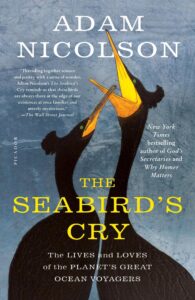
Adam Nicolson, The Seabird’s Cry: The Lives and Loves of the Planet’s Great Ocean Voyagers
When Adam Nicolson was 21, he inherited the Shiant Islands in Scotland’s Outer Hebrides from his father. I have since heard he will let anyone who wants to stay there for free, provided they are willing to pay someone £700 or so to ferry them out and back. Nicolson himself wrote a book called Sea Room about the islands, including the many seabirds that breed on them. In The Seabird’s Cry, he lets his curiosity roam a little farther asea, seeking out a number of species in their varied haunts. The tour of everything from puffin movement to kittiwake perception is a joyous and fascinating one, even as the tragedy of these species’ disappearances is never far from view.
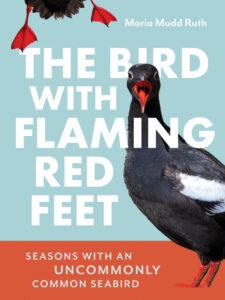
Maria Mudd Ruth, The Bird with Flaming Red Feet: Seasons with an Uncommonly Common Seabird
The pigeon guillemot is in many ways everything the rhinoceros auklet is not—loud, visually dramatic, gregarious, conspicuous, with a willingness to come to land during the day. In The Bird with Flaming Red Feet, Maria joins a citizen science group devoted to their study and follows the birds for years. Documenting her and her fellow volunteers’ attentions, the book is an ode to the kind of careful, patient natural history that contemporary science practiced at its increasingly rapid pace does not encourage as much anymore.
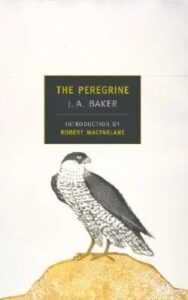
J.A. Baker, The Peregrine
Speaking of natural history, this was a book I approached naively, in that I came upon a copy in a free book pile in New Zealand, of all places. I took it having no idea how revered it was. But I had grown up loving peregrine falcons, and here was this book dedicated to them! (No matter that the edition I had found had a juvenile Cooper’s hawk on the cover.) I started reading and was floored by the liveliness of Baker’s language, by his care with it. Baker is a mysterious figure throughout his narrative: the reader never gets a firm sense of who he is, exactly, or why he comes to have so much time on his hands that he can pursue a pair of falcons over the English countryside. But what a book. I am pleased, too, to note that more recent editions have a proper peregrine falcon on the cover. Not that you should ever judge a book by the cover.
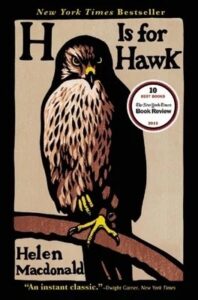
Helen Macdonald, H is for Hawk
Here is another book about a raptor, but unlike The Peregrine, I had read how good this one was ahead of time—had read how, following their father’s death, Macdonald poured their grief into the training of a Eurasian goshawk, juxtaposing their own journey with that of English writer and naturalist T.H. White. Approaching such a highly praised book can be a tricky proposition. Will it justify (or exceed) its reputation? Or will you wonder—awkwardly, uncertainly—whether you alone have seen through the stuff and nonsense in thinking the book not that great? Thankfully, with H is for Hawk, it’s the former. So much the former.
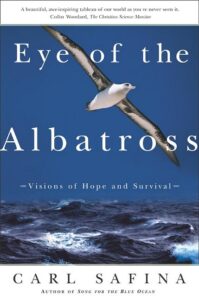
Carl Safina, Eye of the Albatross: Visions of Hope and Survival
Carl Safina’s first book, Song for the Blue Ocean, was a revelation for me, in that it showed me what science writing could do with seemingly mundane topics—in Safina’s case, fisheries management and my hometown of Astoria, Oregon. But before he wrote about those things, or, more recently, animal cognition and culture, Safina was a seabird biologist, and for his second book, Eye of the Albatross, he returned to his roots. Here he follows Amelia, a Laysan albatross, as she wings across the Pacific from her nest on one of the northern Hawaiian Islands. In her exploits, and Safina’s attention to them, we see the oceans’ changing health, and humans’ great impacts on them.
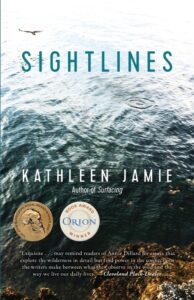
Kathleen Jamie, Sightlines: Encounters with the Natural World
I am a big bringer of books, in that I like to carry them around with me even if I am not actively reading them. Mostly, I suspect, for osmotic reasons. Or it might be ballast. Whatever the case, I have been carrying Sightlines around with me for years. A collection of essays by Scottish poet and essayist Kathleen Jamie, it is full of subtle pleasures. Jamie’s prose is so disarmingly simple and her writerly presence so self-effacing that, whether she is writing about seabirds or whales or some piece of flotsam she found on a beach, I often do not realize the full depth of her argument and insights until it is almost too late. But one of the pleasures of my stupidity is that I have a readymade excuse to re-read these wonderful essays time and again.
__________________________________
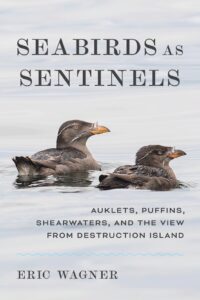
Seabirds as Sentinels by Eric Wagner is available from the University of Washington Press.

Eric Wagner
Eric Wagner is a staff writer with the Puget Sound Institute at University of Washington, Tacoma. He is the author of Seabirds as Sentinels: Auklets, Puffins, Shearwaters, and the View from Destruction Island (UWP, 2026), After the Blast: The Ecological Recovery of Mount St. Helens (UWP, 2020), and Penguins in the Desert (Oregon State, 2018). He also wrote the text for Once and Future River: Reclaiming the Duwamish (UWP, 2016).