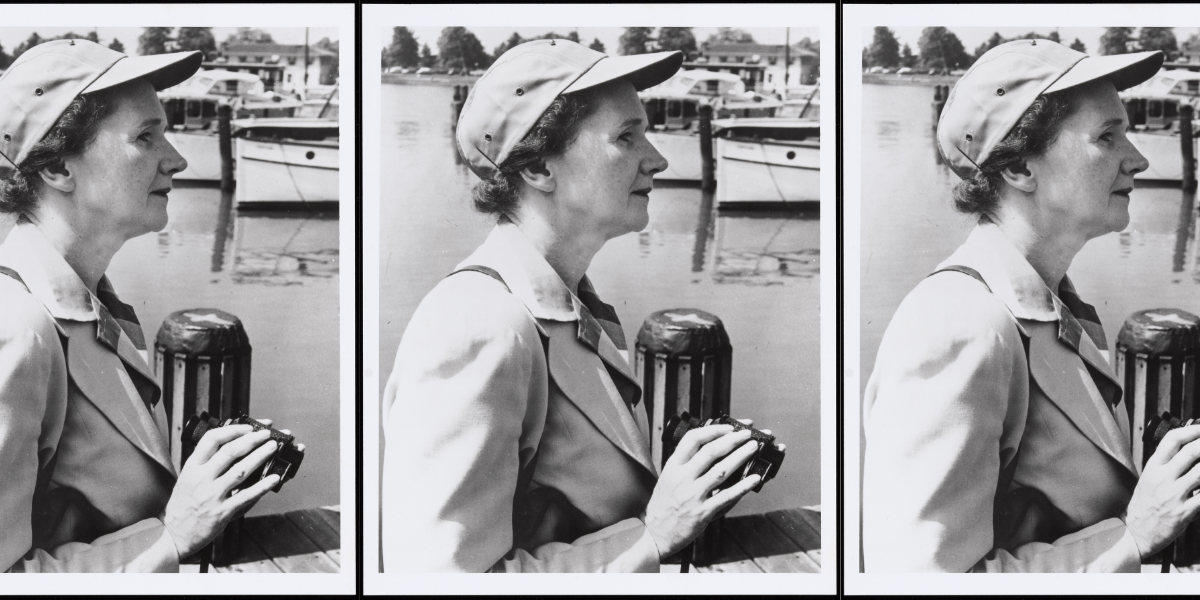
Silent Springs, Windswept Seas: On the Environmental Vision of Rachel Carson
“I hope I have made clear tonight that a new spirit is abroad in this land.”
In her acceptance speech upon receiving the National Book Award for The Sea Around Us (1951), biologist and author Rachel Carson (1907–1964) explained: “If there is poetry in my book about the sea, it is not because I deliberately put it there, but because no one could write truthfully about the sea and leave out the poetry.” Carson dedicated her life and work to nature and the environment. From her early childhood observations of wildlife to her time as a government employee in the US Bureau of Fisheries (later known as the Fish and Wildlife Service), to her emergence as a best-selling nonfiction writer, Carson sought to make her writing always both elegant and scientifically grounded. She is best known for Silent Spring (1962), a book that documented the harms of pesticide use and galvanized generations of environmental activists around the world.
Born in 1907, Carson came of age in a world of increasingly complex and competing attitudes toward nature. An earlier generation’s emphasis on conservation for the sake of continued material abundance was being challenged by new ideas of ecology and environmentalism. Carson bridged all these perspectives, following an intellectual trajectory that moved over the course of her adult life from conservation to ecology and ultimately to the politically engaged environmentalism of Silent Spring.
Rachel Carson’s contributions to our understanding of nature as both environmental home and habitat, whose balance must be protected and preserved, led her to a lifetime’s study of and writing about the oceans, coastlines, and lands of the United States. She thought of her work as one of conservation. In 1946, at the midpoint of her career, responding to a conservation pledge contest in Outdoor Life Magazine, she wrote: “I pledge myself to preserve and protect America’s fertile soils, her mighty forests and rivers, her wildlife and minerals, for on these her greatness was established and her strength depends.”
As a young woman in college, Rachel Carson had been convinced she would become a writer.
The contest had stipulated that entries be no longer than 30 words and offer a pledge “which Americans may recite like the pledge of allegiance to the flag … Everyone’s solemn promise to safeguard our natural resources.” Carson’s entry took second prize and a thousand-dollar cash award.
Carson’s conservation pledge echoes in her Sea Trilogy (Under the Sea-Wind [1941], The Sea Around Us [1951], and The Edge of the Sea [1955]), even as these books, whose main subject is the ocean, combine minute attention to local detail—a sanderling’s wing, a starfish’s splaying, a moon snail’s spiral shell—with broader questions about the ecologies of the sea and the large-form mineral and geological structures that shape them: the movement of underwater fault lines, the volcanic activity leading to the birth of islands, the settling of the rock strata defining the continents.
She was attentive to the world above, too: to ocean currents, weather patterns, and winds. She documented these things not just to hear “the voice of the sea” and to convey “the feel of a world that was entirely water,” but to preserve the possibility of a non-human perspective. Situating the human person in the immediacy of “this particular instant of time,” Carson showed her readers what today we might call a pre- and posthuman perspective, widening out and narrowing in on larger and smaller temporal frames and the myriad possible living forms whose biological processes occur in non-human spans of existence. She came to think about “man as an uneasy trespasser” into this watery realm, and she argued passionately for its importance, independent of human concerns.
As a young woman in college, Rachel Carson had been convinced she would become a writer. Undergraduate courses in biology and zoology at the Pennsylvania College for Women helped her find her path and gave her “something to write about,” as she realized that in combining creative composition with the natural sciences she could glimpse “my own destiny […] linked with the sea.” Capacious, curious, lyrical and scientifically rigorous language, describing first the non-human marine world that she loved and later the devastating effects of artificial pesticides, became her way of exploring the interlinked relationships between living creatures, their habitats, and human beings. As a form of understanding, Carson’s precise yet passionate naming of creatures and natural phenomena allowed her to develop an ever-expanding ecological consciousness that she tried to share with the world through her books.
Nowhere is this perhaps clearer than in her first book, published in 1941, just as the United States entered World War II. She gave Under the Sea Wind the subtitle “A Naturalist’s Picture of Ocean Life” and offered an ekphrastic portrayal of the migratory patterns of ocean birds and other creatures, tracing their lifespans from landscape to landscape and showing how each place contributed to their existence and how they each, in turn, influenced other living beings who made their home in that same place. In each imaginative ecological snapshot she takes, Carson names every contributor in this web of relationships. Lyrical language and a consciousness that ranges unnamed over the water, amplifies the rigor of scientific description.
She sets the scene: “there were few sounds that night except those of the water and the water birds. The wind was asleep. From the direction of the inlet there came the sound of breakers on the barrier beach, but the distant voice of the sea was hushed almost to a sigh….” Using literary devices like personification, she captures each small alteration, each detail that contributes to the “picture of ocean life” on this island north of the coast of the Yucatan.
However, she also accurately names each species that makes up this picture: “It would have taken the sharpest of ears to catch the sound of a hermit crab dragging his shell house along the beach just above the water line: the elfin shuffle of his feet on the sand, the sharp grit as he dragged his own shell across another; or to have discerned the spattering tinkle of the tiny droplets that fell when a shrimp, being pursued by a school of fish, leaped clear of the water.” She ends the book with a glossary in which lyrical and scientific language coalesce in what are almost incantatory definitions of animals, plants, marine geology and ecology: Abyss; Alga; Amphipod, Anchovy; Angler Fish; Anguilla; […].
She knew she would need political support, so, in the summer and fall of 1960, she began to join forces with Jacqueline and John Kennedy.
By the time she would write The Edge of the Sea (1955), more than a decade later, Carson’s lyrical and scientifically grounded naming of shore life in all its ecological interconnectedness would amplify webs of non-human relationships. In this final book in the trilogy, one creature, another, and yet another, all bound together, contribute to the meaning of what a shore is. In a passage about Key West and its “coral coast,” for example, Carson writes about turtle grass as a shorthand for an entire marine network: “In the islands of turtle grass many animals find food and shelter. The giant starfish, Oreaster, lives here. So do the large pink or queen conch, the fighting conch, the tulip band shell, the helmet shells and the cask shells. A strange, armor-encased fish, the cowfish, swims just above the bottom, parting grass blades to which pipefish and sea horses cling. Baby octopuses hide among the roots […].”
Her earlier glossary here becomes an appendix of classifications. The elegance and accuracy of scientific taxonomies alternate with plain language English descriptions: “Protophyta, Protozoa: One-celled Plants and Animals; Thallophyta: Higher Algae; Porifera: Sponges […].” Each being part of a species, each species part of a genus and family, all life in relation to other life.
Carrying this dual way of writing and naming forward, by the late 1950s, Carson’s ever-expanding ecological thinking would lead her to consider the place of human beings in this web of relationships. She would turn the microscopic and macroscopic precision of her language to describing in clear and unambiguous terms the devastation to these webs of living relationship caused by the use of synthetic pesticides.
In Silent Spring (1961), Carson uses scientific precision as a way to make sense of what might feel like senseless devastation. She begins by naming each pesticide: chlordane, heptachlor, dieldrin, aldrin, and ends by naming each living species affected: earthworms, robins, shrews, moles, hawks owls, oven birds, swallows, phoebes, wrens, catbirds, chickadees, titmice, woodpeckers, brown creepers, each species decimated by the poisoning of their feeding and breeding habitats. This rigor not only insists that we do not look away and consider each animal and plant affected by the decision to try to control insect populations through synthetic pesticides but also gives way again and again at moments of great poignancy to the language of environmental fable, allegory and lyric poetry.
Carson had been thinking about the pesticide DDT since the 1940s. With the success of her National Book Award-winning The Sea Around Us (1951), and then the completion of the third volume in her trilogy, The Edge of the Sea (1955), she returned to the topic in earnest in the late 1950s and determined to expand what was to be an article for The New Yorker into a full-fledged book. Ecology remained characteristic of her approach, but Carson now broadened her aims to encompass a mobilization of public opinion equal to the task of addressing the widespread harms of chemical pesticides in everyday life and agricultural ecosystems alike.
She knew she would need political support, so, in the summer and fall of 1960, she began to join forces with Jacqueline and John Kennedy. “I want to thank you so much for coming to Monday’s meeting of the Women’s Committee for the New Frontiers,” wrote Jacqueline on October 12, 1960. “My husband is looking forward to seeing the report of the discussion and both of us are grateful to you for taking time in your busy life to come Monday.”
In Silent Spring (1962), returning to the closing chapter of her Sea Trilogy, she thought again about “man dealing with things he does not understand.” Her critique of U.S. post-war pesticide spraying programs, and the immense damage of toxins like DDT, told of the “disturbances of the basic ecology of all living things” caused by such attempts to eradicate pests.
As she showed, the effects were not limited to animals. From toxic groundwater to polluted fields and dead crops, to poisoned woodland and rotting green spaces, Carson outlined how, in the effort to reduce the populations of insects deemed agricultural pests, synthetic chemicals had decimated the environment. This insidious form of “violence,” was no less cruel and deadly than “violence towards fellow man.” Carson’s efforts eventually led not only to an award-winning book that made Carson a celebrity and household name but helped shape the emergent environmental activism of the 1960s and is credited with contributing to the creation of the Environmental Defense Fund (1967), the Environmental Protection Agency (1970), and other milestones of the modern environmental movement.
Several months after the publication of Silent Spring, constantly on the front lines of a PR battle and suffering from spreading cancer, Carson made it clear that individuals as well as the chemical companies and government agencies her book exposed all played a role in safeguarding the environment for the future. Writing in a newsletter for the Garden Club Federation of Pennsylvania (her home state), she said in March 1963, “The exhaust from the cars we drive, the detergents that ease our work in kitchen and laundry, the chemical sprays we use in gardens and homes—all contribute to the progressive pollution of air, water, and soil. And so control of the situation has become a matter of personal responsibility if we are to pass on to the next generation a world in which the biological conditions for life exist.”
Four decades after Silent Spring first appeared, the writer and environmentalist Terry Tempest Williams exclaimed in the margins of her personal copy of it, “I can’t believe how contemporary this book is 40 years later!” Today, after nearly another quarter-century, Silent Spring is indeed more prescient than ever. The regulation of our environment; the presence of chemicals both intentionally and unwittingly in our food, water, air, and land; the ecological fate of all living creatures, and of the earth itself—all these dilemmas and conundrums find urgent expression in Carson’s work.
Just days after Silent Spring was published on September 27, 1962, Carson spoke before the National Parks Association in Washington, D.C. “I think,” she said, “… that each of us … has had a frustrating sense that we were working alone and to no avail … that the public was serenely unaware and unconcerned. If that was ever true, it is so no longer. We are NOT alone.”
Today, such foresight remains almost hard to fathom. Amidst the momentous changes of her day, Carson not only fashioned a book that anticipated much that was yet to come and still to be debated. She enacted a method, too, one true for her Sea Trilogy and Silent Spring alike, synthesizing vast and otherwise disparate bodies of environmental knowledge, establishing and enlisting a community of writers, scientists, and citizens all engaged in the same pursuit. As she said before that audience in the early fall of 1962 in Washington, D.C., “I hope I have made clear tonight that a new spirit is abroad in this land.”
In the 21st century, Carson remains a cultural touchstone, not only spurring generations of people in the global environmental movement but also inspiring a deep well of nature writing and thinking as a result of her works on the sea. Just days before the first article drawn from Silent Spring appeared in the pages of The New Yorker in June 1962, Carson had flown to California to deliver the commencement speech at Scripps College. In the way of her unique poetry, she raised the enduring question of what we value most in this world. “Who can,” she asked, “place in one pan of some cosmic scales the trinkets of modern civilization and in the other the song of a thrush in the windless twilight?”
__________________________________
Silent Springs, Windswept Seas: Rachel Carson’s Environmental Vision,” an exhibition exploring the life, writing, and scientific legacy of Rachel Carson curated by Carla Baricz and James Kessenides, is on view May 18-October 4, 2026 at the Beinecke Rare Book & Manuscript Library of Yale University. The show features around 100 objects, including handwritten manuscripts of Carson’s famous Sea Trilogy, photographs, previously unpublished personal letters, notebooks, and more.

Carla Baricz and James Kessenides
Carla Baricz is Librarian for Literature in English and Comparative Literature at Yale University Library,
James Kessenides is Kaplanoff Librarian for American History at Yale University Library.
They are co-curators of “Silent Springs, Windswept Seas: Rachel Carson’s Environmental Vision,” an exhibition exploring the life, writing, and scientific legacy of Rachel Carson at the Beinecke Rare Book & Manuscript Library of Yale University.