SI SI SI SI SI: On Fascist Passions in Mussolini’s Italy
Tia Glista Considers Mussolini: Son of the Century and The Silver Book
A squad of amateur fascists feast around a table at a busy restaurant, their eyes flicking from their meal toward a crowd across the room, and then to their de facto leader, a balding 35-year-old newspaper man. They practically hover above their chairs, panting, licking their lips, gripping their glasses of wine instead of drinking from them: they are poised for something else, and so they check in again with their boss, whose curt nod gives them assent to take action. They leap up, bludgeon the other men with batons and kick them repeatedly; a few days later, they perform a similar attack on the headquarters of the socialist newspaper L’Avanti, smashing their equipment, stabbing their workers, lighting people and things on fire. The year is 1919 and the man who leads the squadrismo is Benito Mussolini.
When watching Mussolini: Son of the Century, the new mini-series directed by Joe Wright and based on the 2018 novel by Antonio Scurati, it was not the fact of the violence that surprised me so much as the extent of its heedlessness—the open, unreserved character of the cruelty inflicted on others in public without remorse. I was reminded of a talk given by the philosopher Judith Butler in 2024, in which Butler pointed to the attacks by armed Israeli settlers on Palestinians in the West Bank as a mode of far-right “shameless brutality” that does not seek to cover itself in legitimacy by offering excuses or concealing its mercilessness.
In other words, unlike the ways that states have long obscured or renamed their acts of violence to neutralize them, this kind of assault flaunts its disregard for (even the veneer of) limits or decency, and therein lies its “appeal.” We no longer call these actors unfeeling or indifferent: instead, they are excited, caught up in what Butler names “fascist passions.” In fact, though we might picture fascists in their monochrome uniforms, marching in disciplined formation, enforcing restrictive edicts, fascism has more often arrived in a bacchanal of gleeful, ungovernable insurrection—it is stoked by a permissive, rather than simply repressive, approach to violence.
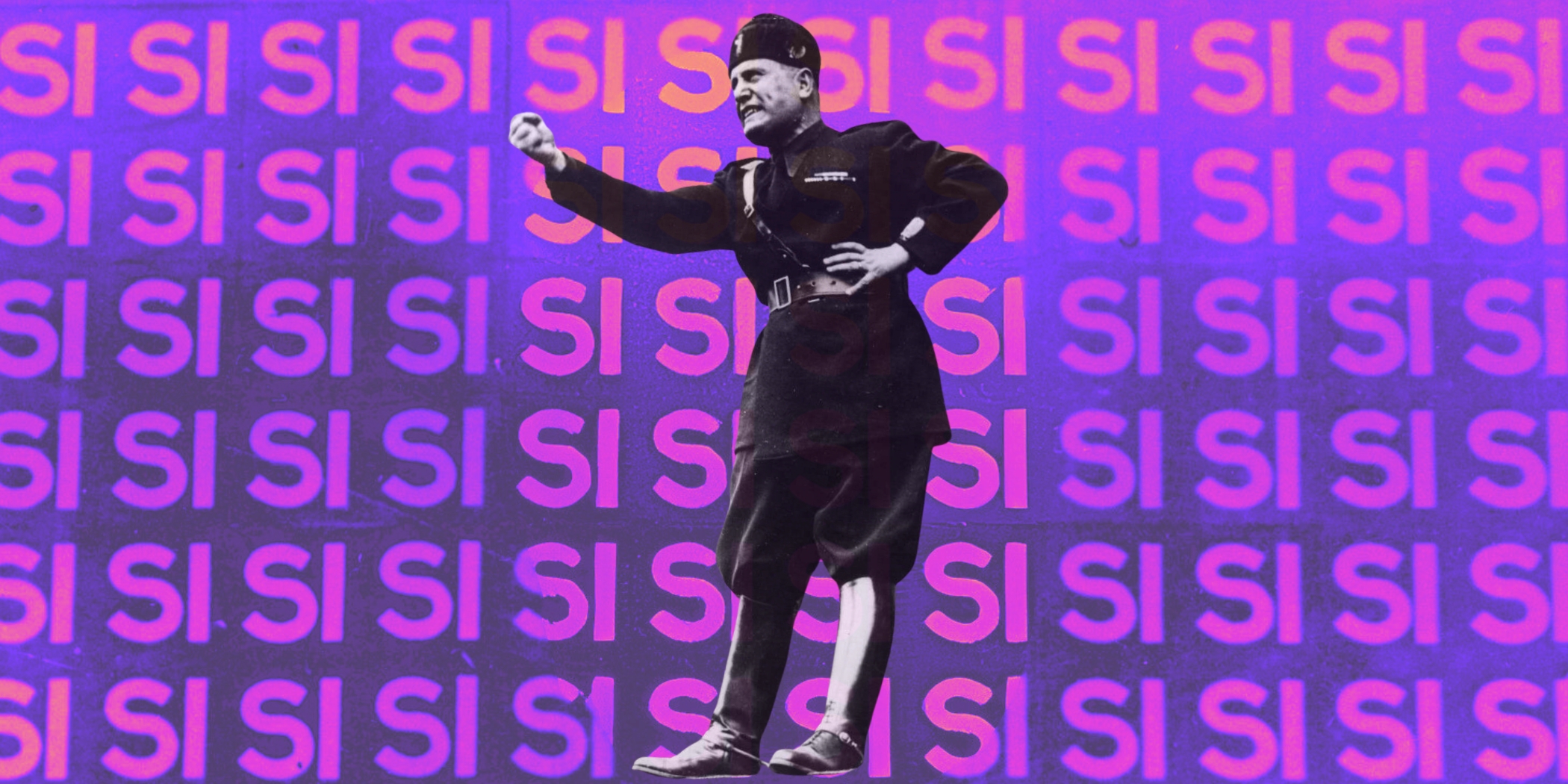
Mussolini and the history of fascist Italy make this thrust aesthetically evident: emblazoned across the facade of his headquarters at the Palazzo Braschi in Rome was a massive imprint of his face and “SI SI SI SI SI” (yes yes yes yes yes) printed more than 100 times across the exterior of the upper floors. Son of the Century stresses this obsession with action and activity. It reminds us that fascism does not merely tell us “no”; instead, it lures us in by offering certain kinds of “yeses,” and solicits and coerces our own in return.
*
This fall saw two new releases that explored the ascent and aftermath of Italian fascism: Wrights Son of the Century, and critic Olivia Laing’s sophomore novel The Silver Book, which covers the months leading up to filmmaker Pier Paolo Pasolini’s brutal murder in 1975, a crime that was long unsolved but is now believed to have been the work of far-right thugs.
Maybe it’s an oversimplification, but it seems to me that while seduction might mean coaxing out the other’s yes, repulsion expresses an unambiguous no.
Laing fictionalizes this febrile period through the journey of a young gay man called Nico who leaves London for Venice and ends up working for (and falling in love with) the legendary costume designer Danilo Donati as he animates the dream worlds of Fellini’s Cassanova and Pasolini’s infamous Salò. Nico is an outsider who is too young and British to appreciate the burden of surviving fascism, nor does he notice, as Pasolini and Donati do, the signs of its enduring life-force. This is likewise the thrust of Salò, based on the Marquis de Sade’s The 120 Days of Sodom, an orgiastic, disturbing carnival of torture, rape, and killing, reset by Pasolini in the town from which fascism reigned in the 1940s. Nico learns that “Salò is a location on a map, a moment in time, a state of mind, coming and going, perhaps even now approaching in the rear-view mirror.”
The unspeakable violence of the film is enabled by a kind of trance into which the victims of the fascists (or “libertines” as de Sade called them) fall. As Laing explained in a book launch at the Center for Fiction this November, Salò is a film about compliance and complicity—there is “a sense of inevitability from the beginning of the film,” where from the moment the teenage victims are enlisted or kidnapped and brought to the libertines’ villa, it is as if the world is placed under a spell: violence occurs without pause for vacillation, grief, or remorse.
By way of Pasolini’s film, Laing explores what happens when there is no limit to power, no guardrails, no breaks on the car. In the world of Salò, “the law of the father extends through all spheres, outside and in, from the bedroom to the factory, the government, the bank. There is no alternative to it, not in the world Pasolini is depicting. Within this world no other exists, except as something to be debased.” In other words: this is not the law that says “no,” but that prevents the “no”s of its subjects. The horror of Pasolini’s libertines is found not only in the violent acts they devise, but the impelled procurement of consent to them. It is si si si si si, all the way to hell.
In spite of its historical genre, The Silver Book is written in the present-tense: it moves swiftly, it is of the moment, and consequences that we as readers anticipate cannot be accessed by those who set them off. At the edge of town one night, Nico races on his motorbike to “borrow” a stack of film reels from a warehouse—a favor for a friend that he neither understands nor wants to undertake, but does anyway, becoming a lynchpin in the novel’s central crime. It is easier to say “yes” than to stand behind a “no,” and thus Nico marvels at his own complicity but does not dwell on it. He does notice, however, how nimbly others also consent to compromising acts—how, for instance, Salò’s young cast members, many of whom were minors and non-actors, throw themselves into the extreme requirements of the film, and how unflinchingly the crew reacts to their abasement: “the girls are displayed, undressed, their assets considered.”
And later, “it is all treated with absolute neutrality, as if it’s just so much matter to animate and light.” Nico senses that the rest of the production team locate the buffer between cinema and reality more effortlessly than he does; on the one hand, this means the nightmare of Salò disturbs him in the way Pasolini intended it to, but on the other, it perhaps also fogs up the material consequences of all-too-real events happening off-set.
Elsewhere, reviewers have criticized Laing for sidestepping this shadowy backdrop: the turbulent period of Italian history in the 70s known as the Years of Lead, when neo-fascists clashed explosively with leftists and unions. But Nico’s lust for the so-called “dream factory” of cinema and his touristic encounters with Rome are precisely the point, I think, in that his naive attraction to spectacle is what allows him to get tangled in a movement he doesn’t understand. Nico is one of the few completely fictional characters in The Silver Book, and he is crafted as a passive avatar thrust into history’s churning engine; where others, like Donati and Pasolini, are rigorously detailed, he is more opaque, vacuous, appearing to be someone on whom others act and not vice versa.
There is little pre-meditation for his decisions; even his love for Donati comes about by surprise. He wonders: “how did he get here? How did someone so accomplished, so charismatic, usher him into their life? The contingency of it is terrifying… he starts to realize how vulnerable he is” (this suggests that love too has something of fascism’s seductive lure, as if the same impulses which open us to others might also undo us; if it is fascist passions we are speaking of, it is not remarkable to suggest that those who are drawn into the far-right undertow go there mistaking it for feelings of love and belonging). Nico’s openness to others is therefore at once both generous and cowardly: though he feels himself to be powerless, merely swept up, it is his choices—his “yeses”—that propel the book toward its awful climax.
Fascism relies on this kind of tunnel vision, this narrowing of sight to the present and the consummation of immediate desires or demands. Italian fascism in particular has roots in Filippo Marinetti’s Futurist art movement, which sanctifies speed in its staccato 1909 manifesto: “tatatatatata,” screeches Marinetti in Son of the Century, as Wright cuts from his blabbering performance at a salon to scenes of fascist militias stabbing striking workers in the face. In the frenzy of constant motion and unremitting action, there is no time for the deliberation or understanding Mussolini associates with the “flaccid” intellectualizing of the left—fascism pushes people along, knowing they will either enjoy the thrill of the ride or not bother with the effortful trouble of pushing back. It is self-interest, never consequences, that guide its compass, its mania of pure, unrestricted indulgence.
It is easy to see the signs of encroaching (or indeed already present) fascism when they are loud and red and read “STOP” in bold type: but there is no sign that reads “go,” only the gratification of open roads.
In her exquisite account of fascist aesthetics, Susan Sontag distilled this effect as an isomorphic preoccupation with both “egomania and servitude”, evident in films and art that produced a “vertigo before power” and reified submission to it. Nazis, she reminds us, forbade art criticism for its associations with “Jewish traits” that put “intellect over feeling,” fetishizing in its place a purity of bodily life without reflection or individuality (one that was romantically represented for them by the Indigenous peoples of North America and Africa). Nazism’s total domination politically and socially found an aesthetic counterpart in the visual reduction of bodies to things, ecstatically subdued before the hypnotic power of a leader, force, or sublime beauty. She writes: “Fascist art glorifies surrender, it exalts mindlessness, it glamorizes death.”
This is what Laing’s reading of Pasolini and Salò stands against—during their conversation with Rachel Kushner at the Center for Fiction, Laing urged against the will to approach the film as a litmus test for toughness, for how easily you can keep an iron stomach. If one does this, they suggested, the film has failed, because it is not driven by seducing its audience but repelling them. Maybe it’s an oversimplification, but it seems to me that while seduction might mean coaxing out the other’s yes, repulsion expresses an unambiguous no. This has oppositional power: it refuses the spell of compliance, the normalization of cruelty. Wright’s mini-series tries on the inverse technique, with Mussolini (Luca Marinelli) consistently breaking the fourth-wall to address the viewer: “Follow me, you’ll love me too,” he says from the jump, as if Wright is asking us to watch how easily we too become seduced by what we, on paper, abhor.
Kushner and Laing also take stock of another binary: speed versus slowness. Whereas I find The Silver Book breathless, whipping around just as Nico does when he is tossed into its milieu, Kushner and Laing point to its moments of rest, such as the languid—almost liquidy—descriptions of Donati cooking a New Year’s feast, or of Nico sketching in the streets of Rome and Venice. These are other kinds of physical catharsis that contrast the explosions of violence indulged by fascist passions: they are caring, tender, reflective, but just as deeply-felt—perhaps even more so. Traditions of Italian Marxism likewise notably depart from Marx’s valorization of work by revering refusal, inoperativity, and idleness, or the power (and even pleasure) of stopping and saying “no.”
This brings me back to Butler, who asked in their lecture how we might make left-wing politics deeply desirable, how we might undo the fascistic colonization of terms like freedom and liberty. They pointed out the persistence of labels like “feminazis”—to which we can add the killyjoys, abolitionists, conscientious objectors, operaisti, and boycotters—that mark the left as the site of repression, and entice people to the right for its laissez-faire attitude. And yet as much as we must stress the beauty of our political collectives and their commitments to a more rigorous and true liberation, we can’t abandon the value of our refusals as well, which mark the status quo as unlivable and assert the necessity of something better, disallow concessions to the far-right, and dissent against binary gender, class hierarchy, heteronormativity, degrading work, and racist scapegoating.
After all, why does the Right so especially vilify those who strike, boycott, and refuse? It is not just because they disagree with their politics, but because these actors disallow the persistent ceding of ground on which fledgling fascists plant their flags. It is easy to see the signs of encroaching (or indeed already present) fascism when they are loud and red and read “STOP” in bold type: but there is no sign that reads “go,” only the gratification of open roads. In other words, we are far less likely to take note of what fascism permits than what it restricts, and yet herein lies the thrust of not only some of its most potent violences, but the ways it enlists us in letting them happen.

Tia Glista
Tia Glista is a critic and PhD candidate in Toronto. She researches and writes on gender, feminism, literature, film, and politics. She is a founding editor of Toronto Review, a magazine forthcoming in 2026.