Seven of the Greatest Farts in Western Literature
Elizabeth Zaleski Finds Famous Moments of Flatulence in Classic and Contemporary Works
I’m a little embarrassed to admit that I spent the bulk of my twenties in various English programs writing papers with titles like “Metonymy and Violent Signifiers in Dickens’s Our Mutual Friend” and “The Floating Phallus and the Signification of Gender in Wuthering Heights.” As you may have guessed, these papers bear more than a whiff of theoretical garbage. And while I don’t regret having studied literature for many years, I do regret the focus of those years.
Instead of reading for language I could plug into Lacanian psychoanalysis, I should have been noticing, for instance, how many plots in the history of the novel center around the fallout from an unplanned pregnancy (a lot of them). Or, on the other hand, how many scenes in the canon depict farting (not a lot of them). To rectify this oversight, a few years ago, my friend Cassey Lottman and I created the Great Farts of Literature database, an ongoing project dedicated to cataloging the best butt bombs in print and from which this list is adapted. I’m pleased to present here seven of the greatest farts in Western literature, all of which reek in exactly the right way.
*
1. Nicholas’s canonical ass cannon in the Canterbury Tales
In “The Miller’s Tale,” Nicholas is carrying on an affair with Alisoun, whom Absalom also desires. Alisoun has previously tricked Absalom into kissing her butt by sticking it out the window just as Absalom leaned in, intent on kissing her other cheek. Absalom returns for more, but also with a plan for revenge. This time, Nicholas puts his tush out the window: “This Nicholas just then let fly a fart / As loud as it had been a thunder-clap, / And well-nigh blinded Absalom, poor chap.” Squinting through the flatulent fog, Absalom manages to return fire, planting a red-hot iron on Nicholas’s bum. Chaucer, who wrote in Middle English, was famously raunchy, and this fart has been rumbling since the fourteenth century. One thing is for sure: a blinding fart to the face never gets old.
2. The demon’s toot in Dante’s Inferno
In canto 21, in some literal circle of hell or other, the poet sees a troop of demons sticking their tongues out as a signal to their head honcho. Showing us why he is boss, the chief demon “wheel[s] about” and makes “a trumpet of his rump.” Of course, Dante wrote in Italian, and the translation I’m quoting is by Henry Wadsworth Longfellow. I commend Longfellow for his choice of “rump” and “trumpet” for cul and trombetta, as the word “rump” is playfully doubled in the word “trumpet.” Other options the poet doubtless weighed—such as “butt horn,” “ass cornet,” and “bum bugle”—still strike one as infelicitous, though “booty kazoo” has a nice ring to it.
3. The manticore’s elliptical fart in The Satanic Verses
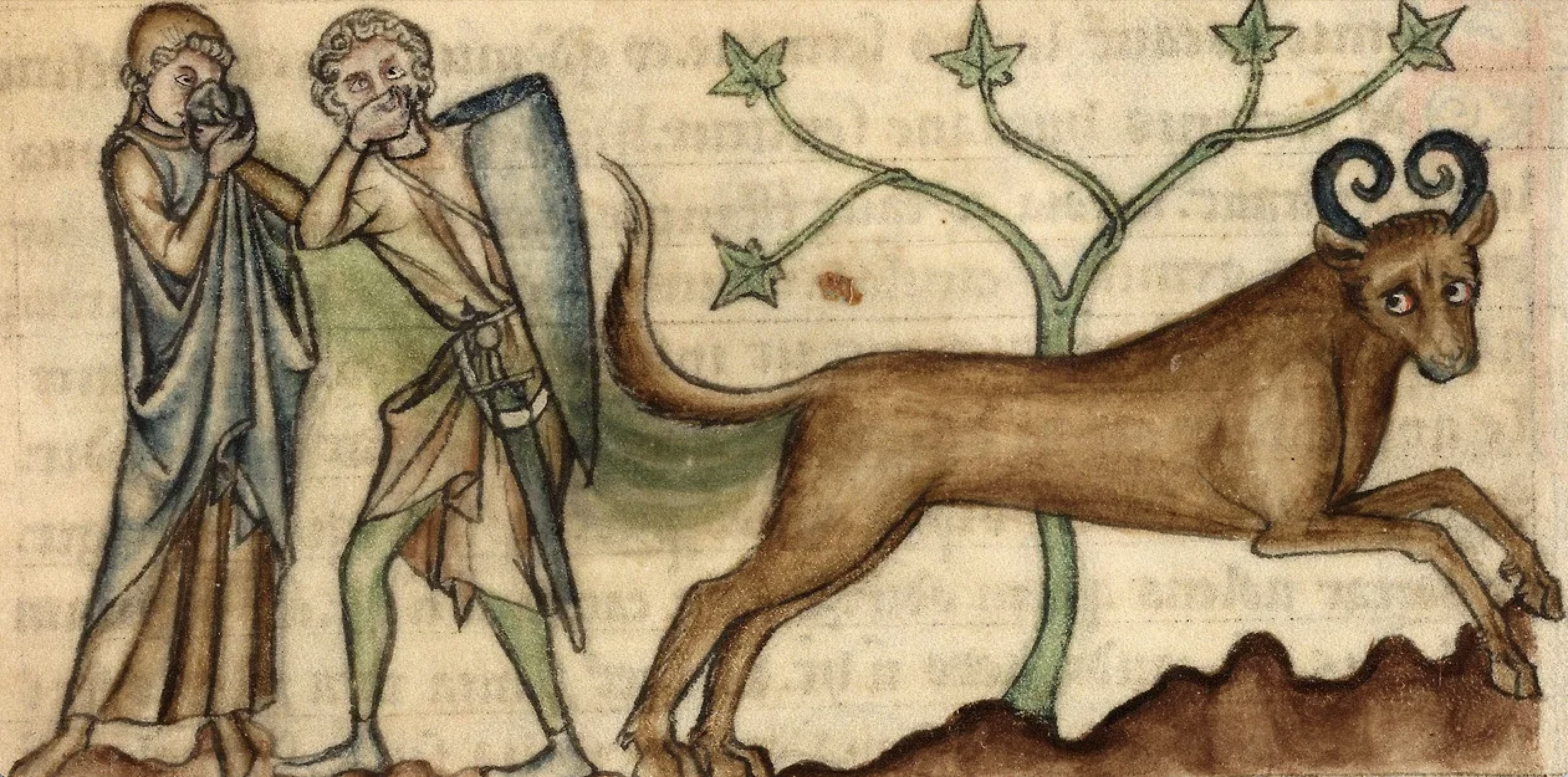
In Salman Rushdie’s Satanic Verses, certain humans find themselves transforming into monstrous forms. One, who is becoming a manticore, is discomposed to find that as he leaves his old body behind, his behind is chugging along like a steam engine: “Every night I feel a different piece of me beginning to change. I’ve started, for example, to break wind continually…I beg your pardon.” Ever the gentlemanticore, this character avoids the word “fart”—opting for the euphemistic image of “breaking wind”—and begs pardon for his flatulence. We have very few details about the scent or strength of this fart, as the passing of gas is a source of ongoing mild embarrassment to this character. In fact, the fart is not narrated at all but presented in an ellipsis. Rushdie does not linger, unlike most farts.
4. The pilot’s silent but actually deadly farts in Hatchet
Gary Paulsen doesn’t mess around and plunges us face-first into both a cloud of ominous fart fumes and a plane crash in the opening scene of Hatchet. Brian is flying to meet his father for the summer, and he politely attempts to ignore the increasingly potent stink emanating from the pilot, “Jim or Jake or something[,] who had turned out to be an all right guy… Except for the smell.” The scene goes on like this for a while, Brian documenting the building “body gas”—“More smell now. Bad”—and then hoping that the pilot is just having stomach troubles. The pilot continues to disintegrate until his eyes roll back in his head, spittle leaks from his mouth, and finally, one presumes, he soils himself: “The smell became worse, filled the cockpit, and all of it so fast.” Brian now realizes that the pilot’s loss of sphincter control portends not a momentary breakdown of bodily integrity but death.
5. Agatha’s room-clearing rip in The School for Good and Evil
In chapter 3 of Soman Chainani’s The School for Good and Evil, Agatha, who feels she is always in the wrong place, finds herself the center of unwanted attention and in desperate need of a “diversion.” Thinking quickly, and digesting incompletely, Agatha does “the first thing” she can think of and “deliver[s] a swift, loud fart”: “An effective diversion creates both chaos and panic. Agatha delivered on both counts. Vile fumes ripped through the tight corridor as squealing girls stampeded for cover and fairies swooned at first smell, leaving her a clear path to the door.” The School for Good and Evil is a YA fantasy novel, but as Chainani’s Agatha reminds us, even in the realm of magic, few forces can match the power a well-timed fart.
6. Sancho’s “little sound” in Don Quixote
Don Quixote by Miguel Cervantes is one of my favorite books, and Sancho’s fart is the first that made me think, “This is a literary achievement.” Sancho and Don Quixote are on one of their ludicrous adventures, and Sancho, whether from “something laxative he had eaten at supper, or…merely a necessity of nature…fe[els] the will and desire to do that which no one else could do for him.” In other words, Sancho needs to relieve himself, but he’s too afraid to leave Don Quixote’s side because of the frightful sounds they have been moving toward. Sancho unlooses his breeches, and the rest is literary history:
Having done this…he encountered another difficulty: how was he to vent himself without making some noise or sound? Gritting his teeth and huddling his shoulders, he held his breath as best he could; but despite all these precautions, the poor fellow ended by emitting a little sound quite different from the one that had filled him with such fear.
“What noise was that, Sancho?” said Don Quixote.
“I do not know, sir,” he replied. “It must be something new; for adventures and misadventures never come singly.”
7. Nanapush’s Malodorous Miracle in Louise Erdrich’s The Last Report on the Miracles at Little No Horse
In addition to being, generally speaking, one of the greatest novelists of our time, Louise Erdrich is, more specifically, the reigning queen of the literary fart. In one exquisitely rendered and uproarious scene, Nanapush, whose wife Margaret has been undercooking his beans as punishment for his having failed to catch a moose, experiences a night to end all nights:
That night was phenomenal. Margaret was sure that the cans of grease rattled on the windowsill, and she saw a glowing stench rise around her husband but chose to plug her ears with wax and turn to the wall, poking an airhole for herself in the mud between the logs, and so she fell asleep not knowing that the symphony of sounds that disarranged papers and blew out the door by morning were her husband’s last utterances.
Yes, he was dead.
But wait, there’s more. Later, when everyone is gathered for the funeral, the mourners are witness to what can only be described as the sulphureous sublime. I leave you to discover the miracle that awaits, but suffice it to say that Nanapush has one left in the chamber, and it is fit to wake the dead.
I hope you have enjoyed reading about some of the greatest farts in Western literature. I’m sure I’ve forgotten a few of the gems I overlooked in the past, but the project of sniffing out the best literary farts is ongoing. If you know of a great fart that should be added to our website, please pull my finger to get in touch!

Elizabeth Zaleski
Elizabeth Zaleski is the author of The Trouble with Loving Poets and Other Essays on Failure. She farted four times while writing this article.