Sarah Pearsall on the Worldwide Scope of the American Revolution
In Conversation with Whitney Terrell and Jennifer Maritza McCauley on Fiction/Non/Fiction
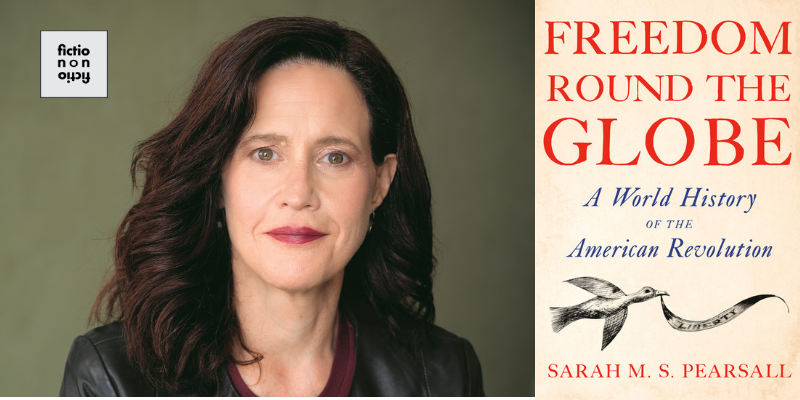
Historian Sarah Pearsall joins co-hosts Jennifer Maritza McCauley and Whitney Terrell to discuss her new book, Freedom Round the Globe: a World History of the American Revolution. As we approach the 250th anniversary of the Declaration of Independence, Pearsall talks about how she chose to write about the global context of the American Revolution. She explains how the hanging of an indigenous woman in Detroit, ordered by British colonizers of the area, led to protests that prefigured the American Revolution. She outlines how tax protests in St. Kitts and the East India Company’s actions in South Asia influenced the thinking of revolutionary leaders in the thirteen colonies. She also discusses the role that war crimes played in the public relations battle of the war and reads a passage from Freedom Round the Globe.
To hear the full episode, subscribe through iTunes, Google Play, Stitcher, Spotify, or your favorite podcast app (include the forward slashes when searching). You can also listen by streaming from the player below. Check out video versions of our interviews on the Fiction/Non/Fiction Instagram account, the Fiction/Non/Fiction YouTube Channel, and our show website: https://www.fnfpodcast.net/ This podcast is produced by Jennifer Maritza McCauley and Whitney Terrell.
Sarah Pearsall
Freedom Round the Globe: a World History of the American Revolution
Others
The Declaration of Independence • “What we know about the UFC fight at the White House”|CNN, June 1, 2026 • “These 6 Acts Dropped Out of the Freedom 250 Concert. Here’s Why”|People, June 3, 2026
EXCERPT FROM A CONVERSATION WITH SARAH PEARSALL
Jennifer Maritza McCauley: So to kind of bring us back to where we are right now, the Trump administration’s rhetoric on immigration seems to suggest that America is somehow unique, that our freedoms, our forms of government, our revolution were somehow sui generis so we shouldn’t share it with anybody. Am I wrong to think that your book argues that our revolution borrowed from and relied on the revolutionary efforts of people from all around the world?
Sarah Pearsall: I mean, yes, I think there is a wider context here. The idea that only settler Americans were protesting imperial policies isn’t sustainable based on all the information and documents that we have. There’s resistance in the Caribbean, there’s resistance in Asia, there’s resistance in Africa. These are all places that have resistance and all places that are struggling to understand the ways that the new settlement of the Seven Years War in the 1750s and 60s, and new ideas and practices of slavery, in particular, are really tied up with rethinking what liberty means and who is entitled to it. I think we need to see that wider context to understand that Americans are one group among many who are making those claims.
I do think there are exceptional qualities to the American Revolution, which is that it is extremely successful. They do succeed in throwing off the British Empire. They do succeed in establishing a new nation. That’s really important, and that is really exceptional, but again, it couldn’t have been done without alliances and without other people fighting the British as well. Generally speaking, even with the most dim understanding, most people know that the French are very vital to that. But in addition to the French, the Spanish are very vital, Latin American and Caribbean people are very vital. There are also South Asian and West African leaders who are partly fighting against the British, and thereby sort of dissipating British resources around the world.
So, in fact, by the 1780s of the 100,000 troops that Britain has at its command as soldiers and sailors, only fewer than 30,000 are actually in the sort of 13 colonies area, because after 1778 it’s a global war, it’s involving the French, it’s involving all these other places, and that means that actually that sort of involvement of these other places continues to really matter, but it matters in a different way. So I do think there is a kind of exceptional quality that we can certainly celebrate, but I don’t think it’s quite the one that people think it is.
Whitney Terrell: I am glad that we had a revolution. I am proud of the American Revolution with all of its complications, and failures and things that the Founding Fathers got wrong. Having spent so much time thinking about this and how other people perceive the revolution, not only here but around the around the world, as we prepare to celebrate this 250th anniversary of the Declaration of Independence in our own way (which will not involve, for me, watching a UFC fight on the White House lawn) does the American Revolution still have the same significance or imaginative power for Americans that it did at the time? Has that original story been lost as we’ve become a massive power, much more like the British Empire now in terms of our power than we were when we had the revolution?
SP: That’s a really important and complicated question to answer. There are ideals that drove the American Revolution. You said you’re proud of that revolution, and I think many of us are. Those are stirring claims: the right to life, liberty, and the pursuit of happiness. I think we can all get behind that. Of course, we can dispute what exactly that means, what they meant then, what we mean now, but I think we can agree that certain principles are driving this event, and that those are worthy values, that the values of unity and respect and equality and happiness, these are all things that are worth striving for at a human level.
I do think that it is helpful for us to think about not just being good citizens of the United States, but of being good citizens of the world. I don’t think those are mutually exclusive categories. I think those two things actually go hand in hand. It’s a moment for us to really reflect on the way in which the U.S. has always been linked with other countries, and that those connections have profoundly shaped our history. It’s never been an exceptionalist or isolated kind of country. The revolution was never an entirely exceptional event, it’s always been in this wider global context. It’s helpful to think about it in those terms.
I also hope that on this 250th anniversary, people will reengage with the Declaration of Independence. It’s something that I make my students read. We actually read it aloud as a group in sections. It’s a relatively short document—it’s fewer than 1400 words—it’s easily available, yet it’s often something that people have a dim recollection of. Maybe they had to read in school at some point, but they really couldn’t tell you what’s in it. I exhort people to read it again. Some of it is very stirring and positive. I tried to focus on that in this book, but a lot of it is really about grievances that people have about what tyranny looks like and what bad behavior is in a governmental way. Those are also helpful for us to think about, and I think we’ve certainly seen that there are long threads of continuity between what we might identify as bad behavior on a sort of national and international stage.
Transcribed by Otter.ai. Condensed and edited by Rebecca Kilroy.

Fiction Non Fiction
Hosted by Whitney Terrell and V.V. Ganeshananthan, Fiction/Non/Fiction interprets current events through the lens of literature, and features conversations with writers of all stripes, from novelists and poets to journalists and essayists.