The leg, a line.
A close-up of a woman’s leg. And the leg is seen because the woman is tying her shoes.
Isn’t the leg a line? she’s heard saying. Tying up the laces. There’s a certain name the neighbors use when her leg sticks out of place. Out of place for a woman, you know. Out of place for how the body should be presented, even while tying a shoe. She hears voices from the front room. A little skin of the upper leg being shown outside of its intended context, that’s when the neighbors take it upon themselves to call her out of her name.
She’s fast, someone says in a low register, or it’s just about the way her thighs push together when she bends, and her ass, her titties sitting.
Are we wrong to lament the condition of those structures?
—And aren’t they ours?
In the footage the woman bends, loops her fingers around the laces, once, twice, grass stains on her knees. She stands, the people stare. Or she moves about, this figure, pushing the shopping cart and they all go at her pace.
The camera lens is covered in grease, we notice, there’s an amateurish quality to all this. It’s nighttime. The woman is lit up by the fluorescent lighting. She knows the store well, the butter beans are over there, she says, pointing.
The volume on the television is up loud. We follow her down aisle five. She checks the ingredients on the label, her long nails tapping the cans, later brushing her forearms against the fresh produce, the mustard greens. A swiping of a card, and they all pause for the sliding door. It is only when she’s ready that they exit.
Lit up by streetlight; silver around the forehead.
We’re sitting on the living room carpet watching the 168 hours of footage. The schools are closed up for the Holiday. The footsteps of the children are heavy, running wild. We’re watching the part of the film when the woman is running errands and the like. Our community mostly walks, and there was a time when this woman walked about: back from the market, to the gardens, barefoot from the lake, on the community center table, to the bridge, in the mud, dragging her soles (dirty) around the house—though now she is bedridden. Confined to bed, riding the bed.
We sit up in her house and watch her go still. We watch the footage, and watch her lead the others through the streets. It doesn’t seem right how much the woman walks in the film, the ease of movement, arms swinging, not unlike a piece of metal, the metal metal, metal of waiting, the neighbor Dionne Brand says, or how often the woman remains on her feet.
She’s carrying a purse on her shoulder, a faux leather, black. Her purchases bagged up by a teen. She carries loads of mustard greens, prune juice, ginger ale, Vaseline, butter beans.
And they shadow her. They gather around her, this elusive figure, don’t she move quick? The six of them scale her. They move in unison. Do you know about that? About moving as a unit? It’s harmonious. Here come the six, they used to say, the six mix, here they are: the six fix, six peas in a pod, the six horsemen, the six king’s men, the neighbors would say. Here they come.
And when the woman drops down to tie a shoe they wait for her to finish. And the audience waits, in the living room the children quiet down their games. They check their own little shoes to see if they need tending.
Her thigh is out of place and shiny with oils. She’s gotten the necessary things—the turkey neck, the cowpeas, white vinegar.
The volume is raised up too high, It must be explained, the woman says, yells, profile to the camera, thighs sticking, strawberry skin, razor bumps showing, the mini skirt, climbing, tattoo peeking, walking slow, and all of them walking side by side—it must be explained how the Hill is raised but almost flat, not at all hilly, she says, mouth wide, and it sits on a salt marsh that is known to be sinking. Named after a certain somebody, a politician or something, a something something Hill, the woman says. Do you know about this place?
The group speeds up their walking to keep time with her. Yes, one of them says. Perhaps it was an Augustus Troy Hill or a Jamaal Amenite Hill, we don’t really know.
The woman is beginning to forget, to misplace things, and the others, the six, they let her tell them again, again, A something something Hill, though they know this speech. On her feet: tennis shoes. The valley is familiar, it is the same now as it was then, during the taping, and before. So we’ve known it and the surrounding flatness for many years, decades. It is sinking a little, but then everything is going down, so today we tell ourselves it is fine, and just the same there is the Holiday, or there is an urge to preserve something. This film, it’s about place, community, she says, being rooted in the Hill, the way we are rooted, okay, and it’s about our Holiday or about tradition, and your place here—you.
Okay, they say. Okay, okay.
The group never uses the word unless there is something silly going on. To sit in the grasses, to talk to the neighbors, to excavate, the woman tells the six. Okay, they repeat. They walk on. They walk behind the gigantic head of this woman, this too tall woman. And get my good side, she says. She towers over them like a pine. There are hills in the distance, and the fog is down low. The camera captures this. Her pace does not give her age away. The woman is old, and she is with child.
It is what it is, the woman says, or the name has stuck. The name?
Yes, honey, the name, The Hill.
The geese, which are aggressive and almost completely gone, stomp when they are near, demanding something. The six, the six bits. And they do film the animals, the birds, and are somewhat distracted by them, even though they are not the focus of the project. And the woman says, film the ducks, film the geese, oh yeah. Capture something good, the ducks are full of good.
We sit on the living room floor, on the sixteenth floor, watching the footage. Do you get it? The wide shot of the buildings, how they exist on the very end of the salt marsh, the artificial lake, the high school, the market, the cemetery, the hospital, the thick asphalt. Asphalt so thick and suspended that we all have difficulty climbing across the street, this whole place is cool to the touch. The prison sits empty.
It is a tradition to watch it, you understand, and the thing is so long that most of us have only seen bits and pieces. The movie is all out of order. I have seen it all, memorized it. Would I not know a thing that covers?
Those who are tired get up to leave. The neighbors are off to church or going straight to their bed, to praise or to rest, respectively, and the film is forever playing in the background.
Leaving and returning, taking turns. This will go on for a week or so. The woman with her bare feet in the soil, sitting on a stoop or in the grass. The woman on her knees. The six are swarming around her. Sometimes it is quiet and still. Moss, the grasses, which are dry and yellow, weeds, weeds. Yellow, or golden, like wood can be golden. And furniture being cut from pine, molded, sewed, finished. The pine trees swaying.
And the woman’s name is Vonetta!
Vonetta!, though the neighbors call her something else entirely (fast!), and we mostly refer to her as she exists (the woman!). Oh, but I don’t like to be reduced.
It’s Vonetta!, she says when she introduces herself to any man or woman, or child. With an exclamation point at the end, the woman continues, an aircraft moving past.
Some stragglers have joined, they adjust themselves on the carpeted floor, finding a free space, or a gap, the arm of the plastic couch. They sit up straight to watch this thirty-year-old film. Vonetta!, this is how the name is written on the birth certificate, I can show it to you, though it might fall apart a little more in our hands, yellowed.
Vonetta!, the woman explains, is the name given by my mother to prepare me for how I would be called out, or how I would be erected, enacted, blamed. The punctuation at the end like a nail left in a wall.
Sometimes in the living room we fall asleep.
When we wake the children are gone, maybe to school, and the apartment is otherwise packed with new faces.
The gals (6) as they stand on the corner waiting for the bus to pass. And the street is paved with asphalt so thick that the sidewalks are not aligned with it. They (6) wear clothes that reflect the decade. Someone beating a carpet from an open window just out of frame while we beat the carpet from the next window. Just behind—the Hutchinson River/the Hutchinson River. There is some repetition going on. How to explain it? Everything we did once, we still do.
There are some preparations going on that have always been going on: the lights being arranged upon the branches of the sweet gum. We are all squished inside the apartment, preparing, watching/waiting for a glimpse of ourselves.
Climb up, the bus driver, Charlie, says.
Charlie is dead. He is captured in the scene as we remember him: eyebrows touching, goatee, low sideburns, waves, hair connecting over his surfaces. There’s so much traffic. To get on a bus is to spend some time climbing aboard, or being pushed from behind, or being pulled up by the armpit.
Climb on sweetie pie, the bus driver calls out to the six.
Bitch, the bus driver calls out.
Fuck you Charlie, they say, one at a time. They climb up one at a time. They help the woman climb up easy. She is careful to show the thigh. There is something graceful about the gesture, a child comments. More chatting, the camera turns away to shoot some B-roll. The six voices harmonize. They go around the loop, Einstein Loop. The bus is clean. Things moving fast outside, and they watch the lights coil in the red maple, and the milk thistle leaning over or resting.
We are losing interest. Milk thistle is good for the liver disease. The sky is gray. We move to the kitchen to watch the others play spades. Isn’t this her floor, her ground?
Windows open, we sit upon chairs upholstered in green materials. It is hot as hell. On the television the earth is frozen solid. Camera is heavy, hell, they take turns resting the equipment upon different shoulders, a muffled sound, The earth is frozen solid, they say in unison. The picture is shaky, with the image pointing all the way up—hands turned solid.
The students are gathering their books. The woman reaches into her left sock to pull out some cash. She flashes it to the camera. A high-pitched giggle, contagious, low and too loud. Her breasts shake.
The six tell the woman to shush/hush.
When she is done fucking around, bragging, she pushes the money into her bosom. The woman is performing. It takes courage to be calm, she says, stepping off the bus. Y’all seem nervous, nervous to make a fuss and I’m as calm as a cucumber.
We’re not nervous, one says, maybe Pearl, we’re tired.
The dimensions of the buildings are even, with the exception of the one building in which most of us still live, number 35, the tallest. And even in their weight these buildings are even, equal configurations in their overall size and width, with pillars that were built for the floods or for the quakes. The apartments are almost exactly uniform in their square footage, in their coloring, and in their overall demeanor. This is how it is, and how it will be.
The buildings are not to be fooled with, a neighbor, one of the six, Sanaa Lathan, says, having climbed off the bus after the woman. Six joints climbing across the street. Vonetta! mumbling something inaudible. Coughing into the crook of her elbow. The pregnancy is far along—the woman holds the curve. They take their time with her, they offer their twelve arms. Some of this effort is picked up by the lavalier mic—
There are no new buildings sprouting up in the distance. There is no construction happening, none, and the city is done. No cranes. Everything is where it is meant to be, the woman says as they move toward the entrance of building #35, 30 keys shuffling in hand, 40?
Sanaa Lathan is trailing the group, Jackie comes up second. Then Seret, Mona. Beryl. Pearl. All the things have already been built. Some of the pieces tend to fall off but they mostly remain in their place, okay, the woman says.
The government repeats, Sanaa Lathan says, they tell us over and over again, ‘Let the pieces fall if they must.’ Well, this shit is right falling apart, you understand?—before the woman, Vonetta!, responds, overlapping—no more federal money will be invested into our buildings, or into their upkeep, mmmm, the infrastructure is in shambles—goddamn, Sanaa Lathan cuts in—goddamn.
They talk over each other, the two women, Sanaa Lathan and this old ass woman, our woman—of course, there are those that still wash the hallway floors, or glue the pieces of gravel back together. They catch each other’s eye.
Look at the white shoes, look at the white shoes! they laugh, necks broken, a cambré, one arm elevated, laughing and arching to the high heavens. Sanaa Lathan has the last word, Lord have mercy.
Sanaa Lathan has a habit of interrupting. She wants things to go her way, or she hopes to impart some knowledge, or to make people see where she is coming from. Do you see where I’m coming from? she says, you understand? She wants to be understood. She’s forceful, imposing, overbearing in her communication. She’s touchy-feely.
A hand on the shoulder or on the hob of the knee. An elbow pushing out. She reaches for hands, she pats people on the back, pokes and squats down to pick people up off the dirty floor. All in our faces, the children say. Sanaa Lathan cradles some to her bosom. She bathes twice a day. It is not an exact thing, she’s a contrarian, every popular idea is hers to contradict. She’s lazy, and her shape was fine, is still fine. There is no difference between her then, her hips, and now, only the rheumatoid arthritis.
And we don’t mind the way Sanaa is, Charlie says, we’ll gladly sit in her company.
Other times we hear her humming something about gluing the pieces back together, a tune about the gravel, pick up the pieces, she hums/sings/scats. And when they are together (the woman and Sanaa Lathan)—they are like buffalo grass and bison, oil and vinegar. Don’t they disagree about how to care for the gardens, the resurrection fern, or how to patch their garments with the sewing machine, how to grind the milk thistle down, how much turmeric and honey to put in, what kind of stitch to use, how many chairs to pull up to the function?
We didn’t mind, we don’t mind their fussing, we let them be.
Watching the woman making her way upstairs, off the elevator, into her domestic space, camera on her heels, and the apartment looks as it does now. Pat is in the upper room, Vonetta! says, and I owe the man $350 in maintenance fees. The space is the same, the furniture. Don’t lean against the china cabinet.
The six horsemen follow upstairs, to the upper floors, into the apartment. They put the purchased items away. They begin to tidy up. The groceries have their place: the nonperishables on the high shelf, the produce washed with baking soda and put on paper towels to dry. It is practiced, a thing of nature. The house smells of elderflower, Beryl says—no, you’re wrong, Sanaa Lathan says, it smells of ginger leaf.
Picture this: Vonetta! washing the hallway floors, Sanaa Lathan climbing on the couch to take a nap, Mona wiping down the counters, Jackie cutting the vegetables into cubes. Pearl dusting the piano. The woman is old, I hear the children saying, their bodies warm against our hips, not the way all adults are old, but really old, ancient, she is endless—
The high cheekbones, we focus again on the cinematic thing, we attend to the six, split diopter, we listen to them performing their duties, and the way they speak on their ailing bodies: put some peroxide on it, Jackie says. Mona says, rub her down with alcohol, then some Vicks, put the kettle on for the hot water bottle. Pearl says, soak in the tub with Epsom salt.
The woman is not slow in her movements, she is methodical. Her knees crack when she bends, something about collagen. She’s swift, the way she moves the mop back and forth.
Youth fails us, the woman says. Or when it moves away, this youthfulness, does it not subvert all expectation? Is all the good faith we had in ourselves, in our younger selves, all those expectations of grace coming along with this movement, was it all for naught? Where is the grace?
Put some tea tree oil on it, some castor oil for the liver, Seret says.
The neighbors have always covered their domestic possessions with textiles, material to help maintain things, or to help their shit not fall apart. This is the reason for the shag carpeting, the plastic coverings. Everyone is afraid for things to become elastic.
Looseness—that is the thing people fear, in a person, in women, and in objects, we hear the woman saying, eyes closed, legs set wide on the plastic couch.
The seasons are thus: tropical or freezing. The seasons are such that the plants die and bloom in quick succession. The things in between, this mildness is short lived, Jackie says. The leaves are there and they burn up quick, or they’re under ice. Jackie is buried under the ice, but when she was around, awake, she liked to wink and to exaggerate things, she liked to discuss the weather, she could predict a rainfall like no other, and it does feel sometimes, Jackie used to say, like the seasons are toying with us. Jackie made lots and lots of money predicting the weather, erecting things, or playing the numbers. Her bob shaking while she talked, swinging; a third carpet being swatted from a window. Jackie lost money on the horses.
The woman is mopping the hall, the front door sits open.
And there are but two and a half seasons, no more, no less. Or it feels like it anyway, so there are two and a half alternating moods, no more, no less. I’m always hot as hell or freezing, Jackie says.
Not many are bothered by these temperature shifts. Clothing isn’t made to express a thing, but to allow for cover or better circulation. The major Holiday is celebrated in frigid or humid temperatures, depending.
Landscape designs withstand for days, weeks, sometimes for many years and then the plants die or dry or are overridden.
Don’t let the woman start up again, one of the neighbors say. The grasses are too high.
We call her fast thing, or Von or Vonetta! We call her the woman. As if she is the only woman, the mother—Wasn’t she the mother? the children whisper to the screen.
Yes, the six say in unison, the grasses are too high, the flora will withstand very little.
From the window in the backroom, this high up, the view consists of this: people walking in a syncopated way, all over and small like ants, surrounded by the remnants of an evolving architecture of plant life. Water lilies, lime trees, hedges.
The day after next the basement is certain to fill up with water from the lake, it’s gonna rain bad, Jackie says.
The volume of the television is up so loud it can be heard crystal clear in the backroom. Mhmmm, they say, yes, they say. It’s known that no basement apartment can really withstand or exist anymore, not like when I was a young thing, not even a first floor spot, or they exist, but they’re occupied illegally, the government tells us, okay, and everyone that can manage lives up high, the woman says.
And then Pearl asks her, Von, Vonny, can plants be architecture? Can they exist in reverence the way the old castles still stand, broken? Or when we plant the cypress trees in a line, don’t they provide good shade?
The woman says yes, yes. Sure. Sanaa Lathan says, no.
The woman insists, plants can be structural, and they are, but the more the landscape is lost to the aggressive seasonality the more their consistency is lost. Oh, but the cypress trees are as straight as a ruler, companions for the teenagers on their walks to school . . . do you ever pay attention to the cypress?, the woman raises her voice, you never pay it no mind, Lathan—outside: lines, pearls, suddenly snow.
When it is permitted by weather, Sanaa Lathan interrupts, the county produces vibrant foliage, real vibrant—the fauna and the flora, you know, the weeds, thistle, grasses, mosses and the fungi, delphinium, cacti (which last in the most uncomfortable of temperatures). Also those orchids, sunflowers, ribwort plantain . . .
Or, the woman chimes in, there is plant death all over, okay, ice. An absence is forged during this vegetal unmooring, can’t you see how time or temperature can undo the landscape? Spoil it rotten?
And the seasons are such that the plants die and bloom in quick succession.
The woman turns, she takes a break from mopping up the hallway, body squared and facing the camera, belly full, lines all over the forehead—blooming and dying repeatedly. And though there is no end to this, none at all, and though the decay sets forth more growth, it is still striking to see something bloom over and over, okay, or for it to die in this quick succession, and for me this change is a swelling, a harmony, Lathan, it’s divine!
Everyone thinks it’s divine. Sanaa Lathan does not wait for the woman to quiet, Net, you think it’s a gift from on high, and I don’t want to blaspheme but the plants can be seen from anywhere you look, from the second floor of the community center, from this here window, from any man-made structure: life/death. It just is. From this height, up on the sixteenth floor, we know the transition. Don’t we look down upon it every day? It’s ours, you understand, it belongs to the mortals. And Pearl, you ask again and again, ‘can plants be architecture? Can they exist in reverence the way the old castles still stand, broken?’ You ask this of us over and over and over, when you know it’s ours!
There is mopping, dusting, cutting, resting going on. Someone coughing into their arm, a second train passing underneath. And the woman waits a while before she offers a conclusion: plants are better than any buildings might be, better because the buildings split or lean pathetically, okay, and though the plants split and lean too, they are eager to find the sun.
When the woman talks, she says, okay, okay, making sure they’re keeping up with her. The group never uses the word unless there is something silly going on, okay, and when the woman uses it, they can’t take her seriously.
Sanaa Lathan says, do you know where I’m coming from? and the woman says, okay, okay. Jackie concludes her thought with a nod, a smile, and a wink. Pearl rolls her eyes. Mona sucks her teeth. Seret is quiet quiet quiet. The woman, she is quiet unless spoken to, and when spoken to is long-winded. She scratches her nose every few minutes, a tic, or she rubs her hands together, like so, or she plays with her scalp, sometimes drawing blood, scratching, patting it down. Beryl curses up a storm.
The woman calls Sanaa Lathan, Lathan. Sanaa Lathan calls the woman Net.
It isn’t that the six don’t have high reverence or respect for the woman—no—in fact, she is a pillar of the community. She has taught the group many things, manymany things: for example, how to spit when frustrated, how to curse in a soft way, how to cure garlic and bundle it into groups of ten, how to fell trees, how to quit a job. They sit with her in the backroom, still, to ask for advice/remedies. Though she is nonverbal, frozen, they go and they sit with her, they talk, asking her things, demanding help, or otherwise staying real quiet waiting for some of her time/attention/gaze. They sit very close to the bed, very close to her, thinking of a question or visualizing the ask, and sometimes it is answered: a millipede on the wall, a crack on the ceiling, an object by the window moving to the floor, the wind.
She is always teaching, she never gets no rest, a child says, and in the next frame the woman can be heard saying: chew up some tobacco, the snuff, place it on the open wound, and for the bee stings gather up those spider webs there, or some urine, rub it in and over.
Looseness, that’s the fear, and though she is the center of this place, though the woman is a direct descendant of the founders of this place, and therefore of the soil itself, and these old ass trees, and though her presence demands a certain level of regard, she is still considered fast, reckless, too generous, loose.
An untended woman, untended to—Beryl says, an untended garden can still bring the neighbors to tears or bring us down to our fucking knees (depending on the skill of the landscape designer), and it is especially upsetting when the people of the Hill , our people, stumble upon the goddamn plants still in bloom while out for a short walk, or a thigh/trunk left uncovered. And then, on our way back home from the market, walking down a familiar path, walking straight down Gun Hill, on Burke, 233rd, 219th, Laconia, Olinville, Eastchester Road, or wherever, the plants (thriving just an hour or two before) are no longer in bloom. Imagine it! Shit, and on these short walks when we encounter this woman, yes, you Von!, and your goddamn landscape designs (with our shopping bags in tow or our children in tow, butter beans in tow) going down near the lake, near the library and the high school, behind the market, we see you—untended to, free—and that’s when we’re most overcome, moved to tears or brought down to our ashy knees.
__________________________________
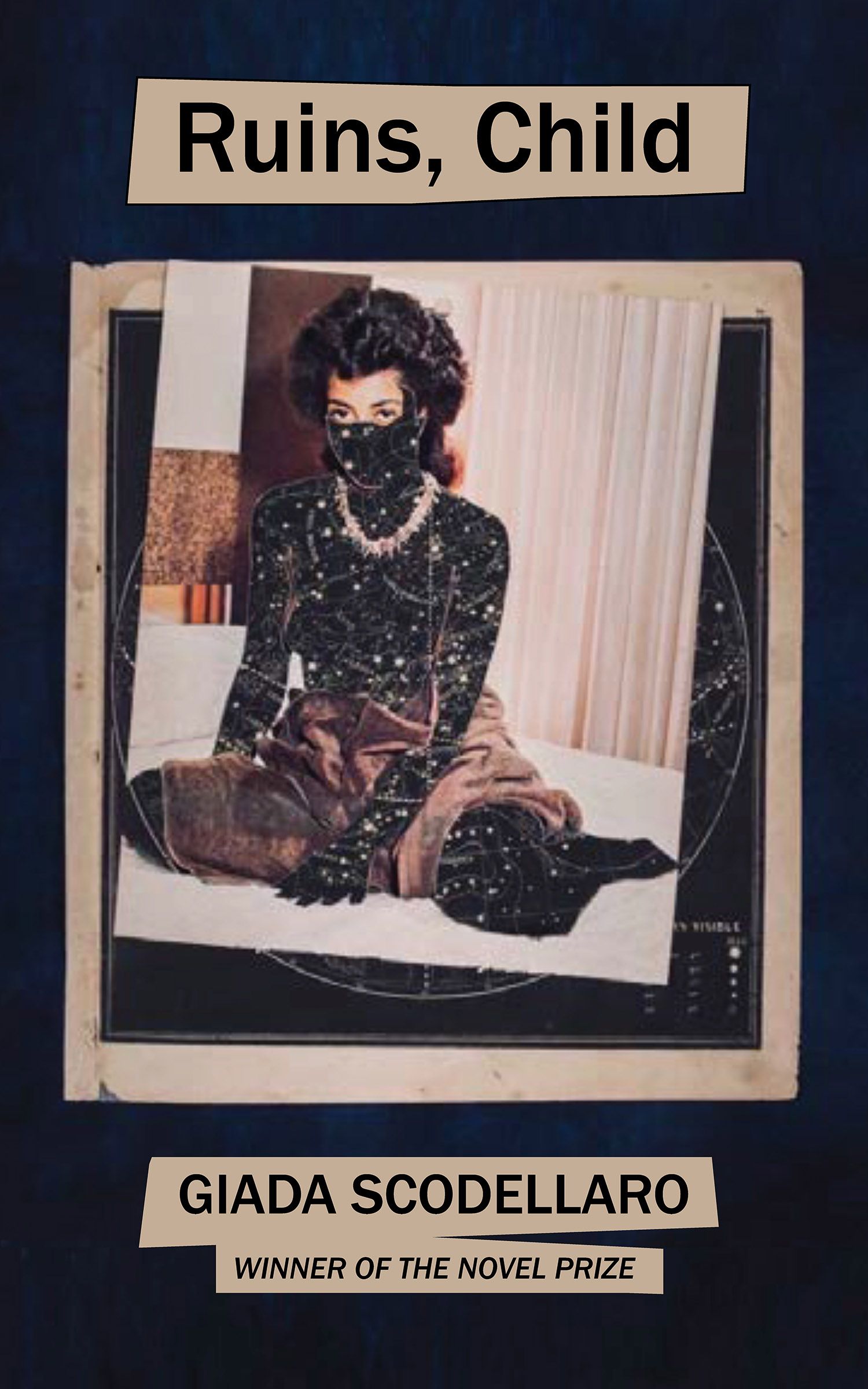
From Ruins, Child by Giada Scodellaro. Copyright © 2026 by Giada Scodellaro. Reprinted by permission of New Directions Publishing Corp.