It was still early, but the sun was already a battering ram against the earth. In protest, Ember kept the blinds closed as she measured coffee grounds, moving from shadow to beleaguered shadow. If only these pockets of darkness were a little wider, a little deeper, she would have happily fallen into one and been lost forever. But today would not allow such an easy departure. The light forced its way in, slicing past the shades in hot white ribbons that burned across the kitchen.
She stepped closer to the window and nudged the blind aside, pressing her forehead to the warming glass and contemplating this narrow view of Jerome’s garden, curious to see if she could name just one of his plants—but of course she couldn’t. This wasn’t her domain. The garden had grown riotous and leggy since she’d last looked. And when had that been exactly? A while ago. Months, probably. She remembered sprouts no bigger than a thumbnail, coming up through the freshly turned soil. Now she could barely see the dirt for all the sprawling growth that covered it.
Behind her, the kettle was beginning to hum. Ember hurried to take it off the flame before the whistle could gather itself and call out. She didn’t want to wake Jerome, who was still asleep upstairs, a dream rumbling in the back of his throat, legs tangled in the sheet. They’d had yet another argument the night before and she had neither patience nor desire to repair anything with him just now. Better that she slip out before he came down and they started up all over again. She was beginning to suspect that the fight was unwinnable, no matter how many times they had it. No point hurrying toward a resolution that was always receding. She poured hot water over the grounds and set the kettle back down as gently as she could.
The more pressing concern, in Ember’s mind at least, was that the sovereignty of her summer was this very moment coming to an end. She’d spent the past few months laboring over a half-finished manuscript in her attic study, forehead brushing against the sloping wall as she sat in curled concentration, and that work had kept her balanced. Kept her absorbed. But now a desolate school year, long and full of needs not her own, yawned.
Existential dread brought on by the start of the academic calendar was certainly not new to her (she’d been teaching for long enough to become well acquainted), but at that moment it felt almost unbearable. Without the long days spent working on her manuscript, there would be nowhere left to escape to—on the one side, the politicking of academia, which she had grown to despise, and on the other, Jerome’s constant grievances, which were wearing her down like the polish of fine sandpaper.
Running a hand over the back of her neck as if to sweep away the tension that hovered there, she took her coffee and sat on the sofa opposite the mostly covered window, where the bright, narrow swathe of Jerome’s garden peeked through. She should really meet the day and open the blinds, but she couldn’t bring herself to face the wattage just yet. Instead, she thought of the unfinished manuscript that would soon begin to gather dust, the chafe of her academic mantle that hung by the door, the frenetic shape of the hours that would follow this one, and felt defeated.
What irked her most was the foregone futility of the day. The first Monday of the term was always a throwaway. Classes would be spent reminding students which texts they needed and claiming she would try to remember their names, although she never did. Had no intention to. There would be inane small talk and paperwork and at least one reminder from Ya that the laureate committee was watching. She would endure it all, not gracefully exactly, but with the same measure of detached complacency she brought to the rest of her academic responsibilities. She took her first sip of coffee and immediately burned her tongue. At least the looseness of discomfort was made tangible now, defined by both taste and texture. She probed the roof of her mouth to find the edges of this new affliction.
Ember was not well-liked at the university. By anyone: students or faculty or administrators. And that was fine. It was her own fault; she recognized that. Her interest had never been teaching and she wasn’t able to hide her exasperation with the entire apparatus. For her, academia was only a means to a very particular end. A matter of rallying the power of an institution to her cause. She’d originally intended the job to be a brief interval while she assembled the money and the personnel necessary to pry open a new archaeological site. Because that was where she belonged—mid-excavation, dirt in every crease, bent in the service of discovery. The trouble was, this academic interlude of hers was creeping toward a decade now, threatening to become the entirety of her career. It had been eight years since her last dig. And still, no matter how many proposals she wrote, no matter how many grants she applied for, no matter how much university letterhead she used, the radical new project she had staked the sum of her professional credibility on was somehow no closer to fruition.
This is the year it all comes together, she thought, but it was a half-hearted refrain. She’d been telling herself this story for so long it had begun to seem more like a myth than a real possibility. Perhaps the time had come to face the fact that it would never come together. That all of this had been for nothing.
But no, she couldn’t bring herself to think that way either.
Turning away from the uncertainty of the near future, she thumbed the thick glaze of her coffee cup and wondered instead what this clumsy piece of pottery might look like in a century. In a few millennia. Anything to separate herself from the discomfort of now—a self-soothing exercise almost as old as she was, though lately its efficacy was beginning to deteriorate.
As a child, she had buried treasures in order to dig them up again: precious stones from her mother’s jewelry box, coins from the bowl of change they kept by the front door, spare keys. Each time she did this it was a revelation. She would insert some small piece of her present into the ground and when she returned to it, the object would be waiting for her, exactly where she had left it but irrevocably changed by the process. Crusted with dirt, marked by the evidence of however many days or weeks or sometimes years she had allowed it to remain hidden underground. Even after she washed these treasures and returned them to their rightful places, even when no one else could see the difference, she knew the objects had been profoundly altered. It was proof that history was both a thing to be found and a thing to be made, and the hubris of this realization marked her early. It stayed with her still.
She was startled by a knock at the door. Roused, she put the cup down and listened, thinking she must have misheard. She wasn’t expecting anyone, not at this hour. But she was already halfway out of her seat when the knock came again. She hurried to the foyer, anxious that whoever it was would knock a third time and wake Jerome after all her careful tiptoeing. She undid the bolt with a thud, and the volume made her wince.
“Yes?” she said, speaking quietly but not troubling herself to be polite. A young man she’d never seen before was standing there, shifting from one foot to the other, with ears so big she didn’t even notice his other features. Her eyes dropped to the envelope in his hands. The post never came this early, nor did it require a knock at the door. She caught the unmistakable scent of saltwater and fish guts, then noticed the sheen of his rubber boots and the grime on the laborer’s coveralls he wore. He was from the docks. Understanding stirred, a flutter in the very center of her chest.
“You’re Ember Agni?” the young man asked.
“I am.”
The letter he carried was from Ish. It had to be. The flutter became a pulse, spreading throughout her body. She reached for the envelope and her hand shook. Finally, she thought. It had been so long since he left she’d almost stopped expecting to hear from him.
“Brought this over myself. Fella said it was urgent.” He paused, turning the envelope over in his hands. Not relinquishing it. “Said payment on delivery.”
“How much?” She tried to keep the desperation out of her voice.
He quoted a sum and Ember hurried to riffle through the pockets of the jackets hanging in the foyer. She found the heaviness of Jerome’s wallet and all but emptied it.
The man counted the money, clearly wishing he’d asked for more. “Don’t have change.”
“It’s fine.” Ember reached again for the envelope. “Just—”
Sliding the cash into his pocket, he finally yielded his slight cargo with a shrug. As if what he carried didn’t matter. She was too dazed to be aggrieved by this carelessness. Balancing the letter on her fingertips, she drew a deep, stuttering inhale. Had her gamble on Ish paid off then?
“You brought it over from where did you say?” she asked, knowing full well he hadn’t said. “Which port?” But he was already taking a step back, eager to be done with this errand now that he’d been paid.
“You have a good morning,” he replied, and with that, clomped back down the steep hill toward the docks, his rubber boots squeaking as he went, taking the dead smells of the sea with him. The envelope all but vibrated in her hands. Once he was out of sight, she closed the door as quietly as she could.
In the darkened foyer, Ember contemplated this unassuming bit of paper, momentarily paralyzed by a mixture of dread and excitement stirred together, an overpowering sensation that oozed from the crown of her head, down the length of her body, then hardened, like a soft golden resin becoming solid. Sealed inside this shell of anticipation, she found that she could not bring herself to read it just yet. She wanted the multitude of possibilities to go on existing, and she knew that as soon as she opened it, only one would remain.
She brought the letter back to the sofa and set it down next to her coffee, which had begun to cool by now, a scrim of milk tightening across the surface. The envelope burned bright against the dark stone table. It was still slightly damp from its time at sea, corners worn down by rough hands and salted air. She considered making a little breakfast while she girded herself to read it, then glanced at the clock and realized there was no time for that. The day was racing past her now. She could either hide here at home, denying this momentum, or hurry forward to keep pace.
Upstairs, she heard the thump of Jerome’s feet hitting the floor. The creak of a hinge, the thrum of water running through the pipes. She didn’t want to be here when he came downstairs. One edge of the envelope’s flap was curling up, as if it might open itself were she to leave it unread for much longer. But, she reasoned, it had traveled such a long way to be here: on her table, in her home. Surely it could travel a little farther. She slotted it in among her other papers and left the coffee cup where it was.
*
On her way to the university, the city was still quiet. She rode her bicycle, leaning into the steepness of the road with more tenacity than usual, pressing the weight of her body down hard on the pedals as she climbed, not bothering to temper the loud gust of her own breath. Letting it be ragged and rough. She poured herself into the physicality of the effort. This last year or two she’d begun to feel these hills in her joints differently and assumed she just needed to push herself harder to reclaim the buoyant elasticity of the first half of her thirties. It had not yet occurred to her that at thirty-eight, her body might prefer another tactic.
By the time she got to campus, students were beginning to stir and the canteen staff was putting a few tables out on the grass. Night custodians were finishing up their rounds. Everyone moved in slow motion—or perhaps it only seemed that way because her heart was still racing. Ember went straight to her office, feeling the over-tight constriction of her satchel’s shoulder strap, banded by sweat where it cut across her chest.
The building wasn’t open yet, and so she used her key, slipping inside with the subtle movements of a thief. The hall was dim and still surprisingly cool despite the gathering heat outside. A familiar smell hit her, that particular combination of cleaning products and slate and chalk dust.
This again.
If she weren’t so intent on the letter, she would have been dismayed by the repetition: yet another first day. Another year to drag herself through. But this time change was near, hovering just beyond her field of vision. She was relieved to make it to her office without having to speak to anyone. The door was still papered with relics of last year—a finals announcement, assignment parameters, a list of office hours, and an assortment of other items her graduate assistant had posted. Cami had gone home for the summer, so here they remained, curled and yellowing after being shut away in the heat since May. As Ember brushed past to turn on the lamp, one of the sheets came unstuck and fluttered out into the hallway, caught in her slight draft. She left it there and kicked the door shut behind her.
Her office was small and windowless, as stifling as a tomb, but she didn’t have to share it anymore and that was an improvement. The other inhabitant (only a year since he’d gone and already she couldn’t recall if his name was Miller or Mills) hadn’t been invited back because there weren’t enough classes to go around for the non-laureates. Since his departure, Ember had been steadily filling his vacated space with deep snowdrifts of looseleaf paper, towers of overdue library books, and no fewer than a dozen dirty mugs, the tea bags as desiccated as mummies. All this clutter was welcome evidence of time passing, of her avid scholarship, and of a noble disinterest in washing dishes. But maybe most importantly, her reclamation of the vacated space was a way to forget that the discipline of archaeology had fallen on hard times.
It wasn’t that the department’s stature had ever been particularly esteemed, but lately, its presence on campus seemed to have more to do with being gradually forgotten than being allowed to remain. Enrollment was down, budgets were anemic. And truth be told, archaeology’s problems traveled far beyond the university. No one was funding new digs anymore, and even established projects were sputtering in the face of withdrawn endowments and unrenewed permits. Academic journals struggled to put out issues, stifled by high printing costs and staff layoffs, scrounging for enough articles to fill their pages and paying subscribers to read them. There was a pervasive sense of cultural apathy regarding the study of the past that was growing stronger by the minute, as if the world had already accrued the maximum knowledge of prior civilizations and required nothing further in order to barrel onward into the future.
But Ember was committed to not thinking about any of this. Especially not now. She sat at her desk, inside the yellow circle cast by the lamp, still holding her bag. She couldn’t seem to set it down, nor could she open it. The blank walls stared at her, vacant pinholes made by previous tenants peering down like dark, shrunken pupils. For all the accumulated clutter of her surfaces, she hadn’t bothered putting anything up on the walls. It hadn’t even occurred to her.
Eventually she undid the buckle of her satchel and carefully extracted the envelope, as if it were in danger of disintegrating. Now that she had it in her hands again, it seemed larger. Thicker. The chaos of possibilities rushed back and forth between the narrow confines of her skull, colliding in time with the beat of her heart, pounding out a rhythm she could both feel and hear. She brandished her letter opener as if it were a scalpel. But before she could apply its blade, a key turned in the lock.
Cami made a small exclamation as she opened the door and saw that Ember was already here. “I’m so sorry, Professor. I should have knocked. I didn’t think you’d be in this early.”
“It’s fine,” Ember said, visibly annoyed by the intrusion. “What do you need?”
“I just came by for the fall course paperwork. I checked on Friday night, but I didn’t see any forms.”
“The…” Ember had no idea what she was talking about. “Course paperwork? For the fall semester.”
It came to her—the forms Cami had given her during their preterm check-in the previous week. Loath to return to campus a single day sooner than she had to, Ember had suggested they meet in the city and named a café at the edge of the market district nearest her home: a microscopic establishment with nowhere to sit, only a long, thin bar right on the sidewalk where a customer might lean an elbow and sip a drink between errands. Ember had chosen the place with impermanence in mind. She didn’t want to give the suggestion that the two of them would be there long. Propped against this narrow counter, with a steady stream of market-goers filling the street, Cami had passed her a sheaf of forms to sign and Ember, already impatient, promised to leave them on her desk before the weekend, then slotted them into her bag and immediately forgot. Which meant they would be somewhere in the proximity of—
She set the envelope aside and riffled through the already-open cavity of her satchel. “You mean these?”
Cami nodded. Distracted and wanting to be left alone, Ember tried to hand them over. Cami squinted at the top page.
“Those are the forms, but I’m sorry. Could you…sign them?” It clearly pained her to make the request.
“Right. Of course.” Ember took out a pen, then paused over the details. She hadn’t even glanced at them until now and was suddenly struck by the fact that it would have been so much easier to just deal with the forms when Cami had brought them to her. And yet—Ember was somehow forever making everything much harder than it needed to be. “I didn’t realize I was teaching two sections of the introductory seminar. Where’s my advanced section?”
“Not enough new graduates.”
“Not enough—” Ember didn’t bother finishing her sentence, realizing that her outrage was wasted on Cami. “Fine.”
Cami opened her mouth to speak, probably on the cusp of apologizing for yet another thing that wasn’t her fault but remembering just in time how deeply Ember disliked self-effacement.
“And the extra intro seminar?”
Cami gave a helpless shrug and Ember understood that another lecturer had gone the way of her old office-mate. She tapped her pen a few times, weighing how much she disliked first years against the optics of objecting. Given that it was her turn to serve as the faculty Leadership liaison, a rotating post that she was many years overdue to endure, it would be problematic to request diminishing her own responsibilities right out of the gate. Not that Ya, who led the department, would allow it. No, better to acquiesce and play the hand she’d been dealt.
Besides, there was the laureate committee’s vote to think about. Ember signed. “That’s it?” she asked.
“That’s it.” Cami collected the forms from her and secreted them away in an enormous accordion-shaped briefcase with a practiced flick through her files. Cami was an archive unto herself, always carrying the relevant document. It was magnificent, really, how thoroughly resourced the girl was. In some loose way, Ember was aware of how lucky she was to have a graduate assistant like Cami, but she had learned to maintain a healthy measure of separation in these matters. Graduate assistants came and went—they were not her friends, and they were not quite her colleagues either. More than students, less than employees. Since Ish (perhaps because of Ish), Ember found she knew less and less how to effectively manage these kinds of relationships. How much familiarity was too much? Or too little?
“I’ll get out of your hair.” Cami secured her walking archive with a sturdy brass clasp and slung the bag over her shoulder.
“Actually. Before you go. Is it terrible to ask you for a coffee?” Ember immediately knew that it was, and also saw that Cami was too soft to protest. She looked especially young today, her limp brown hair hanging across her face like a curtain. By the time she tucked it back behind an ear, her features were carefully arranged into an accommodating smile. Ember squinted at her. Surely there was something more beneath all this mild pleasantness, some edge of resentment, a few shards of indignation on the brink of cutting through. But she couldn’t find it.
“Not at all,” Cami said, as agreeable as ever. “It’ll be a long day for you, I get it. Milk, no sugar, right?”
Ember nodded, both impressed and exasperated that Cami had found it worthwhile to retain not only Ember’s fall term paperwork but also her coffee order. Then again, hadn’t Ember also succumbed to inappropriate requests when she was younger? Hadn’t she also been at the mercy of supervisors who held her job prospects in their sun-spotted hands? “I’m not sure I would survive without you,” she said, not meaning it but attempting to convey appreciation.
“I’m certain you would.” Was there the flicker of a tone? Ember wasn’t sure, and by the time she caught it, Cami had already slipped out into the hallway, now bright with overhead lights burning and dense with footsteps, conversations, laughter. The door clicked shut behind her. Across campus, the bell began to chime the hour.
If Ember could get away with cutting that fucking thing down, she would.
Taking out her calendar, she quickly penciled in the schedule she’d just approved for the coming week. Watching the meditative white sprawl of the next few days fill with her own cramped handwriting, she felt immediately overwhelmed. She wasn’t even prepared for her first class yet. She had intended to spend the morning planning the day’s lectures, but already that time had somehow escaped her. And still, she had not managed to open Ish’s letter.
The scarcity of hours caught her by the throat. For a woman so comfortable thinking in epochs, it was the more human units of time that tended to overtake her. She looked again at the unopened envelope as she listened to the last bell echo: that rich brass peal blooming over the entire campus, lamenting the close of one hour and marking the opening of the next, trapping them all under its sonorous reminder that the minutes would keep ticking past at the same rate, no matter how well they were used.
If she was quick about it, there might still be time. She reached for the letter, finding the softened paper with her fingers, and then there was Cami again, returning with a steaming mug.
Cami extended it to her, handle first. “I was wondering…” “Yes?”
“My dissertation. If you had a moment. I’ve got an idea for the next chapter that I wanted to run past you. I may have mentioned it back in June? And I’ve made some progress over the summer.”
“Oh, I’m not sure that I have time to—”
“It would only take a minute. I could really use an outside per-spective. And you have such expertise with the fieldwork aspect. I’m using the Summit dig as a case study, so it’s right up your alley.” Cami selected a few papers from her archive without waiting for an answer and then looked pointedly at the mug in Ember’s hand. “How is it? Not too much milk?”
It occurred to Ember that for a young woman who emanated pure guilelessness, Cami was, in fact, rather cunning. She sipped her coffee, perfectly made, and understood that such a brazen misuse of graduate labor had cost her these last few moments of freedom.
“No, no, it’s perfect,” Ember said with a sigh, dropping the envelope back into her bag. “Go on, then.”
Cami launched into her conundrum while Ember half listened, nodding often to disguise her own distraction. It was fine, she told herself. A few more hours would make no difference to Ish, wherever he was. Soon. She would open it soon.
__________________________________
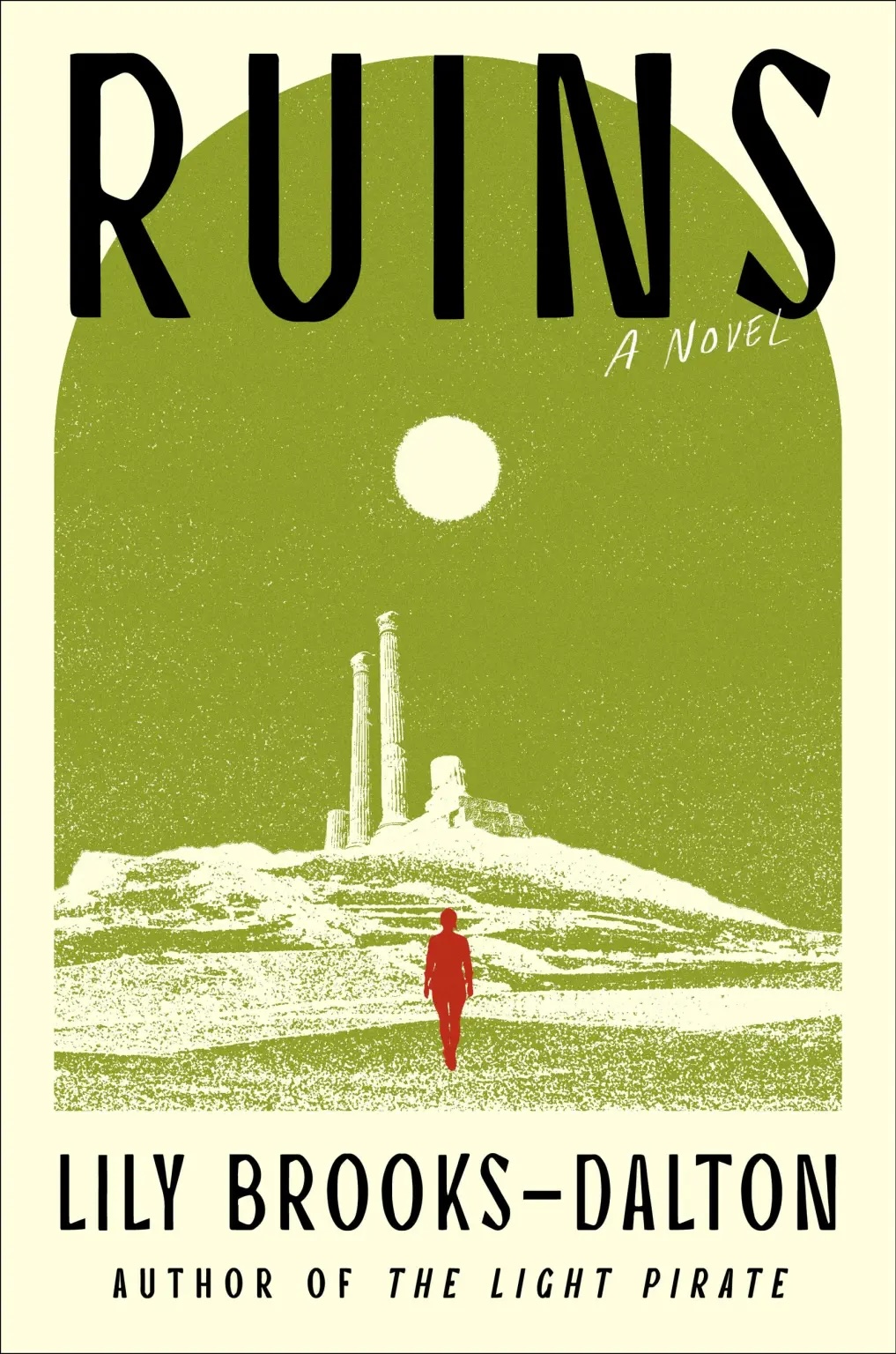
From Ruins by Lily Brooks-Dalton. Used with permission of the publisher, Grand Central Publishing. Copyright © 2026 by Lily Brooks-Dalton.