Robert Morgan on Reading War and Peace For the First Time
“I saw that the Blue Ridge Mountains were everywhere, and that the gift of fiction was to connect me to everybody.”
The fall of 1958 was the last time we grew sorghum cane and made our own molasses on our small farm in the Blue Ridge Mountains. After school, I worked long hours cutting and stripping the stalks, then feeding them into the mill while Daddy and Uncle Abe boiled the molasses syrup over the furnace. The sweet steam mixed with the sour smell of leaves in ditches and marshy places along the creek. I had been reading Charles Dickens, and I was thinking of pickpockets and back alleys of London. I was also thinking of tramping the woods with my squirrel rifle. I was looking forward to high school, and I had a sense my world was about to change.
In the fall of 1958 my eyes, searching through the shelves of the bookmobile parked at the Green River Baptist Church, fell on a book in maroon cloth with War and Peace stamped in gold on the spine. It was the thickest tome I’d ever seen, except for the Bible and the dictionary. I lifted it off the shelf and felt the weight, the substance of it. I had seen War and Peace advertised in the Sears & Roebuck catalogue as “the greatest novel ever written.” It was the book I had been looking for.
Once I started War and Peace, I knew this was a different kind of novel from any I had read before….It was a story of insight as well as action.
I don’t ever remember being without books. We didn’t have enough money to buy a car or truck or tractor, and we had to borrow a horse for farming, but we had a few novels and history books and copies of National Geographic on the mantel. Some religious tracts and pamphlets had been sent by radio preachers after Mama or Daddy had mailed them a dollar. There was a big dictionary that my great-grandpa must have bought, along with a few other books that were in boxes in the attic, when he wagoned hams and produce and sourwood honey down to Greenville, South Carolina, or Augusta, Georgia, in the days before the railroad reached into the mountains.
The Bible was the book grown-ups talked about most in our house. Daddy and my grandpa argued constantly about which prophecies had been fulfilled.
“I figure Stalin is the anti-Christ,” my grandpa said.
“Hitler was the anti-Christ,” Daddy said, “And I figure the Rapture will come by the end of this century.”
“It says the world will end in fire,” my grandpa said. “I reckon Stalin will blow it up with the A-bomb.”
When my sister and I were little, Mama and Daddy read to us every night by the fireplace. They read from the Bible and from a book of children’s stories that included No Penny and The Little Red Hen. The year before I was to begin school, Mama bought a primer and taught me to read about Dick and Jane and Sally, and their dog Spot. I was impressed that their daddy left every morning for work in his Sunday suit.
When I began school, I was bored because I already knew how to read and write and count. As a result, I wasted my time daydreaming or teasing the other students. There was no library at Tuxedo Elementary School, but there was a small shelf of books at the back of each classroom in grades four and above. When I reached the fourth grade, I started checking out books and reading one each day. I read Old Yeller and The Yearling. I read the Hardy Boys books, and I found it hard to believe there were so many stories in the world.
There had been a lot of talk lately about “beating the Russians.” In the aftermath of the first Sputnik, we had been told by our teachers that it was our duty to study science and math to help the Free World compete with Soviet Communism. I took the exhortation seriously and knew that I would study engineering or physics someday if I could get a scholarship. But already, secretly, I was thinking of other ambitions. I had begun taking piano lessons, and practiced Mozart and Bach on the piano for longer and longer hours. I wrote poems and stories in my school notebook.
But once I got Tolstoy’s big novel in my hands, I seemed to think of nothing else that fall. I did not have a reading lamp, so I read sitting on my bed in the light of one overhead bulb. Once I started War and Peace, I knew this was a different kind of novel from any I had read before. It was a story about people, and the minds of people, but also about history and the logic of history. It had to be read slowly, and it rewarded the reader sentence-by-sentence and paragraph-by-paragraph, and not just through the unfolding of the plot. It was a story of insight as well as action.
The novel had a different pace and scale. Some scenes were in ballrooms and drawing rooms, and the characters included counts and princesses and army officers. But the details were so vivid and real I felt intimate with the Imperial world spread out so slowly and thoroughly:
The young Princess Bolkonsky had come with her work in a gold-embroidered velvet bag. Her pretty little upper lip faintly darkened with down, was very short over her teeth, but was all the more charming when it was at times drawn down to meet the lower lip. As is always the case with perfectly charming women, her defect—the shortness of the lip and the half-opened mouth—seemed her peculiar, her characteristic beauty.
Each day that fall I could hardly wait to get the cows milked, and the corn shelled for the chickens, so I could run back to read about the Bolkonsky estate outside Moscow, or the party where Pierre ties a policeman on the back of a bear. Sitting in the cold bedroom with only the dim light above me, with rain tapping on the oak trees outside, I wandered over the Napoleonic battlefield with Pierre, among the confusion and carnage.
We are told that before Tolstoy and Stendhal, all portraits of war had been heroic: Homer and Vergil, Milton and Tasso. But Tolstoy showed us the panic and disorientation, the helplessness of the individual in battle. The sarcastic portrait of Napoleon is a kind of comic relief, balancing the sympathy for Pierre, Prince Andrey, the young Rostov. One of the passages I have never forgotten is the vision of the deep blue sky above the battlefield that Prince Andrey sees when he is wounded:
Above him there was nothing but sky—the lofty sky, not clear but still immensely lofty, with gray clouds creeping quietly over it. ‘How quietly, peacefully and triumphantly, and not like us running, shouting, and fighting, not like the Frenchman and artilleryman dragging the mop from one another with frightened and frantic faces, how differently are those clouds creeping over that lofty, limitless sky. How was it I did not see that lofty sky before?’
The greatest writers never lose sight of eternity, it has been said, no matter how loud or twisted the events in the foreground. Tolstoy’s ability to describe life in drawing rooms and country houses, city clubs and army barracks and headquarters, answered a hunger I had not known I had about how the world works, or had worked. His society women, politicians and generals, rakes and spongers, were more real to me than most of the people I saw every day in Green River.
The essay chapters on history and destiny—the very passages that more mature readers often skip over—were among those that stirred me most profoundly. Even so, I was unprepared for anything as romantic as the scene where Prince Andrey hears Natasha at her window in the moonlight:
She was evidently leaning right out of the window, for he could hear the rustle of her garments and even her breathing. All was hushed and stonily still, like the moon and its lights and shadows. Prince Andrey dared not stir for fear of betraying his unintentional presence: ‘Sonya! Sonya’ he heard the first voice again. ‘Oh how can you sleep! Do look how exquisite! Oh, how exquisite! Do wake up, Sonya!’ she said, almost with tears in her voice. ‘Do you know such an exquisite night has never, never been before?’
As I chopped wood or picked corn in the cool October afternoons, I was really thinking of Natasha and Sonya, of the down on the little princess’s upper lip, of old Prince Bolkonsky working at his lathe, and of the exhilarating hunt over the steppes that lasted all day. Each afternoon and weekend that fall I hoped it would rain, so I could stay in my room and read. Sometimes I rested my eyes by practicing on the old piano. But mostly I sat cross-legged on the bed reading Tolstoy in the gray light of our house in the woods. The best part of the story was still to come.
Reading War and Peace suggested to me that I did not live just in the Green River valley, in the Blue Ridge Mountains, but in the world, in the stream of history.
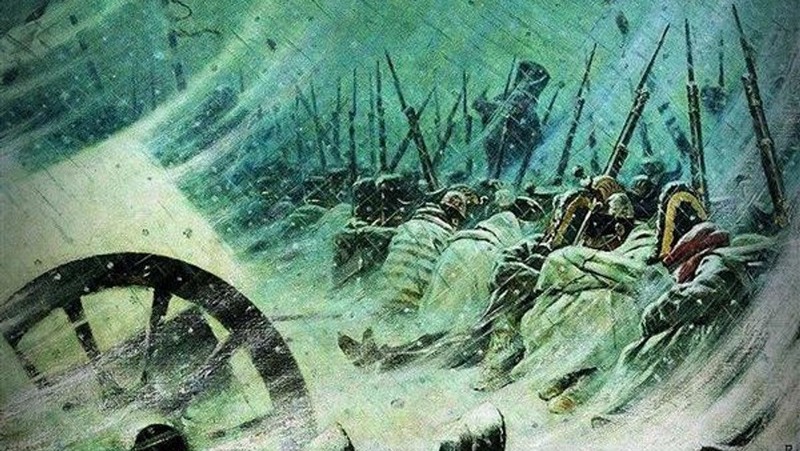
Near the end of the novel, while Pierre is being led away as a prisoner of the French as they flee Russia, he comes to know a fellow prisoner, an old peasant named Platon Karataev. Even as they are cold and hungry and force-marched day after day, the old man never loses his liveliness and friendliness. The reader shares Pierre’s wonder at the old peasant’s resilience. Platon Karataev is a kind of philosopher; he encourages Pierre to see meaning in the simple details of his life, in eating and sleeping and talking, in the living of life day by day. Pierre has spent his previous years searching for meaning and self-knowledge:
He had sought for it in philanthropy, in freemasonry, in the dissipations of society, in wine, in heroic feats of self-sacrifice, in his romantic love for Natasha; he had sought it by the path of thought; and all his researches and all his efforts had failed him. And now without any thought of his own, he had gained that peace and that harmony with himself simply through the horror of death, through hardships, through what he had seen in Karataev. Pierre recognized the truth of the main idea. The absence of suffering, the satisfaction of needs, and following upon that, freedom in the choice of occupation, that is of one’s manner of life, seemed to Pierre the highest and most certain happiness of man. Only here and now for the first time in his life Pierre fully appreciated the enjoyment of eating when he was hungry, of drinking when he was thirsty, of sleep when he was sleepy, of warmth when he was cold, of talking to a fellow creature when he wanted to talk and to hear men’s voices.
This seemed like the best wisdom I had encountered at the age of 14. It still does to the 51-year-old reader today.
In the concluding section of the book, Tolstoy shows us the married couples, Pierre and Natasha, Nicolay and Marya, long after the Napoleonic wars are over. They are raising their families, looking after their estates, worrying about the details of their households. These chapters reinforce the insight of the old peasant, that the meaning of things is in the living of our lives day by day. Still, Pierre is not satisfied. He wants to do more. He would like to influence the reform of society: “All my idea really is that if vicious people are united and form a power, honest men must do the same. It is so simple, you see.”
Reading War and Peace suggested to me that I did not live just in the Green River valley, in the Blue Ridge Mountains, but in the world, in the stream of history, and my thoughts and ambitions were much like those of people everywhere. I saw that the Blue Ridge Mountains were everywhere, and that the gift of fiction was to connect me to everybody.
__________________________________
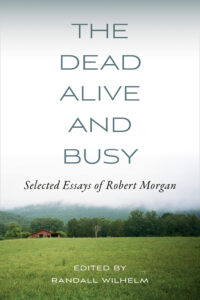
From The Dead Alive and Busy: Selected Essays of Robert Morgan, edited by Randall Wilhelm. Copyright © 2026. Available from University of Tennessee Press.

Robert Morgan
Robert Morgan is the author of several books of poems, most recently Terroir (2011) and Dark Energy (2015). He has published a dozen works of fiction, including the New York Times bestseller Gap Creek (1999). Among his nonfiction books are the national bestseller Boone: A Biography (2007) and Fallen Angel: The Life of Edgar Allan Poe (2023). He has been awarded a Guggenheim Fellowship and an Academy Award from the American Academy of Arts and Letters. A native of western North Carolina, he is currently Kappa Alpha Professor of English (Emeritus) at Cornell University.