







The grandfather looks out at the sky and the bright red earth. He instinctively raises the back of his hand to his brow to wipe away a few beads of sweat. The heat, which came early this year, will linger well past dusk today. He breathes in and out slowly, as if trying to reproduce the rhythm of the landscape. The mountains around him are dotted with argan, carob, and olive trees as well as tufts of thyme and cypress. He knows he should go home, that the mosquitos will begin to target his arms and ankles soon, that Anir is waiting for him. And so is she.
Is she, though?
Like the mountains, she has seemed indifferent to everything and everyone since that night. Every time he thinks about her, he sighs and an image reappears: the mother and child. . . . No, don’t think about that, he tells himself. Just marvel at the sky, the ground, the trees. Give in to the inescapable urge to dissolve into the sand and light.
The air here is so stifling that he can’t even hear the leaves rustle as the birds hunt for a tree to roost in. His face is relaxed, his features at rest, his mouth and eyelids closed. Dusk has always been his favorite time of day.
The old man opens his eyes and bares his white teeth. He knows they’re coming and doesn’t want to miss them.
He enjoys watching them return to the Saint’s Apiary after hours of work. Drunk on pollen and nectar, the bees retreat to their hives for the night, carefully and methodically, as if driven by a higher intelligence, an anonymous architect, or pure chance. Not so long ago, every family in Inzerki had its own compartments in the apiary. It once housed the hives of every beekeeper in the region, handed down from father to son. Still more apiculturists would come for weeks or months at a time as part of a transhumance tradition, so their bees could spend the bloom season in the area. The grandfather remembers that, when he was young, every hive was home to thousands of bees, and their constant drone could be heard for miles around the village. Suddenly his smile disappears, and just before he stands, he mumbles, to the bees or perhaps to no one in particular, “The flowers are almost gone now.” He gets to his feet and scans the sides of the mountain, which the darkness will soon swallow. This year he plans to keep his promise to teach his grandson everything he knows about honey and the Saint’s Apiary. He closes his eyes and savors the drone of the bees for a moment longer.
“When I was Anir’s age, their music filled the whole valley.”
She has never liked dusk. Night arrives in its wake, drowning out colors and the landscape at her window—her only tie to the outside world. Anir knows how she feels. He’s noticed that at dusk she always cowers at the far end of the room near the only chair and that her big eyes grow even darker as they stare, unmoving, at the last sliver of light fighting—and soon failing—to hold back the night. Every evening it’s as though she’s forgotten the sun will return. When the sky turns pink and blackness begins to swallow up the blue, she whimpers and even screams, and Anir starts to hate dusk too. He forgets the way pink, orange, and yellow intermingle with blue for an instant before night falls. He forgets that he’ll marvel at the stars that appear in the sky, and that once he’s in bed, he’ll enjoy the nocturnal silence, broken only by the sound of the little donkey braying at regular intervals, as if to rock him to sleep and ferry him to the shores of slumber. When he sees his mother’s face paralyzed by the ravenous darkness, when she clenches her jaw and bites her lips so hard a trickle of blood drips down her chin, when her anxiety crushes him so completely that he can’t breathe anymore, he forgets what he likes and what he doesn’t; he wants to run to her and curl up at her side. But in these moments, his mother no longer recognizes him.
Anir has remained glued to the door, his left hand gripping the handle as if clinging to something solid might keep him from faltering. When he finally tears his gaze from her face, his free hand places a plate of bread, olive oil, and honey on the floor near the entrance to the room.
Then he closes the door without a sound. Now that the door is shut, now that he’s free of the sight of his mother, air fills his lungs. After several deep breaths, he manages at last to dislodge the huge, burning knot from his throat and the pit of his stomach.
__________________________________
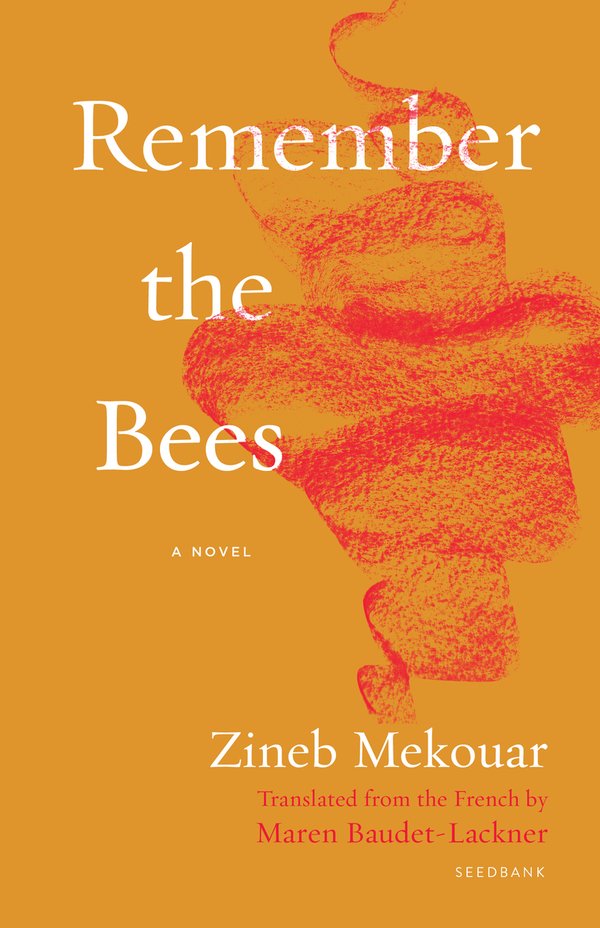
From Remember the Bees by Zineb Mekouar, translated by Maren Baudet-Lackner. Used with permission of the publisher, Milkweed Editions. Copyright © 2026.