Reconsidering Mary McCarthy’s Iconic Friendship Novel The Group
Rebecca Chace on How McCarthy’s Book Influenced Her Own Work
Just after my novel, Talking to the Wolf, was accepted for publication, I picked up Mary McCarthy’s novel, The Group for the first time. In my own novel, a friend breakup and untimely death changes everything for four women. These lifelong friends are heading to their 35th high school reunion dragging the overstuffed, invisible suitcases of middle age—including the ghost. I had heard of The Group before – wasn’t it best known for shocking sex scenes among the New York elite? While there were some parallels with the novel I had just written, I really grabbed a copy of The Group hoping for some titillation. But I was utterly absorbed by McCarthy’s biting social commentary that mocks and elevates the bonds within her “Group” of friends, Vassar class of 1933.
The Group, published in 1963, tells the story of eight college friends who move to New York City after graduation determined to be “modern women.” Published the same year that Betty Friedan’s The Feminine Mystique exploded images of the post-war housewife, The Group asked uncomfortable questions of its middle-aged readers. What were the costs of being a smart, educated, ambitious woman in a culture that had not yet invented the term “Second-Wave Feminism”?
In 1963, the country was still reeling from the fever dream of the House on Un-American Activities Committee. There was a burgeoning civil rights movement and an expanding “conflict” in Vietnam. On November 22, three months after The Group was published, a decade of assassinations began in Dallas.
McCarthy herself was influenced by the popularity of the communist party in New York intellectual circles.
The novel was a scandalous bestseller, optioned for a film directed by Sidney Lumet. Like much of McCarthy’s fiction, the novel was highly autobiographical. McCarthy said that she was “putting real plums in an imaginary cake.” The plums were not pleased. As a “real life” member of the Group remarked acidly in a 1964 article in the San Francisco Chronicle, “I wouldn’t be surprised if the sex lives, at least, were Mary’s own.” Another Group member said, “What impressed us during our college years was that we were living in an age when brains and knowledge were being drafted to solve the nation’s problems. And who has more brains than a Vassar girl? We felt we were terribly important to the world.”
This naïve imperiousness was both shared and skewered by McCarthy, an orphan from the west coast who landed at Vassar without a trust fund. “She was exciting and terrifying,” a classmate described McCarthy in the same article, “with her skinny figure, her racing around in flats, her verbal performances in class.’ Another one added, “We were afraid of her brains.” Perhaps they should have been.
McCarthy was still drafting the novel at the time of her 1962 Paris Review “Art of Fiction” interview with Elisabeth Sifton. “It’s a novel about the idea of progress, really . . .” she said. “It’s supposed to be the history of the loss of faith in progress, in the idea of progress, during that twenty-year period.”
On publication, McCarthy’s ambitious sociopolitical agenda was mostly overwhelmed by her witty, ironic tone. As one Group member observes another at the wedding breakfast that opens the novel, “She stared sadly at Pokey Prothero, her best friend, who was sitting sprawled out, across the table, putting ashes into her plate of melting ice cream and soggy cake with the very bad table manners that only the very rich can afford.”
The “Vassar Girls” of McCarthy’s novel graduated into Depression era New York City, when FDR’s New Deal was decried as a socialist experiment by conservatives. Left-leaning intellectuals embraced Communism with an idealism uninformed by—or disbelieving—the rumors of Stalin’s purges. McCarthy herself was influenced by the popularity of the communist party in New York intellectual circles. She wrote for the influential Stalinist—later, anti-Stalinist—literary magazine, the Partisan Review and had an affair with one of the founders she considered a mentor, Philip Rahv. “I even marched in May Day parades,” she said. “And I remained, as the Partisan Review boys said, absolutely bourgeois throughout.”
Despite their parents’ expectations of them to move from graduation into marriage and children, what struck me was that the Group’s loyalties, though often strained, are primarily to each other.
New York intellectual elites of her generation were mostly male, and McCarthy was one of the few women published regularly in the Partisan Review, and The New York Review of Books. In an era when female intellectuals had to fight hard to be taken seriously, the commercial success McCarthy achieved with The Group, she later said, “ruined her life.”
The novel was attacked not only by Norman Mailer (big surprise), but by her “Frenemy” Elizabeth Hardwick, who called it an “awful, fatuous superficial book” and published a cruel parody of the novel in The New York Review, “The Gang.” Hardwick used a pseudonym, but McCarthy (and everyone else) knew exactly who had written it. Their friendship survived, but the tension between envy and loyalty amongst the “Vassar Girls” portrayed by McCarthy hadn’t changed much over the decades. It’s tough to be allies when you’re fighting for the same, male-dominated turf.
In the 1930s, members of the liberal minded “Group” encountered domestic violence and sexual assault, along with intense pressure to quit their post-college jobs to marry and have children. Nearly all are unhappily married by the end of the novel. Kay, McCarthy’s most autobiographical character, almost certainly commits suicide. Her unconventional “bohemian” marriage right out of college opens the novel; her funeral, arranged and managed by the Group, closes it. Despite their parents’ expectations of them to move from graduation into marriage and children, what struck me was that the Group’s loyalties, though often strained, are primarily to each other. There are lovers, husbands, mothers and fathers, but even the most conventional of these friends remain primarily invested in these relationships decades before the “Bechdel Test.”
The only member of the Group who escapes the trap of societal expectations is Lakey. Charismatic and glamorous, Lakey leaves for Europe right after graduation, returning only when forced to by the fall of France. She is accompanied on her travels by a wealthy baroness, whom the other women come to understand is her lover. After recovering from their initial shock, her friends mostly accept this arrangement, and Lakey is given the last scene in the book.
When Kay’s ex-husband, Harald, arrives uninvited to her funeral, he asks Lakey for a ride to the cemetery. In the car, he asks about her relationship with Kay, “did you sleep with her?” (italics McCarthy’s) Lakey only smiles, “like a lizard.” Her silence is revenge upon the man the Group holds responsible for Kay’s death.
As expected, Harald attacks Lakey with all of his specious assumptions. ‘“You’re a coward,” Harald said, “to spread your slime on a dead girl.”’ He continues, ‘“You’ve never used your mind except to acquire sterile knowledge. You’re a museum parasite. You have no part of America! Let me out!’
‘You want to get out of the car?’ said Lakey.
‘Yes,’ said Harald. ‘You bury her. You and the ‘group.’”
Our last glimpse of Harald is him standing by the side of the road, trying to hitch a ride back to the city as Lakey speeds serenely on toward the cemetery in her roadster.
We don’t have to agree about sex, politics, money, or the relentless pace of late-stage capitalism. But we’d be wise to keep our difficult dearests in the passenger seat as we speed toward a future which is, as McCarthy knew, far from serene.
Recently, I was surprised when I was turned down for an event at an elite women’s club because the language and content of my novel were seen as “too strong.” Sex is one of many things the characters in my novel experience, discuss, and obsess about, like the women in The Group. They swear, and sometimes drink too much at a party. I didn’t expect any of this to shock adult readers. The comrades might accuse the book of being too bourgeois. Perhaps some of the ladies will secretly read my novel under the covers with a flashlight.
__________________________________
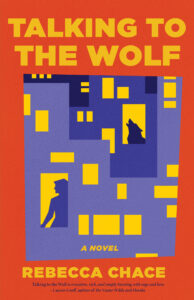
Talking to the Wolf by Rebecca Chace is available from Red Hen Press.

Rebecca Chace
Rebecca Chace is the author of two novels, a memoir, and a book for middle-grade readers. Her third novel, Talking to the Wolf, is forthcoming from Red Hen Press in 2026. She is also a playwright, screenwriter, and a regular contributor to The New York Times. Her work has appeared in The Yale Review, LA Review of Books, Guernica, Lit Hub, Bookpost, and many other publications. Fellowships include Civitella Ranieri, MacDowell, Yaddo, Dora Maar House, American Academy in Rome (visiting artist), Virginia Center for the Creative Arts, and others. She is a Faculty Associate at the Institute for Writing and Thinking, Bard College.