Printers’ Fists, Palaces, and Pavese Stone: New Poetry Coming in March
Rebecca Morgan Frank Recommends Andrés Cerpa, Monica Ferrell, Melissa Range, and More
By the time this column drops, you may still be shoveling snow to even get to your local bookstore, or maybe, like me, you are headed to Baltimore for the Association of Writers and Writing Programs (AWP) Conference where you’ll find most of these books at the book fair. In my January column, which previewed twenty-one 2026 titles, I covered a handful of notable March titles, including new books by Camille T. Dungy, Aimee Nezhukumatathil, Joan Naviyuk Kane, and Isabel Neal, the latest Yale Younger Poets Prize recipient. You may already have on your radar Maggie Smith’s sure to be popular A Suit or a Suitcase, which drops this month, too, as does The Vineyard, by FSG’s Jonathan Galassi (Knopf), and Joshua Bennett’s We (The People of the United States) (Penguin Books). Upstart JackLeg Press’s line-up includes Genevieve DeGuzman’s Karaoke at the End of the World. Then there’s the newest from Andrea Cohen, Sugar, one in a stack of Four Way Books offerings that includes a new collection from Maggie Dietz, If You Would Tell Me. Also on my to-read list are R.A. Villanueva’s A Holy Dread (Alice James Books) and Carolina Ebeid’s Hide (Graywolf.)
The list goes on! There’s still plenty of poetry, and we are on the edge of spring, amidst all other unrest and bad news. Wherever we are, happy reading.
*

Andrés Cerpa, The Palace (Alice James Books)
“Memory is a dead animal lost in its grandeur. A wolf split & howling. / A hawk as small as a leaf.” Andrés Cerpa’s elegant mythic constructions reach their heights in this third collection from “Diaspora Poem[s]”– “She is dead but I am playing dominoes with my Abuela in her kitchen / when she loses the past tense / completely”– to “Delphi”- “[t]he horses starved then came back as snow, / dementia, fire, rings on the trees.” Whether through the particulars–“the motion of men on pullup bars / by the sea” –or the grand gestures: “When I was a child, god held a blue butterfly knife / to my jaw–/ he begged me remember, he begged me / to sing,” Cerpa captures a longing that’s both material and more than this world, and we never have to choose which side he’s landing on. “If I could choose my own story,” the speaker says, “The conifers of heaven / would exist in my chest. / But every mattress dollar / my wife and I save / never seems to be enough.”
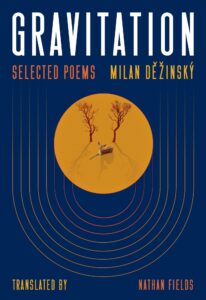
Milan Děžinský, Gravitation: Selected Poems (University of Pittsburgh Press)
Nathan Fields’ translations of Milan Děžinský from the Czech sample from three of the award-winning poet’s eight collections. The image is the engine of these poems: “The skeleton in the boy bounces upon the swing, / And when it’s all the way up, / I see his two eyes: two infinitely deep holes in a skull.” Or narrowing in for “Night Swimmer,” “He takes his first stroke and his pale wrinkled tip / flashes under the water like the embryo of a star.” Despite the James Wright allusions – “The branch bent but did not break”– in Děžinský’s hands, the image is more distanced eye than experiential; this is all perspective: “When I spotted the dead guy I felt like when / they bring you in and take the blindfold off your eyes.” Even Děžinský’s title poem’s tumbles via chiasmus are driven by the act of looking itself, right from the opening image: “They’re having a picnic, but it looks as / if they were taking the tools out of the car in an emergency, / or they are taking the tools out of the car, but it looks as if they were going out on a picnic.”
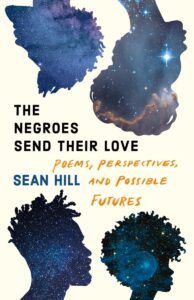
Sean Hill, The Negroes Send Their Love: Poems, Perspectives, and Possible Futures (Milkweed)
Sean Hill’s newest collection moves by steady plain-spoken essays and sharp lyric poems exploding by proximities. A poem of new parenting that ends “Danger blossomed when our son’s small hand drew nearer to the red coiled eye” stings on the heels of the essay, “To Be Born in the Briar Patch,” which has at its core the father and child in a playground where “KKK” and “Amen” have been etched into a playset tunnel. As we follow the speaker between Fairbanks, AK; Bemidji, MN; and Milledgeville, Georgia, memory and history contextualize the present of parenting while existing as a Black man in America. In “Life, Yet: In Carmel, the speaker’s wanderings move from “If I were arranging objects from / my life like a curated exhibit or like a / still life, a vanitas” to the alternative: “ Or they could lay like evidence on a table or facts / laid out awaiting a decision about,/ say, my murder that someone may walk / away from scot-free.” Throughout, the son is heart, legacy, addressee: “Mixed race you, our son, are a border—not between your mother and me—between the past and the future, between life and the power to determine one’s own and set terms unfettered.”
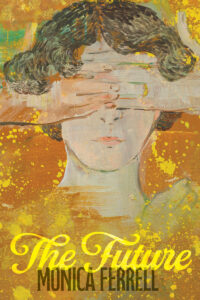
Monica Ferrell, The Future (Four Way Books)
How to make sense of the unfolding future? Write your own “Duino Elegies” that begins “No one hears. The doll has a mouth and eyes, / has a tongue, has a hand that writes. Yet the small / soul can’t reach the surface and goes unknown. / Still, it corresponds. . . . ” Transcend time with poems of “Andromeda,” the “Cosmos,” Ozempic, Tik Tok. Monica Ferrell’s pop culture references never take over; instead, they embody the inevitability of internet-driven culture seeping into our consciousnesses. She calls for us to get metaphysical, but as an act that’s bodily, allusive: “Feed the lion/ Be the lion / If only. / I’ve only been a girl / who pushed out two or three tots.” The speaker notes, “Listen: I’m not sad. As long as I can, / I will work my little flute, which is to say / This body with all its stops / Making a sort of music.” The music alone of this collection is a pleasure, but the voice compels.
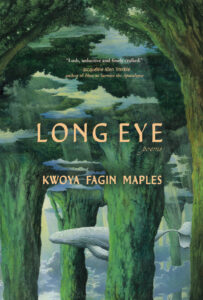
Kwoya Fagin Maples, Longeye (Hub City Press)
Amidst a series of “Autobiography of a Black Mermaid” poems threaded throughout her second collection, Kwoya Fagin Maples plants “Atlantic Origin”: “I gullah geechee people, / open crab with my hands and teeth,” locating the poems in this particular culture of the coastal South. These are poems of lineage and sea, a watery escape in which “The blue whale hoards. Her heart / the size of a Volkswagon. / All the love we could want / down there in the dark.” While “[t]here is mercy in water, relief, for evil on land,” that evil reveals itself in the everyday; in “The Next-Door Neighbors, 1990,” in which the neighbors build a privacy fence, the speaker ends, “Can’t say nothin’ to white people, Dad said. “They can’t let you have nothin’.” Throughout, the mermaid poems steal the show: “With time, my arms and interest fail, / I am queen. / They whalefall, descending depths, lost to hagfish, octopi, worms, until lonely bone mineral, / remains….” And “I could light up down to the tailfin, / glow red as a glass bird, / as a bloody belly comb jelly– I could see the way free.”
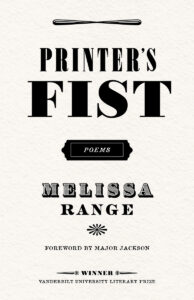
Melissa Range, Printer’s Fist (Vanderbilt University Press)
The second Vanderbilt University Literary Prize recipient is Melissa Range’s Printer’s Fist, forged from archival research of nineteenth century anti-slavery movements. “William Lloyd Garrison Apprentices as a Printer’s Devil at the Newburyport Herald,” with its echo of “boy wanted” pointedly drops “Preferred: the gospels burning in his face” before the final turn. Gone is the rollicking music and fervor of her debut, Horse and Rider, but form still reigns in this third collection; with Range, there is never a mere formal parade; she understands how form can drive. A poem opening that at first glance might appear too flippant– “Some mobs go for brickbats / come mobs go in for guns, / some mobs go in for fire and ropes, some mobs go in for fun” –erupts into the story of an abolitionist and his co-conspirators being egged after leaving a meeting, and Range ultimately gets the tone just right. Reminiscent of Kevin Young’s Ardency in its deft archival roots, music, and formal leanings, Printer’s Fist reminds what historical documentary poetry can still do, particularly when history is being erased everywhere from National Parks to liberal arts curriculums.
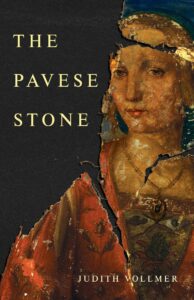
Judith Vollmer, The Pavese Stone (Alice James Press)
“The week I moved here, barely unpacked, / someone slapped me fully in the face, / crossing a parking lot . . . .” So opens the second poem in of Judith Vollmer’s seventh collection, the shocking anecdote unexpectedly evolving into intimate address: “I’m telling you this so you’ll / not feel so lonely, / though I understand if you do.” Whether an ode to the polaroid – “[h]aving it processed elsewhere might / change everything,” a mediation on a Diana Krall cover of Joni Mitchell, or wandering “Reader Notes” on Pavese, Vollmer maintains quiet authority. A poem dedicated to Anne Waldman takes us on a drive “looking for a yarn shop specializing in worsted / sheep’s wool” and lands us beside the two: “we stopped / to look at a brook saturating / the road and stepped, happy into our/ splendid concentrations.”

Rebecca Morgan Frank
Rebecca Morgan Frank's fourth collection of poems is Oh You Robot Saints! (Carnegie Mellon UP). Her poetry and prose have appeared in such places as The New Yorker, Ploughshares, American Poetry Review, and the Los Angeles Review of Books. She is an assistant professor at Lewis University and serves on the Board of Directors of the National Book Critics Circle. She lives in Chicago.