Peter Hessler on the Implications of a Chinese Education
In Conversation with Whitney Terrell and V.V. Ganeshananthan on Fiction/Non/Fiction
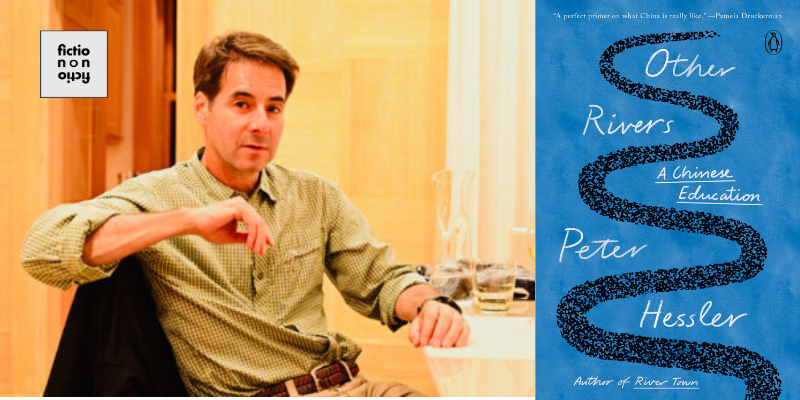
Acclaimed nonfiction writer Peter Hessler joins co-hosts Whitney Terrell and V.V. Ganeshananthan to talk about his new memoir, Other Rivers: A Chinese Education. Hessler, a New Yorker staff writer who first went to China as a teacher in the 1990s, explains how education there shifted between that era and 2019, when he returned to Sichuan Province with his wife and daughters to teach English again. He discusses the impact of his students’ shift from rural to urban lives, unpacks the differences between his twins’ schooling in Colorado and in China, and the relationship, in both places, to memorization, creativity, and authority. He also talks about keeping in touch with his students from the 1990s, many of whom became teachers, over decades. Hessler reads from Other Rivers.
To hear the full episode, subscribe through iTunes, Google Play, Stitcher, Spotify, or your favorite podcast app (include the forward slashes when searching). You can also listen by streaming from the player below. Check out video versions of our interviews on the Fiction/Non/Fiction Instagram account, the Fiction/Non/Fiction YouTube Channel, and our show website: https://www.fnfpodcast.net/ This podcast is produced by V.V. Ganeshananthan and Whitney Terrell.
Other Rivers: A Chinese Education • The Buried: An Archaeology of the Egyptian Revolution • Strange Stones: Dispatches from East and West • Country Driving: A Chinese Road Trip • Oracle Bones: A Journey Through Time in China • River Town • Peter Hessler Latest Articles | The New Yorker • A Teacher in China Learns the Limits of Free Expression • The Double Education of My Twins’ Chinese School • China’s Shifting Relationship to the Countryside • China’s Reform Generation Adapts to Life in the Middle Class
Others
Stoner by John Williams • Gossip Girl • John McPhee • The Grapes of Wrath by John Steinbeck • East of Eden by John Steinbeck • Karoline Leavitt: This is a full-blown communist revolution • Factory Girls by Leslie T. Chang
EXCERPT FROM A CONVERSATION WITH PETER HESSLER
V.V. Ganeshananthan: Unlike your earlier stays in China, when you went in 2019, you went with your wife, Leslie T. Chang, a former Wall Street Journal writer and the author of Factory Girls, and also your daughters, Ariel and Natasha, to whom the book is dedicated. You and Leslie decided to put them into a Chinese public school. How nervous were you about that?
Peter Hessler: In a way, we weren’t as nervous as we should have been, for a couple of reasons. One is, Ariel and Natasha are identical twins, they’re pretty outgoing, as twins often are, they’re pretty good students, and also, having two of them in sync, we knew, “Okay, they’ll probably be able to support each other.” We could tell they had an aptitude for language. We lived in Egypt when they were small, so some of their earliest words were Arabic, so we felt like they could do it. If I had had really shy kids, or kids who weren’t academically inclined, I wouldn’t have made that decision, because I knew that it would be very demanding.
We knew what Chinese education was like in many ways, we have a lot of respect for it, but we also realized that there’s a window when it’s better because it gets really intense as you move on. So we hoped to go to China toward the end of their elementary school and early middle school. We felt like that was the ideal time for kids to be in the Chinese system, because it’s demanding, it’s rigorous, but it’s not yet overwhelming. It’s also not quite so focused on university admission, which wouldn’t be relevant for us.
So it was all carefully planned, and we knew what we were getting into. I’d spent a lot of time around Chinese schools. My students were teaching, so I would visit their classrooms. I knew what it was like. And Leslie and I made a trip to Chengdu before we moved there and visited a lot of schools and talked to the administrators and teachers to try to find if this would work. The hard part was also political, because there were no other Americans in the school. There were two thousand kids, and they were the only two foreigners, and the only two who didn’t speak Chinese. So the school had to have some faith, and they really did. We ended up very impressed with their willingness to do this.
Whitney Terrell: So, there’s multiple levels of education that are all being handled at the same time in the book: you’ve got your kids being educated, then there’s the students that you’re teaching, then there’s the students from the past who you’re keeping track of, and then also—we’re not going to have enough time to talk about this—you talk about ancestors of your family and Leslie’s family who had experiences in China much farther in the past. I wanted to talk about this school and the WeChat threads, which remind me of some text threads that I’ve been on as a parent in America, and what you thought about the Chinese education at the elementary level.
At one point you write, “That semester, the twins spent 30 percent more days in class than they would have at their Colorado public school.” The students in your college classes seem very literate, very well read, compared to the students. I often see. They’ve read more American novels than many of my students have, and that’s really impressive, and seems very good. But, on the other hand, some Chinese parents critique the system as being too focused on memorization and not on creative thinking. I just wondered if you could talk about the Chinese educational system compared to the American educational system.
PH: It’s so much more demanding. As you said, they were in school more days, almost basically another day a week when you’re talking 30 percent. We started the semester in early September, it ended in mid-January, there was only one significant break, which was five days for National Day, and they had to make up two of those days, one of them on a Saturday and one on a Sunday. And during that break, they gave our daughters 36 pages of math homework. That’s not what happens in an American school. These were third graders. They had three to four hours of homework a night.
At the end of their semester they had final exams: 90 minutes for math, 90 minutes for science, 90 minutes for English, 100 minutes for the Chinese language class. These are third graders who are learning to sit for an hour-and-a-half to take an exam. The end goal is the Gaokao, the college entrance examination. This is a culture that has always valued examinations, and you could see them training students. In the book I mentioned, it’s like an endurance athlete. I’m a distance runner, and you could see, like, they’re teaching these kids how to focus, and I could see that change in Ariel and Natasha. So, it is incredibly intense, and it’s a long, long tradition that leads to this. This isn’t something that started recently. The Chinese developed the civil service examinations in the year around 600 AD in the Sui Dynasty. That was really just central to culture, and this idea of education in service to test taking is really a big part of it.
We were impressed with the rigor, to be honest. Both Les and I have always felt like the ideal educational system would be somewhere between America and China. I mean, I think the main problem with the Chinese system was it was just too much, it was just overwhelming. I don’t know if I really agree that there’s a lack of creativity, and at least, to the end of high school, the outcome arc is clearly very impressive. When they’ve done these big comparative studies across cultures, China tests the highest on critical thinking skills, on math, on language. That’s very clearly true now.
It actually stagnates and even declines a bit in college. They don’t have the kind of intense experience that American students sometimes have at university, because in China, a lot of it has already been set by what university you entered. But up to university, I think it’s really impressive. I think the problem is actually more of a systemic one, in that good students tend to be groomed for government jobs and government positions, and so you lose some of the dynamism from that. I’ve seen that in all the cohorts that I’ve taught. You can see it leads to more careful students, to these students being more cautious, maybe not taking risks.
WT: I just heard Jesse Watters on Fox talking about how leftist professors are teaching people to hate America. You hear that anti-intellectual, anti-schooling ideal, that we need more vocational schools in America, on the right in America. At the same time, they’re saying they want to be competitive with China. Do they understand the way that they advocate for their educational system in China? Tearing it down seems insane to me.
PH: No, they don’t have any idea, like going after Harvard, to go after your top one of your top universities, an incredibly valuable institution that’s a huge global brand, to go after that the way the US government has would seem just—Mao Zedong did do that because he wanted to tear everything down. But for the average Chinese person, now they just think it’s totally insane. I think this is a big issue in America, and something that bothers me is this lack of respect for education.
You also see that a lot with the teachers. I talked about my students from Fuling. They were training to be teachers from 1996-98 when I taught. As I’ve stayed in touch with them, I’ve surveyed them. More than 90 percent of them are still teaching today. Now, imagine if you took a cohort of Americans who had been training as teachers in 1996. What percentage do you think would still be teaching today? Incredibly low, because a lot of them were like my sister who finally left because she couldn’t deal with the parents anymore. American parents have so little respect for teachers.
When I surveyed those Chinese teachers on their job satisfaction, it averaged like 7.9 on a scale of one to ten. They were treated well, their salaries were good, they received a lot of respect, and we could see it in the school where our daughters went. The parents didn’t go after teachers the way they do in the U.S., like “This person is in a special role with my child. She deserves our respect.”
Transcribed by Otter.ai. Condensed and edited by Rebecca Kilroy. Photograph of Peter Hessler by Pan Shiyi.

Fiction Non Fiction
Hosted by Whitney Terrell and V.V. Ganeshananthan, Fiction/Non/Fiction interprets current events through the lens of literature, and features conversations with writers of all stripes, from novelists and poets to journalists and essayists.