“Our Damage Doesn’t Define Us.” What We Owe to the Natural World and Each Other
Chera Hammons on Writing in the Shadow of Violence, Trauma and Revisionist Natural History
Once a year, I google the name of a man who will always be a stranger to me. In 2008, my former spouse discovered this man lying behind the fast-food restaurant where they both worked, bleeding to death from what was later determined to be a gunshot wound. I can’t imagine the helplessness of finding a person suffering that way. The man died before the ambulance arrived. And with his passing, I became strangely tied to a family I’d never met. Their loss radiated outward like ripples in water after a stone is dropped.
Throughout our marriage, my former spouse lied to me many times. Often, he lied for no reason I could discern. He used to say, “I won’t lie if you ask the right questions,” which is how he absolved himself from creating the story that he wanted to hear. I never learned what made a question right. Years after our divorce, it occurred to me that maybe I hadn’t asked the right questions about what had happened that day. When he arrived home so late after his shift that afternoon, I had asked, “Where were you?” instead of “Where are we going?” I had asked, “What happened?” instead of “What does this mean?”
For a long time, I knew no details except what he told me, and I didn’t know whether I could believe him. In my experience, he had so often cast himself as a hero or a martyr when he was neither. Part of me even wondered whether he had exaggerated his own importance at the scene. I felt ungenerous for this, so I tried to push it out of my mind. The truth was, it didn’t matter whether he had embellished his experience or not. He was clearly suffering because of what he had seen in that parking lot. Adding to my confusion, the details the police released changed dramatically several times as forensics were undertaken and the murder investigation continued. Eventually, the police stopped releasing updates. My picture of that day remained blurred by inconsistencies.
It astonished me, how far an act of violence could spread. I barely survived the aftermath of it. Yet I had been the lucky one, the one farthest from the damage.
At first, I searched for news stories because I wanted to know what was true. Then I kept searching, because I wanted to know whether the victim’s family had ever found justice. By the time I began, the murder was already a cold case. To this day, it remains unsolved. I keep hoping that one year there will finally be an answer: This is who did this terrible thing. This is why. Something within us needs for there to be an answer. How can the pursuit of happiness ever be possible if we live in a world in which loss has no meaning?
After that day, my ex became abusive. Eventually, I was left stranded in a rural house with no money, food, or heat, watching in shock as the light from the windows moved across the floor, stretched, and then drew back. Watching that light was all I was capable of doing for days.
It astonished me, how far an act of violence could spread. I barely survived the aftermath of it. Yet I had been the lucky one, the one farthest from the damage.
Because I did not have any option but survival, I had to move on. As I rebuilt my life, the natural world was my solace. After I moved back to my hometown, Canada geese woke me every morning, calling from the park across the street from my small, dark apartment, and for a few moments, it was as if their freedom was my own. Foxes lived in the hedges at the office where I worked at a stressful entry-level job, and I would eat lunch outside so that I could watch them play. When I came home, my cat would be sitting in the window waiting for me with that unassuming generosity that only animals have.
On the weekends I would go to Palo Duro Canyon and walk along a streambed, musing over the striations in the rocks while birds sang all around me in the cottonwood trees. My days often felt like I was living in a bubble; I floated outside of my own body, and there was always a hazy yet insistent something distorting the space between myself and the world. When I went out into nature, the bubble popped.
We’re irrevocably tied to the earth. What happens to the natural world happens to all of us. I believe that nature suffers the same way we do. We’re as violent to our land as we are to each other. We cut down the forests, mismanage the wildlife, pollute the rivers, drain the aquifers. We cause earthquakes when we fracture the ground to retrieve oil. These are all symptoms of a greater disease. Violence doesn’t stay contained. It spreads and spreads. Gunshot wounds are now the leading cause of death for American children. How can this be? What does it mean, now, to be an American?
As a child, I loved the revered American conservationist John James Audubon, because it seemed that he had spent his life trying to preserve something special. I was disillusioned initially when I learned the birds in his artwork had been killed in order to be posed for painting, and later I learned he was a slave owner, a sport hunter, a plagiarist, and a profiteer. He harbored extreme, racist views against Black and Indigenous peoples. His art was beautiful, but he was a fraud. He fabricated the discovery of a new bird, Falco washingtonii, in order to sell more of his books. He was accused of scientific misconduct by his peers and rejected for membership in scientific academies.
The familiar, idealistic version of his legacy is one that has been carefully curated. His granddaughter published revised portions of his journals, then destroyed the originals; thus, even the primary source of our information regarding him is unreliable. In March 2023, the National Audubon Society, whose mission of conservation is a good one, acknowledged these concerns but resisted pressure to change its name, reasoning that the Audubon name had “come to represent so much more than the work of one person.” Though admitting a problem is a good place to start, it is not as meaningful as correcting it.
This suffering earth is wracked by extremes. The climate is changing; plants and animals are going extinct; the oceans are rising and warming. The planet is becoming less habitable, largely because of the attitude of exploitation and violence that found an outlet with men like Audubon. We’ve given power to people who justify destruction. This exploitation is both personal and systemic: corporate greed, pollution, waste, carelessness. The earth wants to heal, but it needs the same things we do: care, effort, and time. Where does this leave regular people, who are themselves just trying to survive?
Let us go together into a future where our damage doesn’t define us, but teaches us how to be kinder people, people who speak on behalf of a beautiful world.
Justice is by its very nature imperfect. Once you’re not whole, nothing can make you whole again. If you tape a torn page back together, it is still a torn page. You can’t undo damage, only try to mend it. The degree to which my past trauma still dictates how I live my life frustrates me. Still, I have tried to move forward. Three years after tragedy struck, I married again, this time choosing a friend I’d known since we were children, someone who doesn’t lie. This second marriage has endured through every difficulty imaginable, and because of what happened before, I don’t take what I have now for granted. After I started to heal, I began to write again. I have tried not to make the same mistakes I did before.
My poetry collection, which I have called Birds of America after John James Audubon’s famous publication of the same title, is a dissection of life in the aftermath of violence. It asks how we, complex and contradictory beings in a country rife with dualities, learn to nurture the soul of a land that is alternately over-hot and over-cold, flooded and turned to ash by our actions as a species. It asks what we owe to a generous earth, and to each other.
Birds of America is my imperfect attempt to show that history can’t be buried forever, and that what happens to one of us happens, in some way, to all of us. The book is my love letter to a world I’ve had an unintentional hand in damaging. It’s an apology. It’s a call to action. It’s a book about living after trauma. It’s a book of gratitude. At its core, Birds of America asks what it means to love someone, and to love the earth, while what we love is vanishing.
I am still learning how to ask the right questions. But it is my hope that when you finish the book, you will have a renewed strength to love fiercely, as if no one has ever harmed you. That is what we deserve from each other. Let us go together into a future where our damage doesn’t define us, but teaches us how to be kinder people, people who speak on behalf of a beautiful world.
__________________________________
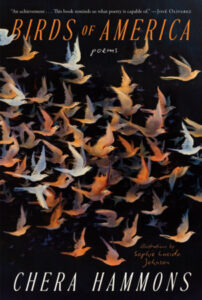
Birds of America: Poems by Chera Hammons, illustrated by Sophie Lucido Johnson, is available from The Dial Press, an imprint of Random House, a division of Penguin Random House, LLC.
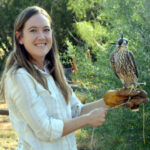
Chera Hammons
Chera Hammons is a winner of the PEN Southwest Book Award through PEN Texas and the Helen C. Smith Memorial Award through the Texas Institute of Letters. She holds an MFA from Goddard College and formerly served as writer-in-residence at West Texas A&M University. Her work, which is rooted in love for the natural world, appears in Baltimore Review, Pleiades, Poetry, Rattle, The Southern Review, The Sun, The Texas Observer, and elsewhere. She lives on the windswept prairies of the Texas Panhandle. In her free time, she enjoys reading, birdwatching, spending time with her horses and donkeys, and caring for her houseplant collection, which is slowly but surely taking over her entire living space.