Organized Rebellion: How Nightlife Evolved Throughout the Ages
Imogen Willetts Explores Our Long History of Nocturnal Fun-Seeking
There are times in a person’s life when the end of the week brings a welcome flurry of messages or phone calls: about parties, club nights, secret gigs, off-beat theatre shows, or just a cheesy but life-affirming disco in the backroom of a sticky-floored pub. Are you going out tonight? In The Best Times, his memoir of twenties New York, Lost Generation writer John Dos Passos describes that change in atmosphere at five o’clock: “the air begins to tingle,” he writes. “It’s tonight, if you drink enough, talk enough, walk far enough, that the train of magical events will begin.” We all know that feeling.
The seemingly superficial act of getting gussied up to drink, dance, have fun and meet people has left an incredible legacy. Nightlife has been the greatest generator of cultural inventions: jazz, the Charleston, the cancan and disco were all created on, and for, dance floors. Not to mention art movements such as surrealism and Dada, whose daring ideas were chewed over at late-night drinking sessions. Nightlife has inspired entire artistic forms such as Japanese ukiyo-e. Considering the influence it had on French modernists, the last century of Western art history would look very different were it not for nightlife. And these knock-on effects are important, sure. But this book is not some lengthy “nightlife as artistic incubator” treatise. Instead, I want to unearth the history of the big night out.
Nightlife is organized rebellion. It grants us access to transgressive experiences denied to us at any other time. But the magic that Dos Passos describes doesn’t always materialize. High expectations breed disappointment. Add passive attitudes, an uneasy feeling of being ripped off and the endless entertainment options now available at home, and we’re left feeling unlucky and resentful to be living through such a lame, terminally online and isolated time. We think, if only I had been young during the seventies for disco, or the nineties for the rave scene, or even earlier—how about coming of age in twenties Paris?
Nightlife is organized rebellion. It grants us access to transgressive experiences denied to us at any other time.
It’s not just us. The once habitual “big night out” has become an increasingly fringe activity. It’s estimated that the US lost roughly 1 in 6 of its neighborhood bars between 2004 and 2014. In the UK, 34 pubs closed per month in 2024; numbers are now at an all-time low of 39,000. It’s even worse for nightclubs. The UK lost more than half of its nightclubs between 2013 and 2024. If the trend continues, there will be none left by 2030. France has lost 70 per cent of its nightclubs since the 1980s, while Italy has lost more than half since 1990. America almost lost half of its gay bars in the last decade. Meanwhile, less hedonistic businesses—24-hour gyms, escape rooms and coffee shops—are thriving. We have become unnervingly well-behaved, at least in the analogue world.
Even so, the media outcry about “nightlife being over” misses one crucial element: historical context.
*
Go back far enough and the night out started with the campfire. The ability to control fire transformed the night from a time of invisible terrors into one of feasting and revelry. The anthropological theory goes that, while sitting around flickering flames, prehistoric humans developed crucial skills in storytelling, language and imagination. We owe a lot to the night.
Fire came first. Elaborate costumes, dance and music were added into the mix much later. Supposedly that happened roughly ten thousand years ago, when nomadic communities got together after dark to watch dance performances, enhanced by drumming, masks and painted faces. According to Barbara Ehrenreich in Dancing in the Streets: A History of Collective Joy, there was a practical purpose. These performers were sharing hunting techniques by re-enacting the slaying of a ferocious beast. Plus, it was really fun, felt good and bonded the group together.
That prickly surge of euphoria we get on dance floors, at concerts, sports matches or at religious ceremonies has a name. In 1912, sociologist Émile Durkheim called it “collective effervescence,” the feeling of being part of something bigger than ourselves. He studied Australian tribal gatherings and found: “When they are once come together, a sort of electricity is formed by their collecting which quickly transports them to an extraordinary degree of exaltation.” There’s a biological advantage to collective unity. It’s why we’re hardwired to find pleasure in the intense high of a peak communal experience. Whether it’s a prehistoric dance party or a sweaty festival tent, the sensation is the same. Ten thousand years ago, our ancestors experienced “collective effervescence” during the drumming frenzy of a hunting ritual; now we feel it during that feral electroclash finale of Charli XCX’s “365,” or perhaps during those uncool, feel-good stadium anthems like “Mr. Brightside” and “Sweet Caroline.”
Of course there’s a lot of time between the invention of our “night out” accoutrements (illuminations, costume, music, dance) and when this book begins. Look, I’m no expert on prehistory and I’m not going to dwell on this deep time stuff, but a brief summary of the interim might go something like this.
We started living in cities a few thousand years ago. We lost the campfire ritual, but got pubs instead. Archaeologists recently uncovered a 5,000-year-old Mesopotamian tavern, in modern-day southern Iraq, making it the oldest known pub in the world.
But nights out got dangerous. In his moral critique Satires, the poet Juvenal warned his readers about ancient Rome’s taverns “open all night long,” in which the risk of death was such that “you may well be accounted remiss…if you go out to supper without having made your will.” Street thugs “mad with drink” prowled the streets, and “whether you attempt to say a word or retire in silence, is all one; they beat you just the same.”
Rome’s Suburra district was a slumland of brothels, taverns and gambling dens, which for the most part, the upper classes could enjoy only with the protection of a bodyguard. Even just getting there was hazardous. The residents of upper-floor apartments would take advantage of darkness’s anonymity to fling out buckets of human excrement. And if that wasn’t off-putting enough, falling roof tiles were a constant threat. Nights out really lost their luster in the thousands of years between the development of cities and the invention of electricity.
Remember that all-important “collective effervescence” sensation? Religion stepped in to fill the gap. Barbara Ehrenreich describes how life in Ancient Greece was tough for women: excluded from public life and at times banned from drinking wine. In revolt, groups of young women (the maenads) followed the wine god Dionysus into forest groves to feast on the flesh of wild animals and dance themselves into a naked ecstasy. “These were not solely mythical events,” writes Ehrenreich. There’s evidence to suggest a troupe of Dionysian party girls climbed all 8,000 feet of Mount Parnassus in one frenzied outburst. Rome had Saturnalia: all-night partying accompanied by surrealist performances that ridiculed the city’s strict social hierarchy. During the long Scandinavian winters, Norsemen partied until dawn in sweaty mead halls, where they feasted and recited epic accounts of battles and tales of Odin and Thor, with shamans leading the revelers into a trance-like rapture. All very fun, but if there are gods being worshipped it’s not nightlife.
In medieval England, going to church was surprisingly hedonistic. The Feast of Fools was one notably messy celebration, with its carnivalesque atmosphere of performances, parades and raucous dancing. Wells Cathedral, which had a reputation for debauchery, supposedly introduced wooden pews in an effort to subdue the rowdiness.
In the sixteenth century, religion flourished and Western nightlife arrived at its true dark age, according to the historian A. Roger Ekirch in At Day’s Close: A History of Nighttime. Fortified towns across Europe implemented strict curfews, enforced by militant nightwatchmen. Your options for hedonism were restricted to the occasional religious festival, or a treacherous—sometimes deadly—journey to a local alehouse. Suppose you lived somewhere remote and wanted to go for a drink? Murderous brigands lurked in dark country roads. Lone men known as nightwalkers prowled around looking for fights. The night air itself was believed to be filled with disease-carrying miasmas. And then there were the supernatural threats. The upheavals of the sixteenth century brought a resurgence of mysticism, one consequence of which was that fear of the devil became increasingly intense. The night was seen as Satan’s time, a foretaste of his reign in hell. A frightful bestiary was believed to descend under cover of darkness—hobgoblins, ghosts, will-o’-the-wisps (an eerie, magical light that hovered around bogs) as well as witches and demonic figures. You’d have to be seriously dedicated to the camaraderie of the alehouse to brave all these perils.
How well founded were these fears? Moonless nights in preindustrial societies were genuinely dark. If you lost your torch or your bearings, you could get into trouble very quickly. Will-o’-the-wisps did indeed lure travelers to their deaths: rotting organic matter mixed with phosphine and methane creates blue and golden flames, which travelers frequently mistook for the light from a cottage and then got lost trying to reach it, only to drown in a bog. Even the supernatural threats might have had a degree of reality. Ekirch finds evidence that robbers simply dressed up as demons to terrorize their victims, while sheep-stealers managed to get away with their crimes by “masquerading as ghosts.”
If you made it to the alehouse, your problems didn’t end there. In his Young Man’s Guide, published in 1676, the Puritan minister Thomas Gouge tells the cautionary tale of a drunken unfortunate who was coerced by the devil himself. Under the influence (of Satan, or drink, or Satan in the form of drink), the young fellow went home and promptly “defiled his Mother, and murthered his Father.” Imagine the hangxiety.
In his 1606 pamphlet The Seven Deadly Sins of London, Thomas Dekker adds to the fearmongering. Writing in the aftermath of the plague, he condemns the corruption and sleaze that helped it spread, wondering “how many lips haue beene worne out with kissing at the street doore” at night. Tellingly, one of his “sins” is candlelight, whose companions are: “Darknesse, Conspiracy, Opportunitie, Strategems and Feare.” It is simply: “a harbourer of all kindes of Vices.” As punishment, candlelight itself “wilt burne for it in hell.”
Living in seventeenth-century London would have meant witnessing a battle between two schools of thought. There were slow developments in street lighting that made nights out safer, but at the same time moralists like Thomas Gouge were trying desperately to subdue our hedonistic instincts. It could have gone either way. You don’t need me to tell you this but clearly, nightlife won. Religion’s influence waned and nightlife flourished in the vacuum. In the seventeenth century, we started going out en masse, and continued to do so until…well, only very recently.
Why does nightlife begin 350 years ago, and not—say—five millennia ago, with that first Mesopotamian pub? For present purposes, let’s define nightlife as a commercial and secular environment designed to offer a variety of pleasures at night. It’s more than just a place to drink. And what about those crazy drumming rituals or all-night maenad feasts? Neither secular, nor commercial.
By this rubric, nightlife begins in Japan, in the autumn of 1657. The shogun’s authoritarian state was involved in ways we have, thankfully, shed. London’s pleasure gardens of the seventeenth century followed, offering a rural retreat from the squalor of urban life. In turn-of-the-century New Orleans, nightlife was an economic lifeline that resulted in the creation of jazz.
By 1900, electricity was lighting up music halls and city streets, turning night into day—but this only inspired rebellion in a different form. Paris’s fin de siècle artistes rejected technology and retreated into their simulation of a decaying medieval hamlet. After the First World War, global cities boomed with Jazz Age entertainment, giving us the goldilocks conditions for an unprecedented decade of partying.
Nightlife is versatile. It responds to our changing social needs….What if we’re in a fragile transition phase, rather than a full-throttle nightlife apocalypse?
Back then it was simple: if you wanted live music and entertainment, company and gossip, you had to leave the house. That changed with the rise of television in the 1950s. Yet ultra-maximalist revues—taken to new extremes in Las Vegas and Havana—still managed to lure tourists to shows with opulent special effects and scandalous displays of nudity. Canned music and vinyl records might have spelled the end of nightlife, but the discotheque scene and rise of the DJ in New York simply replaced the old dance hall and revue format with new sounds and experiences.
Television did change our attitudes to going out. It went from being an intergenerational activity into something increasingly associated with youth. It meant hook-ups, dating and sexual freedom. Young people went out while the middle-aged stayed in. By the nineties, rave culture had brought anarchic, anti-authoritarian energy into the fold, fueled by the squatters’ movement, postindustrial decline and the rise of techno, a raw aesthetic that still looms large in nightclubs today. The aughts saw LA’s club scene entwined with celebrity and reality TV, a fragile alignment that has proven to be especially weak in the face of social media and the rise of dating apps.
*
Today, we seem to be turning away from the night and all its teeming possibilities. Worse, we are trying to make them respectable. The V&A’s Lost Music Venues exhibition and the Institute of Contemporary Art’s monthly reading group on “raving” suggests that the dance floor is becoming eulogized, even—as Chal Ravens argued in The Quietus in 2024—academicized. The Willow, a nightclub in a Chinese restaurant (free prawn crackers, tables pushed back), was a beloved disco dive during my university years; now it’s the subject of an exhibition at the York Festival of Ideas.
There’s something galling about this fetishization of lost nightlife while the actual industry collapses. Old nightclubs, once seen as delightfully trashy and low brow, are revered by the cultural establishment. It’s as if they’re safe to celebrate once they’re closed and can’t generate any more noise complaints.
Still, a boarded-up nightclub is a sad sight. Walk around the English seaside town of Margate for long enough and you’ll probably pass Club Caprice, a cream-colored relic on the seafront, looking like some post-apocalyptic Ibiza. Keep going and you’ll see another shuttered nightclub, this time a weary lilac shed emblazoned with Frank’s Nightclub in perfect eighties cursive. And you’d probably think something like, what a shame we don’t go out like we used to.
But here’s the thing: nightlife is versatile. It responds to our changing social needs. The modern club—and indeed the professional DJ—is just six decades old, but we’ve been going out in search of spectacular public entertainment for hundreds of years. What if we’re in a fragile transition phase, rather than a full-throttle nightlife apocalypse? Indeed, if you keep going through Margate and into Cliftonville, another venue would tell a different story.
At 276 Northdown Road, you’ll find the independently run nightclub and cultural space, Margate Arts Club. It was established in 2016 by Amy Zing and Luke Vandenberg, the creators of London’s legendary queer parties Sink the Pink, which Attitude magazine once dubbed the “future of clubbing.” Margate Arts Club maintains their ethos of playful, camp and inclusive partying. As Amy Zing says: “I really do believe that the blinkers of society can just dissolve on a dance floor and we just find ourselves and find each other.”
Margate Arts Club feels less like clubbing and more like stepping into the house party from every childhood fantasy you had about growing up. There are no intimidating bouncers or tiresome “no trainers” rules like nightclubs of old. It’s intimate, creative and delightfully DIY. There are few poseurs or obsessive documentarians—just a “come as you are” ethos and having a great time. We could do with hundreds more of them.
____________________________
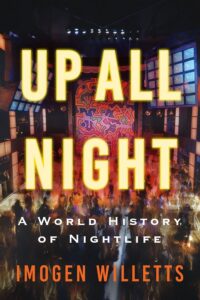
From Up All Night: A World History of Nightlife by Imogen Willetts. Copyright © 2026. Available from Grove Press, an imprint of Grove Atlantic.

Imogen Willetts
Imogen Willetts is a historian and was Senior Creative Producer at the Royal Academy of Arts in London, where she led its cultural programs of live events and festivals. This included leading the sell-out RA Lates series, after-hours gallery events that reimagined the nightlife behind iconic artistic movements, as well as an annual summer party that took inspiration from Vauxhall Pleasure Gardens. Imogen lectures in cultural and urban history at Kingston University’s School of Art and at Central Saint Martins. Up All Night is her first book.