Ordinary Mind Remembering Ordinary Matter: Allen Ginsberg on Poetic Honesty
“When the subways are gone to dust, this will still be there.”
In the West, the main tradition seems to be chaotic, because it has always been one of continuous change. In visual art, from Byzantine painting up through Renaissance painting, artists actually attempted to physically reproduce perspective, or at least an optical illusion of it.
And from Poussin, through Cezanne, up to the Cubists, there’s been a definite progression, one artist building upon the previous—you might call them revolutions or rebellions, but they’re just cumulative insights.
Cezanne, for example, wanted to repaint Poussin, but from nature, and, in so doing, broke up the canvas’s optical field into hot colors that advanced and cold colors that receded. He created the illusion of space by forcing the eyeball to shuttle from one plane of color to another. And the Cubists picked up on that in the twentieth century and abstracted from his landscapes, making pure Cubist constructions in which the optical space on the canvas—very similar to Cezanne’s—was composed of little abstract blocks.
The point I’m trying to make is that Western art favors novelty rather than a stable, unvarying method, say, as in Tibetan painting, where from master‑to-disciple, century‑after‑century, the same technique is employed.
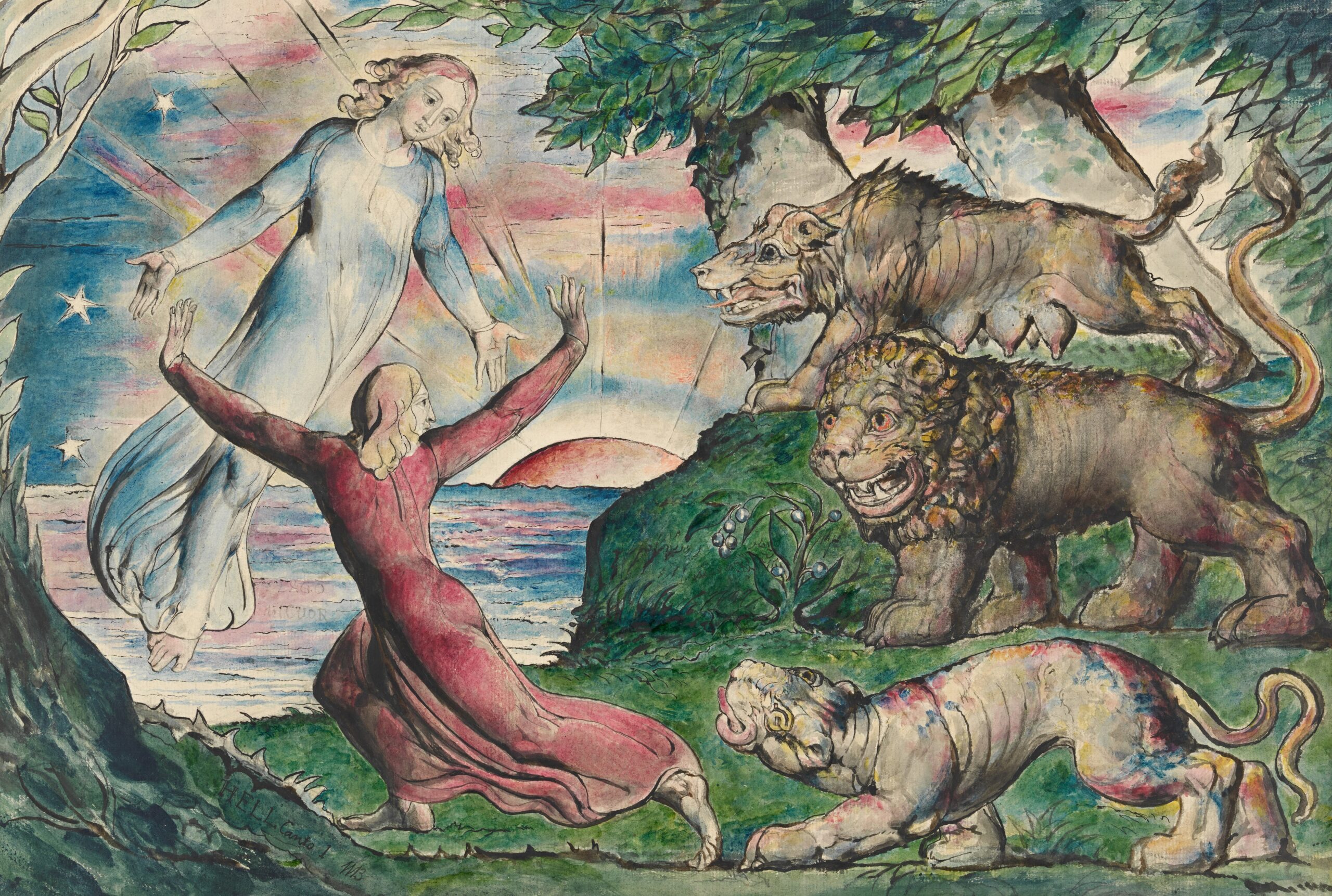
Blake’s imagery is actually very similar to a lot of baroque Tibetan imagery describing the birth of ego in open space. His imagination and that of Tibetan poetics and painted Thangkas are oddly similar, both in the realm of mind‑projection and three‑dimensional visualization. It’s the perfection of these techniques and the freedom within them that’s prized. Here in the West, there seems to be some kind of honor in advancing progressive evolution—progressive evolution of the way you register your perceptions.
The Tibetan and Blakean traditions deal with extremely rarefied, subtle, and very definite worlds, both featuring symbols that serve as fixed images for meditation and the contemplation of psychological archetypes.
On the notion of fixed images, or lack thereof, Plato had this great saying: “When the mode of the music changes, the walls of the city shake,” meaning, when people start to shake their asses differently, there’s a significant political paradigm shift.
Williams was always repeating this phrase, “A new world is only a new mind.” It’s brilliantly put for an American slogan of that post‑Einsteinian understanding of relativity, and how perception of the phenomenal world depends on the measuring instrument and the perceiver.
The idea here, illustrated by Urizen’s birth, is that the eyeballs create what we see. The ears create sound, the nostrils create smell. In other words, that the external phenomenal universe is a projection of our own nervous system. In other words, unless you can turn on a radio, the symphony doesn’t exist coming through the air like that. It might exist in an-other dimension, but not in that one.
So the genius of poetry is when it’s not poetry, really, in that way. You don’t have to worry about it. Let poetry take care of itself. What we can take care of is our attention, frankness, having enough energy and generosity to carry around our notebooks and place our egoless minds there.
Like in the first poem that I read of Charles Reznikoff that actually made me cry because it was so honest.
She sat by the window opening into the airshaft,
and looked across the parapet
at the new moon.
She would have taken the hairpins out of her carefully coiled hair,
and thrown herself on the bed in tears;
but he was coming and her mouth had to be pinned into a smile.
If he would have her, she would marry whatever he was.
A knock. She lit the gas and opened her door.
Her aunt and the man—skin loose under his eyes, the face slashed with wrinkles.
“Come in,” she said as gently as she could and smiled.
Well, what you’ve got there is directly observed detail, unpoetic for its time. What you can see and hear is how close he is to ordinary mind, how near the work is to becoming a totally tearful, sad, completely tragic, completely understandable, completely known, totally empathetic and grounded piece of information about what happens in life without even bothering to be a poem.
“Once a toothless woman opened her door,/ chewing a slice of bacon that hung from her mouth like a tongue,” he writes.
One of most hideous images in American poetry, and yet one of the most memorable. You can really see it, and then his comment:
“This is where I walked night after night; / this is where I walked away many years.”
That was Reznikoff ’s life, but one so full of fine perception of what was there. It’s totally present when we read it now—his perception, his emotion. Everybody’s yakking about how they want to show emotions in their poetry but the way he’s done it is simply by being totally accurate to what stimulated feeling in him, ob-serving it so completely clearly.
By gathering the objective external data that caused the sensation, he’s been able to animate that same sensation in us. It’s like Cezanne trying to reconstitute the essence of space in his canvases. Here, by reconstituting the data, the primary sensory data, he’s been able to transfer that emotional affective blood‑gush into our bodies.
Reznikoff was hardly known. He used to be invited by Anne Waldman and the St. Marks Poetry Project to give readings. I gave a reading there and the church would be full, Reznikoff—a really old man—would give a reading and there would be maybe thirty people. This old man would read stuff that was so pure we’d sob, and no one else was there to hear it. He was very humble. He had these very carefully marked old poems that he took out. He was worried whether people would listen to him, not wanting to bore them, and was he talking loudly enough? It’s amazing how he did his work. He was like a saint in this way. He lived in an apartment house near Lincoln Center in New York, one of the new apartment houses. He led a sort of anonymous life in libraries, like a scholar, looking up texts.
He would take long walks around Manhattan a lot. There were occasions when I was wandering around Bryant Park and met him by the New York Public Library, just walking around, four in the afternoon.
I didn’t know what he was doing there and he didn’t know what I was doing there, but we were both doing the same thing—observing space, particular pigeons, in the middle of the city and trying to figure out what was going on. And when we bumped into each other it was always funny—“Oh, you’re doing it too.” And, then, of course, the park was full of bums like us.
He walked the length of Manhattan every day. Sometimes he’d take the subway:
Going to work in the subway
this bright May morning
you have put on red slippers;
do they dance behind the counters
in the store, or about the machines
in the shop where you work?
Number 17:
Rails in the subway
What did you know of happiness,
when you were ore in the earth;
Now the electric lights shine upon you.
Or number 18:
Walk about the subway station
in a grove of steel pillars
how their knobs the rivet‑heads—
unlike those of oaks—
are irregularly placed;
how barren the ground is
except here and there on the platform
a fat black fungus
that was chewing‑gum
That really kills me. He’s the first guy who ever noticed these things enough to include them in a poem. Everybody has seen that “fat black fungus that was chewing‑gum” on the sidewalk, on the pavements, on bus floors, on the floors of gram-mar school, in subways. Everybody. It’s universal, but nobody’s ever taken particular notice of the peculiar aesthetic beauty of it.
In fact, the whole notion of seeing things in the subway, writing about the subway, is a kind of mindfulness that only somebody walking around a lot, at ease, not preoccupied, would observe.
“That fat black fungus that was chewing‑gum” probably will last a long, long time. When the subways are gone to dust, this will still be there. This little perception will still probably be memorable. I mean even if books are gone, people might still recall this image. Also, the “grove of steel pillars / how their knobs the rivet‑heads— / unlike those of oaks—” is pretty accurate.
Everyone has seen those riveted knobs, those regularly riveted knobs in subway pillars, but nobody’s looked at them long enough to see their peculiar nature. Some remember and some don’t. He remembered. He remembered clearly. It’s ordinary mind remembering ordinary matter. It isn’t straining after an unworldly beauty.
The astounding thing is that the precision or objectivity—the objectivity of his approach—strangely results in a totally subjective fountain of tears. Some of his poems I can hardly get through. And I’ve wept over him any number of times. Alone, or reading his work aloud, because the emotions are so not necessarily strong, but very clear.
That’s what’s so tragic—that it’s all so clear, the truth is so obvious. The tragedy is so unobstructed and there’s no wash of sentimentality over it. And yet, you can’t help but cry, because it’s life.
__________________________________
From Ah!Merica, a collection of previously unpublished lectures, originally delivered at the Jack Kerouac School of Disembodied Poetics at Naropa University, by Allen Ginsberg. Copyright © 2026.
Available from ISOLARII
Allen Ginsberg
Allen Ginsberg is one of the 20th century's most famous poets, perhaps most renowned for his epoch-changing poem, "Howl."