One Man’s Crazy Scheme to Create a New County in Northern Ireland
Jan Carson on Tethering the Fantastical to the Factual
Rarely am I able to pinpoint precisely where a novel comes from. Patricia Highsmith once wrote, “ideas come to me like birds in the corner of my eye.” Until very recently this felt like an apt synopsis of my own creative process. An idea would appear, unbidden, on the edge of my awareness and loiter there, for months or years, ensuring I couldn’t focus on anything else. Worn down and exacerbated, I’d eventually get out my laptop and begin to write a book.
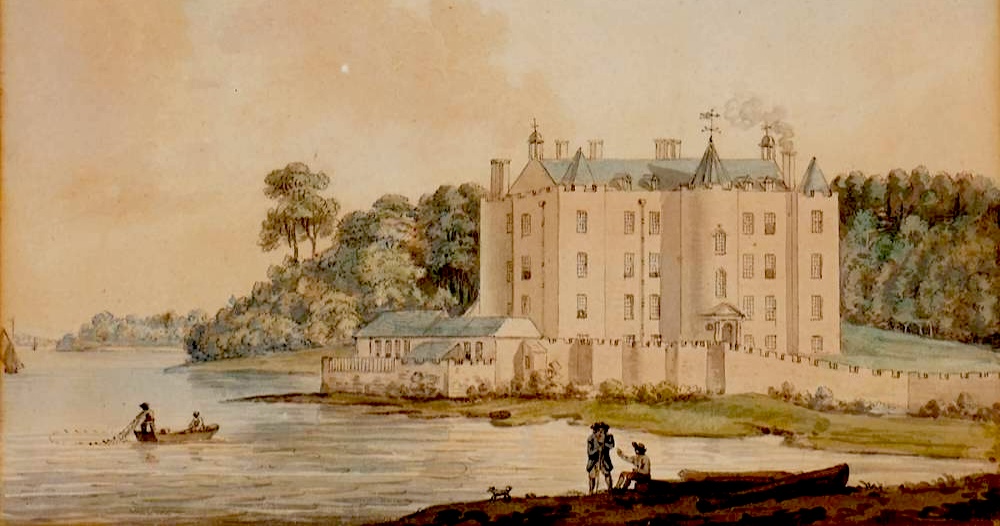
My latest novel, Few and Far Between was a completely different beast. It had a precise and sudden genesis. I was on a residency in Eastern France, lonely and wrestling with writers’ block, when a friend sent me an email entitled, “this sounds like something you’d write about.” People are forever offering me ideas for stories. Mostly they’re just anecdotes. This email contained a Belfast Telegraph article about one-time prime minister Terence O’Neill’s 1958 proposal to drain Lough Neagh, the largest freshwater lake in the UK and Ireland. O’Neill planned to turn it into the seventh county of Northern Ireland. I was immediately taken by his madcap scheme. My friend knows me well; it was exactly the sort of thing I’d write about.
That evening, fuelled by a bottle of nice French red, I went spiralling down a research rabbit hole, pulling up maps and Googling, “could you actually drain Lough Neagh?” In theory O’Neill’s scheme was possible, but the instant rain fell -and it rains a lot in my part of the world- the waterline would creep back up. I thought my project had run aground. Then, I stumbled upon a topographical map revealing an archipelago of islands just beneath the lough’s surface. I was completely unaware of their existence. Most Northern Irish people still are. The second I read their evocative titles—Tom’s Hard, Eglish Flat and Connolly’s Hard (which lends its name to my protagonists; the eminent anthropologist RJ Connolly and his dysfunctional family)—the whole novel came to me in a flood-like rush.
I’d be tethering the fantastical to the factual.
I could picture O’Neill’s failed attempt at a drainage scheme; the islands emerging as the waterline dropped. I knew a group of people would seek sanctuary on this archipelago, hoping to escape the violence and intimidation of the Troubles. They’d attempt to form a utopian community. It wouldn’t last very long. (Literary utopias never do). I could even imagine a handful of haunted islands, loitering on the Far Side of the archipelago. There’d be an island which swallowed up shameful and unwanted items, an island of almost-deads, caught in limbo between life and death and an island of perpetually sleeping trauma victims; each an extended metaphor for some aspect of life in post-conflict Northern Ireland.
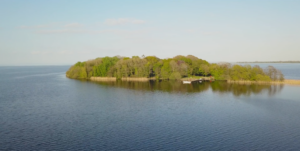
Two days later I had maps, a rough plot, character outlines and the daunting realisation that I was embarking something more complex than a regular alternative history. I’d be tethering the fantastical to the factual. In Northern Ireland, where there’s no such thing as uncontested fact, this would be a slippery process, akin to pinning down a Lough Neagh eel.
I turned to my favourite alternative histories for inspiration, beginning with Catherine Lacey’s Biography of X. Speaking to The Chicago Review of Books, Lacey said, “when I’m reading history, I always think, “it didn’t have to go this way, did it?… Once you start moving one thing, it becomes easy to move anything.” I have a deep admiration for the way Biography of X weaves contemporary American history around and into the protagonist’s story. It’s as if the bricks from one building have been repurposed in a completely different structure. Here, historical fact is made to feel alternative and, as such, begins to critique itself. I remain in awe of Lacey’s vision, but it didn’t feel like the right form for my novel.
I kept returning to a question I’d been asked by a student a few years back. “As a writer of non-realist fiction, how did I view history?” Most of my work addresses the Northern Irish conflict and its repercussions. This is a hurt which is still raw and, in many aspects, unresolved. Did I have reservations about manipulating the history of the Troubles to serve my own narrative ends? Ultimately, I decided that I did.
I turned to more traditional forms of alternative history. Curtis Sittenfeld’s brilliant Rodham and Philip Roth’s The Plot Against America. The structure of these novels is simpler than Lacey’s yet no less impactful. One small, or not so small occurrence, causes American history to veer off its prescribed route. Repercussion instigates repercussion and before the reader knows it, they’ve arrived at a point in American history which is not just alternative, it’s unrecognisable. (Or in Roth’s case, was unrecognisable when it was published and is now disturbingly prescient).
I hope the distance afforded by fiction, might offer a fresh perspective on the history we are all still living though.
For a while I considered this domino rally-type model for my novel. Could I take O’Neill’s drainage scheme as a starting point and follow the alternative road wherever it wished to lead me: Ireland re-united, utopian or overrun by its own ghosts? I’m afraid my imagination wasn’t up to the task. The Northern Irish temperament is stoic to the point of obstinance. We tend to get stuck in the ruts of our own limited vision. I couldn’t picture change on such an epic scale.
However, I was drawn to Roth’s words at the beginning of his novel. “History is everything that happens everywhere… even what happens in this house to an ordinary man.” The idea of an alternative history explored on a smaller, perhaps more domestic stage, felt less overwhelming. In fact, I had precedent. I have umpteen stories set in tiny, claustrophobic spaces: caravans, cars, hotel rooms. In my writing, these spaces tend to act as microcosms for the bigger socio-political stage. I find it easier, and oftentimes more effective, to explore the Conflict’s impact on an individual rather than an entire society.
So, I found the shape of my alternative history. On Mainland Northern Ireland, the conflict plays out according to the history books. (I should include a caveat here. I’m not to be trusted as a historian. Anyone who grows up in the North brings their own bias and blind spots to their understanding of what happened here). The “real” history runs in parallel with the fictional story of the Neagh Archipelago.
Out in the middle of lough an archipelago of strange islands emerge. A community forms and fractures and, when the Good Friday Peace Agreement is signed in 1998, drifts back to the Mainland, reintegrating with “real” history. The haunted islands of the Far Side become a dumping ground, “for all the shite that was meant to get sorted but never did.” The Archipelago muddles on for fifty years until the Lough’s beset by an ecological crisis. At which point, reality catches up with fiction in the form of a devastating blue-green algae outbreak.
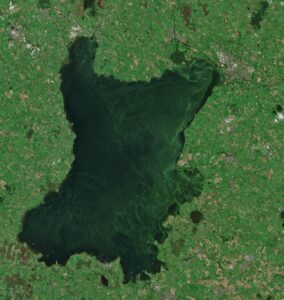
Ultimately, the world of Few and Far Between sits to the side of history like a lay-by off a bigger road. If anything, it’s an attempt to cordon off a small section of reality and speculate on what might have been. I hope the distance afforded by fiction, might offer a fresh perspective on the history we are all still living though.
__________________________________
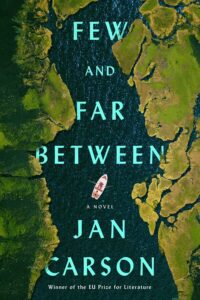
Few and Far Between by Jan Carson is available from Scribner.

Jan Carson
Jan Carson is a writer and community arts facilitator based in Belfast. She is the author of several short story collections and novels including Malcolm Orange Disappears, The Raptures, The Last Resort, and The Fire Starters, winner of the EU Prize for Literature. She has won the Harper’s Bazaar short story competition and been shortlisted for many awards, including the BBC National Short Story Award, the Seán Ó Faoláin Short Story Prize, and the Irish Book Awards Novel of the Year. Jan is a Fellow of the Royal Society of Literature and her writing has been translated into over a dozen languages, appeared in numerous journals, and been frequently broadcast on BBC Radio. Quickly, While They Still Have Horses is her first book to be published in North America.