On Writing the Hard Truths of Rural American Life
For Jennifer Acker, Money Troubles Are As Much a Part of Farming As the Weather
When I was growing up in rural Maine, I never told people that my father was a farmer. Not because I was ashamed, but because my father wasn’t a farmer like the other farmers in town. For those men (and they were all men), who milked dairy cows, raised hogs, or cultivated acres of blueberries, farming was their livelihood. My father had grown up that way, on a subsistence farm in Colorado that sold milk and dried beans, but with the support of the GI Bill he’d earned a PhD and become a psychologist. So while we lived on a farm, with a barn full of horses and chickens and homemade legume threshers, farming wasn’t how my parents made a living.
This is important because many small family farms are one drought or barn fire away from bankruptcy. I knew this implicitly as a kid, from the farm kids I went to school with and from my father’s own stories of Depression-era struggles to make ends meet. (To his father’s shame, the Colorado farm folded when my dad was 14, and the family had to pull up stakes and move to Los Angeles where they worked in a hotel owned by a rich uncle.) I knew that farmers who relied on the land to support their families lived with a degree of precarity that my family never had to experience. This is why I put money problems front and center in my farming novel, Surrender. Any book that didn’t would be dishonest.
For farmers, it costs real dollars—and not just rivers of sweat and tears—to care for what they love: the land, their animals, their families.
Money trouble is always useful in fiction, my grad school teacher Alice Mattison used to tell us. It’s easy to understand why characters worry about their material needs, or dreams of advancement. Looming financial deadlines create narrative tension. An if/then formulation does wonders for perking up the reader. If she didn’t earn enough by kidding season, she wouldn’t be able to feed all the goats over the summer. Because farming is subject to a lot of regulations (as is any activity that produces things the public can eat or drink) and farmland is, in some places, considered a public good, specific laws can be a useful tool to place pressure on fictional farms. Taxes aren’t sexy, but they are a real threat that can loom like a hungry bear at the end of winter, and this can be put to a novelist’s advantage.
Money, when you don’t have a lot of it, is also firmly embedded in characters’ emotional lives. For farmers, it costs real dollars—and not just rivers of sweat and tears—to care for what they love: the land, their animals, their families. What if a family member gets sick at the same time as the animals? Obviously, the people come first, but animals are beloved, dignified creatures too. Livestock are also sources of income. What is the right lens through which to value a living being when dollars cannot be spared? This is the kind of essential moral conundrum fiction needs.
While farmers may appear paragons of independence, their decisions do not occur in a vacuum; farmers are embedded in a community. Writing about agriculture necessarily means writing about small towns, and therefore about local politics. The standout communal event of the year in rural Maine, after the fireman’s supper and T-ball games, was that emblem of participatory democracy the Town Meeting. Held every March when the ice is beginning to contemplate possibly allowing itself to crack, Town Meeting was where all residents had equal say. (And where kids like me stuffed their faces with Girl Scout cookies.)
Neighborliness is still considered a virtue in many rural areas.
Liberals, conservatives and libertarians alike came together to deliberate how much to spend on fixing potholes and whether to increase the salary of the school librarian. Regardless of whether you agreed with your neighbors, you had to listen to what they said and respond to their points persuasively if you disagreed. In a small town, you can not only witness governance in the making, you can influence it. Such forums for debate are lively spaces for characters to show their true colors or get into consequential arguments.
Events like Town Meeting also illustrate the kind of negotiation that occurs when people with opposite political views have to solve problems together. Rural America today, under Trump, has gotten a bad rap. While the electoral maps may look largely red in most rural areas, the reality is more nuanced. I’m not denying the veracity of the map—a vote is a vote!—but the political landscape on a local level, meaning how politics and values are expressed from person to person, is far from determined by the colors of the flag.
Neighborliness is still considered a virtue in many rural areas. Where I live now in Western Massachusetts, my most immediate neighbor has both said, triumphantly, during Trump’s first term, I guess it’s okay to say Merry Christmas again, as if Obama had personally hog tied Santa and his elves to the North Pole, and has regularly and voluntarily snowblown our walkway without asking for anything in return. I hate his politics, but I have brought him soup when he’s sick.
We are all full of contradictions, but small towns shine a light on how much people who are different from each other need to interact, and this is rich territory for fiction. Another grad school teacher of mine, Brian Morton, used to say that fiction “really gets cooking” when two or more people enter a room. Conflicts naturally arise in small towns due to shared space, desires for independence, and the necessity of solving problems communally. In a small town novel, you want solutions to knotty local problems to arise in surprising ways. When characters act away from stereotype, readers are compelled to keep turning the pages.
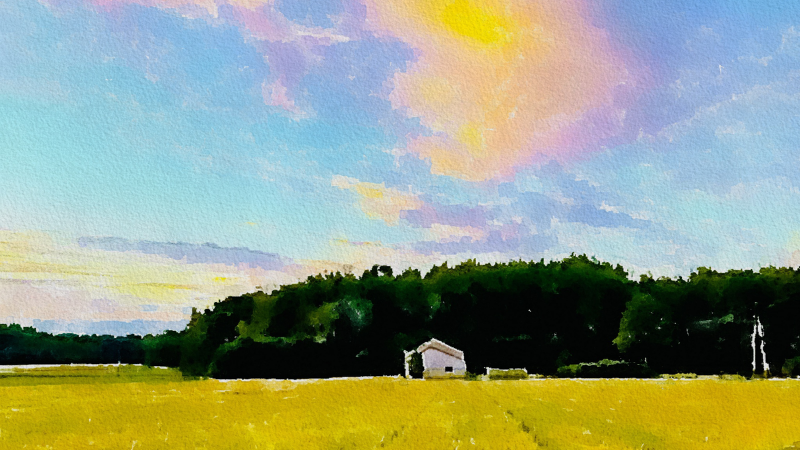
My last piece of advice when writing about small town life is to beware of romanticization. A lush, bucolic countryside often inspires visitors to think, I could have such an easy, quiet life here away from the rat race, with cute farm animals to boot! Small towns may appear dreamy, but lack of economic opportunity also means many people live close to the bone. A writer needs to be careful not to paint a town in roses, ignoring the junkyards and broken fences.
__________________________________
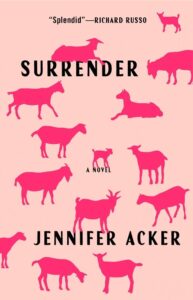
Surrender by Jennifer Acker is available from Delphinium Books.

Jennifer Acker
Jennifer Acker is founder and editor in chief of The Common and author of the debut novel The Limits of the World, a fiction honoree for the Massachusetts Book Award. Her work has appeared in The Wall Street Journal, Oprah Daily, The Washington Post, Literary Hub, n+1, and The Yale Review, among other places. Her second novel, Surrender, will be released in April 2026.