On the Urgency of Climate Change, Creating Hope in a Crisis, and the Limits of Western Storytelling
A Roundtable on Our Climate Futures with Libia Brenda, Vandana Singh, Gu Shi, and Hannah Onoguwe
It’s genuinely difficult to cultivate a hopeful perspective on the climate crisis, and prospects for climate action, in 2025. While I was writing this introductory note, COP30, this year’s United Nations climate summit in Belém, Brazil, ended without an agreement to transition away from fossil fuels, despite dogged pressure from a coalition of more than 80 countries over the convention’s 12 days. Meanwhile, the government of the United States, the world’s largest economy and second-largest emitter of carbon, was simply absent from the event.
This all-too-familiar grim global tableau forms the backdrop for Climate Imagination: Dispatches from Hopeful Futures, a collection of speculative fiction, essays, and artworks that I edited with Ed Finn; the book will be published on December 2 by the MIT Press. We challenged our contributors, who represent 17 countries around the world, to envision hopeful futures shaped by climate action. These visions of the future are grounded in the scientific consensus about the severity and urgency of the climate crisis, but also in the cultural and geographic complexities of real places across the globe, and real communities on the ground.
We need stories that honor our unique circumstances while simultaneously insisting on our shared peril, and our shared responsibility to muddle through this together, however we can.
For me, the act of hope is easier when it attends to the local and the particular. The climate crisis is one vast phenomenon with which we’re all contending. It kicks up chaos in disparate forms everywhere—a wildfire here, catastrophic flooding there; crop failures here, migration crises there—but it’s also a protean, or perhaps a tentacular thing. We’re all dealing with it locally, on our home turf, with our friends and neighbors. Climate stress and climate action are multifarious, which makes it easy to forget that we’re all in the same struggle together.
We need stories that honor our unique circumstances while simultaneously insisting on our shared peril, and our shared responsibility to muddle through this together, however we can. In our book, climate action is a project not just to preserve what we value most, or merely to weather the storm, but to create visions of a more vibrant, more livable future—and to do so collectively, as an act of globe-spanning communion.
Climate Imagination is just one effort among many to tell stories that imagine what successful climate action might look and feel like. To mark the book’s publication, I’ve brought together four authors—Libia Brenda, Hannah Onoguwe, Gu Shi, and Vandana Singh—each of whom contributed two pieces of original fiction to Climate Imagination. I’ve been working with these writers since 2021, through countless public events and forums, video calls and chats, emails and marked-up documents. In this conversation, we talk a bit about our book and their contributions to it; I also invite them to reflect on how the notion of “climate fiction” travels and signifies across a range of cultural and literary contexts.
–Joey Eschrich
*
Joey Eschrich: Each of you have roots and connections in different parts of the world and a variety of cultural contexts. In your experience, how are writers and readers—particularly those outside of the Anglophone West—thinking about climate fiction as a style or as a literary movement?
Libia Brenda: For starters, not all writers and readers have the same concept of climate fiction, and many of those ideas are our own, even before the Anglophone West labeled them. In Mexico and across Latin America, there have long been writers that see in what we now call climate fiction a way of thinking about the world, the climate crisis, and what can be possible—and particularly how these larger systems affect the lives of people.
In these countries, there has been a preoccupation with the environment and for the consequences of environmental damage; under the label “climate fiction” or not, writers have been addressing those issues for some time now. There are many literary traditions across Latin America that could be labeled as something close to climate fiction, but literary production precedes a specific label, and that production isn’t always an indicator of some “movement.” Literature moves at its own rhythm, and speculative fiction can even get some places before other forms of writing.
It’s also useful to mention that the books market and the editorial industry in Latin America are very different from those in other countries, so it’s not always easy to encompass different writers under an international style or label. It’s not always easy to speak in terms of a “movement” either, although over the past five to seven years there are more writers from Colombia, Argentina, Mexico, Brazil, and so forth who are talking in similar ways about solarpunk, hopepunk, weird fiction, climate fiction, and such. Good examples of this can be found in the works of authors like Gabriela Damián Miravete, Andrea Chapela, Rodrigo Bastidas, Luis Carlos Barragán, Fernanda Trías, Liliana Colanzi, Edmundo Paz Soldán, Iliana Vargas, Marilinda Guerrero, and Martha Riva Palacio Obón.
Vandana Singh: I am not as deeply read as I would like to be on South Asian or Indian climate fiction, but there’s some very interesting work coming from the region, from both established and emerging writers. Key themes include politics, colonialism, technology, issues of caste and gender, and Nature as a driving force; young bilingual writers like Soham Guha are playing with such themes in two languages.
Beyond fiction, there is a lot of discourse on climate change, climate science, and impacts in India among scholars, scientists, and teachers, in which I’ve had the privilege of participating from time to time. The polycrisis is unfolding reality in India, in ways that are more visible there than here, although it coexists with a similar obliviousness—the kind of detachment from reality that ensues when one is high on consumerism.
Gu Shi: It was only after finishing these two stories that I started to join discussions about climate fiction in China, and with everyone on this roundtable. From my personal observation, Chinese scholars focus more on researching climate fiction from abroad—most of which I haven’t actually read myself. Of course, there are also some climate-related sci-fi works in China, such as Chen Qiufan’s Waste Tide. However, due to the relatively small number of such works overall, they haven’t yet become a widespread trend and remain a thematic choice for authors and publishers. It is even rarer for works to emphasize the concept of “climate fiction” in their promotion.
Before I started writing, I didn’t fully realize how challenging it would be to create hopeful climate fiction.
Hannah Onoguwe: In my corner of West Africa, I’ve found that with readers, when a story is rooted where they are, then it morphs into something that could be happening to someone they might have bumped into recently. When it actually resonates and the issues are close to home, they are more likely to be moved to action. It ceases to just be science fiction, something “out there” from the West created and consumed purely for entertainment. I’ve heard some writers talk about jumping on this bandwagon of climate fiction just because it’s “trending” and so, why not? Some are focusing on what publishers might be looking for, which might not always translate into actual care for the environment.
Other writers, however, are recognizing the urgency of the crisis and are invested in weaving it into their stories, no matter the genre. Whatever the case, I think the more the message is written about and read, the better for all of us. It’s a win-win. It will go beyond something on a page or for merely economic value to what is happening to our Earth now and how it will affect all of us.
Joey Eschrich: The challenge we issued in this project was to tell stories of possible climate futures that are hopeful, while not shying away from the realities of the global climate emergency or the complexities of pursuing climate action on the ground. Did you find it difficult to create a story that communicates hope in some way? How did you define or think about the notion of a hopeful climate future, as you were working on the fiction pieces that appear in the book?
Gu Shi: Before I started writing, I didn’t fully realize how challenging it would be to create hopeful climate fiction. It was only after completing my work for Climate Imagination that I looked into it further—and I found that crisis, whether it be natural disasters or AI-related catastrophes, serves as the narrative starting point for most sci-fi stories, not just climate fiction. This makes it inherently challenging when we aim to craft stories with an underlying tone of positivity.
Fortunately, as an urban planner, I have a unique perspective: the futures depicted in urban planning forecasts are often overly optimistic, idealistic, and hopeful blueprints. This allowed me to strive for a middle ground between the two extremes—between the crisis-driven nature of most fiction and the rosy outlooks of urban planning.
“City of Choice,” one of two stories I wrote for the book, portrays a world where, due to climate change, an annual “Flood Season” arrives each summer, submerging the city’s roads, plazas, green spaces, and the lower floors of buildings. The protagonist, a mother who works as an urban planner, uses her professional knowledge to enhance the city’s resilience while repeatedly escaping crises with her three children, aided by artificial intelligence.
During the creation of this story, I came to a realization: amid the climate crisis, our world—whether in terms of the environment, economy, or people’s emotional well-being—could indeed become worse than it has ever been. However, what we can do is, no matter how difficult the circumstances, always take action within our capabilities to solve the problems we face in the present moment, and uphold fairness when making tough decisions. Ultimately, I believe that this unwavering courage to never give up in the face of disaster is perhaps the greatest form of hope.
If we are going to propose a better future, we need to think collectively and set aside ideas like the sole hero, and try to draw from the strengths that community can offer for working towards a better life.
Libia Brenda: “Cosmic Fire,” the novelette I worked on for the collection, was from the beginning a collective endeavor: it was created by five speculative writers (including me), a graphic artist, and three scientists, all but one of whom are women, and all of whom are Mexican. We’re all friends and colleagues who have been working together in various ways for years. From that communal process, hope was at the core of the project, based on our work methodology.
I was constantly talking, thinking, and imagining in the company of other creative and intelligent people. Whether laying out a possible outcome for our tale or trying to trace a narrative through various generations of characters, we were imagining and building together, and it is easier to be hopeful when one knows that one is not alone; moreover, it is easier to work towards a common goal. That’s true both in the real world as much as in the imaginative and creative space. If we are going to propose a better future, we need to think collectively and set aside ideas like the sole hero, and try to draw from the strengths that community can offer for working towards a better life.
We are not blind nor oblivious to the climate crisis—being from a country like Mexico, how could we be? It’s evident that capitalism and colonialism are responsible for most of the present problems. So, we imagined a story that drew from the territory in which we reside, and we proposed a possible future grounded in our environment, and not based on white tech-bro imaginaries, which offer only more of the same in terms of that model of extractive capitalism. “Cosmic Fire” is an intergenerational narrative that’s anchored here, in Mexico, which has its own rich and unique history and traditions but, crucially, is also part of Latin America, a politically complex group of territories which is composed of more than twenty different countries, each with its own culture, historical references, and literary traditions.
Hannah Onoguwe: The task of picturing a Nigeria in its present state, but truly working—through rather drastic steps—to be free from oil and the damage that industry does to the environment and communities and livelihoods, was difficult for me even with my writer’s imagination. Because: economic considerations. So, in my novelette “Death is Not an Ornament,” I ended up conjuring another civil war to unlock those possibilities in my head. For a hopeful climate future, much has to change besides the mindsets of stakeholders—it will require policies and institutions that ensure that countries are actually keeping their word when they make environmental commitments.
I wrote two fiction pieces for Climate Imagination, and both focus on radical individuals, coupled with a collective gaze turned towards sustainable alternatives. To catalyze change, we will need people fueled by this radical passion who are also able to communicate in the local languages and proffer little everyday practices and manageable changes that work. I think if we turn away from purely economic considerations to a more nurturing outlook, then it won’t seem like we’re losing too many of the benefits and conveniences of the current status quo. Bear in mind that human communities survived without much of these things for centuries, and that a balance can be wrought as we open our minds to the possibilities.
The hyperindividualism of the West is a disease that, by isolating us, prevents the emergence of solidarity that would engender the collective action that we need.
Vandana Singh: For me, hope is akin to what Antonio Gramsci called “optimism of the will.” No matter how terrible things are, they can only be made worse by giving up and letting the powers that be have it their own way. So I see hope as a deliberate, defiant stance that informs and inspires the kind of action that can bring forth positive change. It is increasingly difficult to maintain anything resembling hope in the world that the super-rich have created, a world hurtling toward disaster in every way, whether you look at climate change, species extinction, violation of multiple Earth system boundaries, war, conflict and increasing social inequality. All this is complicated by technologies such as generative AI and a public health epidemic of loneliness, depression and anxiety. I find that it is very easy to despair!
I’m well aware that I am relatively insulated from the worst aspects of the polycrisis we face. I am inspired and humbled by people who are at the frontlines of disaster and oppression, who have the courage, creativity and intelligence to push back. There are real-life examples of wonderful local pocket utopias, if you will, spacetime bubbles of alternative ways to be, to live, to relate, created mostly by marginalized peoples. So, when I think about or attempt to create hopeful climate futures, I always acknowledge that we must walk, to the extent we can, in the footsteps of those who have known hellish dystopias for a very long time.
Joey Eschrich: One common feature across many of the pieces that you all wrote for Climate Imagination is an element of intergenerational relationships: between mentors and mentees, children and their elder relatives, descendants separated by many generations, people who may not be blood relations but are connected by long chains of kinship. What role do intergenerational relations play in our thinking about the climate crisis and climate action?
Vandana Singh: In my fiction and in my academic work as a transdisciplinary scholar of climate change coming from physics, one aspect of modernity that I’ve tried to depict is fragmentation: of space, time, and relationships. It is a hallmark of our existence, and an aspect of that is the shattering of intergenerational relationships, which, of course, enables a disconnect between us and the past and the future. I grew up under the broad umbrella of multiple relatives and friends in India, and I have experienced that lack since I came to the U.S. years ago.
The hyperindividualism of the West is a disease that, by isolating us, prevents the emergence of solidarity that would engender the collective action that we need. It also restricts the imagination, because when you are isolated from the past, you tend to think that the current reality is the only way to be. Considering how humans have lived since we evolved more than 250,000 years ago, the segregation of people by age group is very recent and utterly abnormal.
Besides which, climate change is a problem of intergenerational injustice. Earlier generations of the privileged are historically responsible for handing over to young people a planet hurtling toward catastrophe. So, it isn’t just that we need to mend and restore intergenerational relationships, but that we also need to hold the older generations responsible for their blindness, greed and stupidity. It’s complicated, as it should be!
Hannah Onoguwe: Just as family relationships and socialization play an important role in passing down values or building talent—like with music, sports or business—there are similarities with thinking about the climate crisis and subsequent action. First, the knowledge that this is important, and then the question: What are we doing about it? Families are the first point of contact in shaping values and building legacies, so even with eating habits, spending habits, and so on, we’re teaching the younger ones what we think are the right habits to form, what practices to shun, what we’re not going to do as a family even if it might seem cool.
Intergenerational relations are important for the concept of community and communality—not only the relations between direct blood relatives, but in general, the base of a whole mode of human interaction.
Growing up, we copy what we see from family long before we really understand the why, or care, so it often moves from practice to heart. Eventually it might even help in guiding careers, how we care for the environment, and the ways we also pass that message across to other people. For the protagonist in “Death Is Not an Ornament,” there is a bit of disconnect at first on her father’s side of the family—with good reason, as it turns out—but eventually, although she’s already involved in environmental work, renewing those family connections is key in her decision not to waver from commitments, despite immense pressure to do so.
Gu Shi: My novelette “City of Choice” draws inspiration from the ancient Chinese legend of “Da Yu Tames the Floods.” In the legend, Yu, a heroic figure, saved Chinese civilization from decades of devastating floods by dredging rivers and waterways. Yu was so occupied with controlling the floods that he “passed his home three times without entering”—by then, he already had a wife and child. For this reason, I chose Tushan Jiao, Yu’s wife in the legend, as the protagonist of my story, focusing on a central question: How did she survive alone with her child during the terrifying era of the great floods?
In “City of Choice,” Tushan Jiao also takes in two other children: one dies of illness, while the other later becomes a politician who passes on a difficult problem to Tushan Jiao at the end of the story. This setup echoes real-world climate issues. We often say that climate crises will drastically reshape future generations’ lives in the coming decades: when disasters break down complex social ties, families become people’s final solid strongholds. And the intergenerational relationships within families not only carry the inheritance of civilization and bloodlines but also, due to differences in each generation’s stance and responsibilities, lead people to make to distinct choices when facing disasters.
Libia Brenda: Intergenerational relations are important for the concept of community and communality—not only the relations between direct blood relatives, but in general, the base of a whole mode of human interaction. In many cases, in Mexico and other countries, children are (or used to be) raised in large, multigenerational families, and sometimes that means that people who are more distant relatives or even friends can be part of the family. Since climate action is a necessarily collective endeavor, then intergenerational relations are key in order to form groups of people and in order to teach children and the youngest people how to rely on each other, how to listen to each other, how to trust each other beyond one age group or anybody’s origin.
In “Cosmic Fire” we play with these dynamics, building bridges between relatives (blood-related and otherwise) that weave the path and the heritage of the members of one family. The story covers a long time period and unfolds across a large geographic area, and that family extends and grows, while the women in the family remain connected in a variety of ways.
I also feel that Western assumptions about storytelling are very limited, and stories are judged by these standards even when they emerge from a different cultural context.
Joey Eschrich: What issues and perspectives are readers of climate and environmental fiction missing if they’re reading only works in English, by Western writers? Are there particular storytelling or literary traditions that are perhaps underappreciated or absent in the West that have inspired you in your climate fiction work?
Hannah Onoguwe: For an issue like climate change that touches and concerns everyone, I imagine that only consuming fiction originally written in English would be skewed in some way. Of course, because humans travel anywhere and everywhere, there are definitely Western writers who have told stories about various ethnicities, set in diverse locations, who have done phenomenally well with the telling. I think it hits differently, though, when those stories are written by non-Westerners who are writing about their personal or collective experiences. There’s more of an authenticity that is near effortless.
Also, can we somehow revitalize oral storytelling? This was a beautiful way that children learned morals and values before they could read and write, listening to stories told under the moonlight without the distractions posed by technology today. Reading is often a solitary exercise, but gathering round to hear stories has its own impact because of its collective nature. The feedback is immediate, and oral stories can spark spontaneous ideas that move listeners and stir up their resolve to act.
Even if that particular moonlight scenario might not be feasible today, we can explore other options. Radio is one way that’s done, to some extent; let’s also popularize getting local stories told in local languages and dialects. Too many times, we only imagine policymakers and stakeholders in air-conditioned rooms and upscale locations that participants have to fly to.
What I tried to do in crafting my stories for Climate Imagination was to imagine stronger networks on the ground—especially for those people who might not have smartphones or access to the internet—through which people could get the message firsthand, in their mother tongue, with actionable steps they could run with.
If we only consume one type of art, one type of literature, no matter how varied, sooner or later we’re going to end up with a limited worldview, and with a limited sensibility, an idea of the world somewhat incomplete.
Vandana Singh: While I’m by no means an expert, I’ve always been inspired by Indian literary traditions in multiple languages (I can read only Hindi fluently, but more translations are coming all the time). Like Hannah, I’m intrigued by oral storytelling, in which the audience is not just a passive listener but a responder and participant. There’s a long tradition of it in India. So I’ve been experimenting with stories that can also be read aloud and where the listener or reader is directly invited into the story.
I also feel that Western assumptions about storytelling are very limited, and stories are judged by these standards even when they emerge from a different cultural context. For instance, ironic distance, avoidance of sentiment, a preference for hinting and for ambiguity—I’m generalizing, but these are typically how one is expected to write, and I’ve mostly adhered to this. But I come from a culture where story runs the range from detached and distant to wantonly melodramatic, from ambiguous to didactic, and there are a bewildering variety of forms and structures. So I have been feeling the need to break out of the barriers set by Western storytelling standards and expectations.
Libia Brenda: If one only eats a single group of food, they’re going to have nutritional deficiencies, and that can cause health issues. Similarly, if we only consume one type of art, one type of literature, no matter how varied, sooner or later we’re going to end up with a limited worldview, and with a limited sensibility, an idea of the world somewhat incomplete.
There are wonderful examples of literature from Mexico and other Latin American countries that can be, in some way or another, linked with the work that my collaborators and I have done in “Cosmic Fire”: from anthologies like El Tercer Mundo después del Sol (The Third World From the Sun), by the Colombian writer and editor Rodrigo Bastidas in 2021, which collects stories from across Latin America, to collections like Ustedes brillan en lo oscuro (You Glow in the Dark), from the Bolivian writer Liliana Colanzi in 2022; or novels like Mugre rosa (Pink Slime) from the Uruguayan writer Fernanda Trías in 2020, and La noche en la zoma M (Night in the M Zone), from the Mexican writer Alberto Chimal, in 2019. And even more recently, Gabriela Damián Miravete’s They Will Dream in the Garden in 2023 and Andrea Chapela’s Todos los fines del mundo (All the Ends of the World) in 2025.
It’s never superfluous to underline this: none of this has anything to do with so-called “Magical Realism,” which is a lazy term that sometimes is used to encompass all of Latin American literature that is not blatantly realist. From Mexico to Patagonia, in each Latin American country there is a rich literary and cultural heritage that draws from ancient traditions, preexisting the colonialism that started during the fifteenth and sixteenth centuries over this part of the world. These cultures also incorporate that colonialism, and incorporate traditions that were carried by people from other places that came with the colonists; further, all this is mixed with contemporary cultural complexities that each of those countries transits through during the twenty-first century.
If more Western readers went beyond preconceived ideas (which are sometimes fabricated by the commercial aspects of the literary industry, not by authors), they could discover very relatable and very complex ways of making literature, the literature that we are writing right now.
Gu Shi: Honestly, I haven’t read much Western climate fiction—only a few climate-related sci-fi movies like 2012. So I can’t say for sure what Western readers might miss out on.
I will say that in writing these two stories, I constantly drew inspiration from ancient Chinese legends. Regarding “City of Choice,” the great flood tamed by Da Yu left a profound impact on Chinese civilization. If such a catastrophic flood occurred in the past, it will undoubtedly have the potential to happen again in the future. Using sci-fi to explore this possibility is of great practical significance today. The protagonists of my other story, “Mothership Comes to the Heart of the Ocean,” are derived from the story of Xiao Ming and Zhu Guang, two goddesses in Classic of Mountains and Seas (Shan Hai Jing). They emit light amid the vast, mist-shrouded marshes, illuminating areas hundreds of li away.
Though Shan Hai Jing describes their story in merely fifteen Chinese characters, it contains a unique and mysterious beauty—and that is exactly what I wanted to convey in this story. Bathed in this light of hope, “She knew she could walk on her own feet to the very heart of the ocean.”
__________________________________
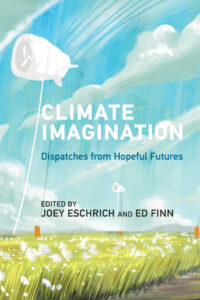
Climate Imagination: Dispatches from Hopeful Futures is available from MIT Press.

Joey Eschrich, Libia Brenda, Vandana Singh, Gu Shi, Hannah Onoguwe
Joey Eschrich is the co-editor of Climate Imagination: Dispatches from Hopeful Futures. Libia Brenda, Vandana Singh, Gu Shi, and Hannah Onoguwe are contributing writers to the anthology.