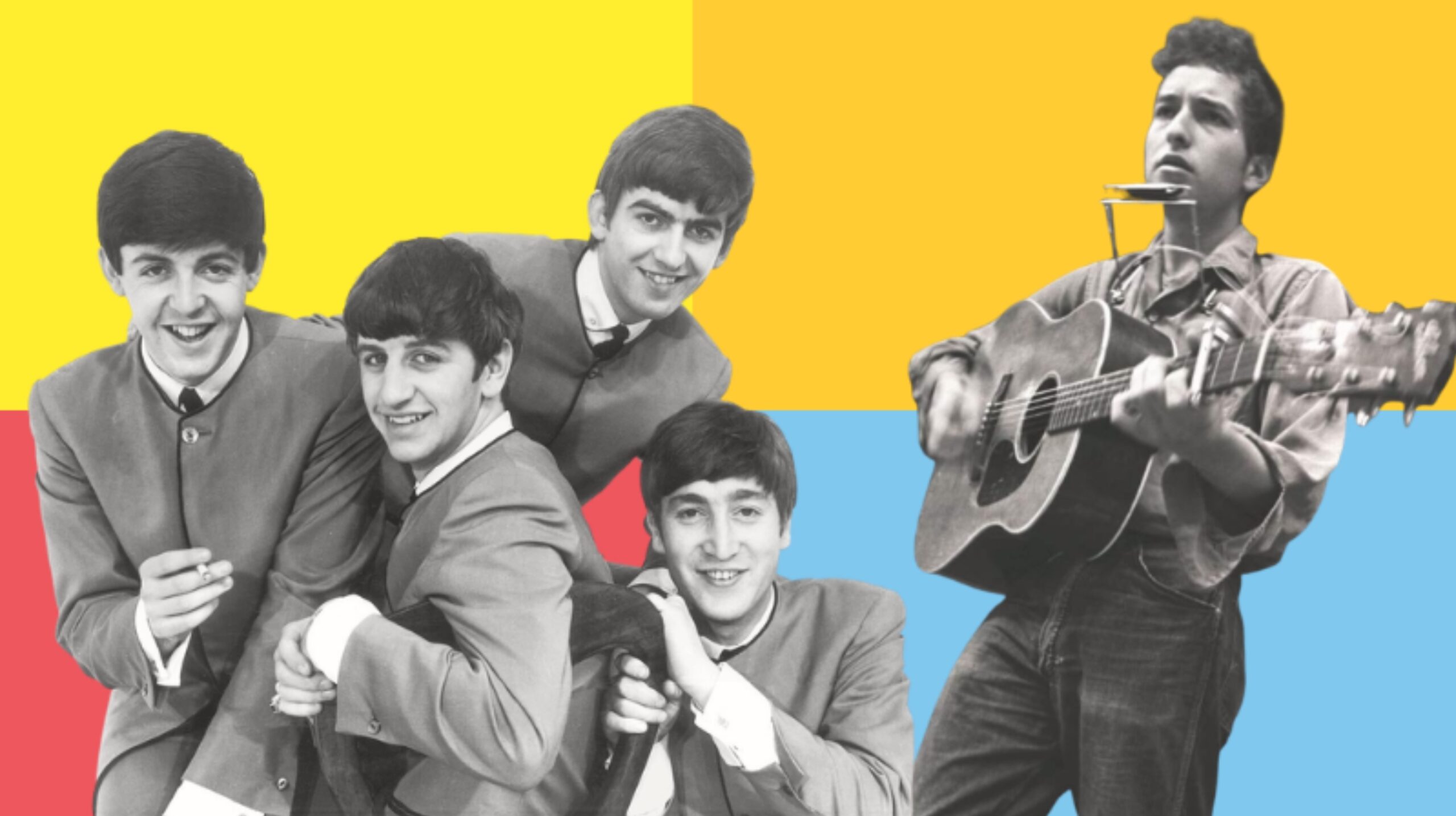
On the Unique and Ongoing Relationship Between Bob Dylan and the Beatles
Jim Windolf Explores the Lengthy History (And Present) Between the Cultural Icons
“What about Bob Dylan?”
That was the question put to Paul McCartney shortly after the Beatles had first come to America in February 1964. The man holding the microphone was Murray Kaufman, a popular New York disc jockey who went by the name Murray the K. He was a resourceful, persistent man who had managed to break through the crowds and police barricades outside the Plaza Hotel and install himself in the Beatles’ inner sanctum on the twelfth floor.
“Robert Dylan,” Paul replied. “Fantastic. Very good indeed.”
He wasn’t just being polite. Shortly before their arrival in New York, during a lengthy residency in Paris, McCartney, John Lennon, George Harrison, and Ringo Starr had listened to Dylan’s first two albums again and again in their suites at the George V hotel. “Paul got them off whoever they belonged to, and for the rest of our three weeks in Paris we didn’t stop playing them,” John would later recall. “We all went potty on Dylan.”
Murray the K’s question to McCartney suggested that, even then, in the early days of Beatlemania, Bob Dylan and the Beatles went together in the public mind, though Dylan had yet to go electric and was regarded as a serious folk music poet, and the Beatles were best known, in the United States, at least, for their unusual hair, their excitable fans, and their energetic hit, “I Want to Hold Your Hand.”
After landing a few more exclusive interviews with John, Paul, George, and Ringo, Murray the K started referring to himself on the air as the fifth Beatle. Nobody quite believed that a forty-one-year-old New York deejay in a porkpie hat had much to do with the rise of a group from the north of England, but the notion that there might be some unsung or overlooked Beatle would prove to have real staying power.
Dylan’s supple voice was front and center, floating above a crisp acoustic guitar locked in with a prominent bass.
For second-generation fans like me, the idea served as a kind of prompt, giving us the premise we needed to trot out the bits of knowledge we had gathered and to put our affection into words. Was George Martin, the producer who was integral to their sound, the fifth Beatle? Or was it their manager, Brian Epstein, who had brought them from Liverpool to the wider world? When I was a kid, that was the kind of thing I talked about with my best friend in the hours we spent by the stereo in the living room of his house, listening to his big sister’s worn copies of Sgt. Pepper’s Lonely Hearts Club Band and the compilation albums 1962–1966 and 1967–1970.
Dylan didn’t have the same presence in our lives, but we knew he was a big deal. For one thing, there he was, on the cover of Sgt. Pepper, standing among the personages held in high regard by the Beatles. One day my friend and I went into his sister’s quiet bedroom and found something by Dylan in her record stack. It was Before the Flood, a live album he had made during the tour he had undertaken with the Band in 1974, after some years away from the concert stage. We gave it a try, only to find it harsh and forbidding, as if it wasn’t meant for us. But not long after that, when I was almost twelve, I went to Dylan on my own. What did it for me was “Hurricane,” a single he put out toward the end of 1975. It wasn’t a big hit, but it was played on the radio now and then—and when I heard it, I was entranced.
At more than eight minutes, it was an epic that brought attention to racist law enforcement practices through Dylan’s recounting of the arrest, imprisonment, and trial of the boxer Rubin “Hurricane” Carter. I was pulled in by the story, which took place in Paterson, New Jersey, a city close to the tranquil suburb where I lived, but I was also drawn to the overall sound. Dylan’s supple voice was front and center, floating above a crisp acoustic guitar locked in with a prominent bass. A melancholy violin weaved in an out, as if commenting on the action. Drums and congas came to the fore whenever the band seemed in danger of breaking down.
During the brief appearance of “Hurricane” on the pop charts, I was a regular listener of the syndicated radio show American Top 40. I took nerdish pleasure in following the fortunes of hits as they made their way up and down the rankings, and I tended to favor songs that owed much of their appeal to lush arrangements or effects made possible by recording studio technology, a varied parade that included David Bowie’s “Fame,” Steely Dan’s “Rikki Don’t Lose That Number,” and Barry White’s “Can’t Get Enough of Your Love, Babe.” In this context, “Hurricane” stood out—rough, ramshackle, raw.
After it had left the charts, I fell for something at the other end of the musical spectrum, the glossy, disco-inflected “Silly Love Songs,” which would be the biggest selling single of 1976 in the U.S. It was written, arranged, produced, and sung by Paul McCartney (and credited to his band, Wings), with an emphasis on his rubbery bass line and the distinctive vocal harmonies that were so much a part of his post-Beatles work. Its lyrics were as far removed from the world of “Hurricane” as its slick sound, offering a sly defense of the composer’s unwavering belief in the love song as a vehicle for serious self-expression. Later that year, I had a new favorite: George Harrison’s “Crackerbox Palace,” a dreamlike evocation of childhood experience that seemed somehow to match up with my own.
The first albums I bought included Dylan’s Hard Rain, McCartney’s Band on the Run, Harrison’s Thirty-Three & 1⁄₃, and the Lennon compilation Shaved Fish, which scrambled my brain as it whipsawed from the gentle utopianism of “Imagine” to the horrors of “Cold Turkey.” The years went by, and I did not put those records away. And after I had been working as a journalist for a while, I thought I saw hints of a story—the long and eventful relationship between Dylan and the Beatles—scattered piecemeal across biographies, out-of-print memoirs, and long-buried articles.
Dylan met the Beatles in the summer of 1964 at the Delmonico Hotel in New York. For many years after that, John, Paul, George, Ringo, and Bob saw one another in various combinations. They got drunk and high together and shared meals at one another’s homes. They played advance pressings of their albums for one another, and on those occasions the sense of rivalry bubbling beneath the surface was apparent to others in the room: the Beatles were lukewarm in their initial reaction to Dylan’s Highway 61 Revisited, a landmark of twentieth-century music, and Bob was at first dis-missive of the Beatles’ groundbreaking sonic experiments for the album Revolver. “Oh, I get it,” he told Paul. “You don’t want to be cute anymore.”
Over the following decades, Harrison and Starr attended a great number of Dylan shows, sometimes joining him for a song or two and visiting with him backstage.
Along with the competitiveness and cutting remarks, there was admiration and respect. At the height of Beatlemania, Bob stood in the wings of the Paramount Theatre in Manhattan to watch the group make its way through twelve songs as waves of screams washed over the stage. Eight months later, the four Beatles sat in a private box at the Royal Albert Hall in London as Dylan, solo in the spotlight, held the audience spellbound. A year after that, when Dylan was getting booed and heckled in venues across America and Europe after having shape-shifted from a man-of-the-people folk singer to a Byronic rock god backed by a four-piece band, the Beatles cheered him once again at the same theater.
In the summer of 1969, as the Beatles were nearing the end, John, George, and Ringo joined the festival crowd at the Isle of Wight to see a milder Dylan give his first full concert in more than three years. Over the following decades, Harrison and Starr attended a great number of Dylan shows, sometimes joining him for a song or two and visiting with him backstage. McCartney has seen Dylan in concert in recent years and described at length his influence on the Beatles in his 2021 book, The Lyrics.
They seemed never far from one another’s thoughts. During the “Get Back” sessions of January 1969, the Beatles ran through parts of fifteen Dylan songs; and Bob has played Beatles songs—in the studio, during rehearsals, or on the concert stage—in the 1970s, 1980s, 1990s, 2000s, and 2010s. “They took all the music we’d been listening to and showed it to us again,” Dylan said in a 1976 interview. “They have every-thing in their music from Little Richard to the Everly Brothers. They helped give America’s pride back to it. There ought to be statues to the Beatles.” In the only interview he gave in 2022, Dylan singled out for special praise two songs written chiefly by Paul, “Eleanor Rigby” and “Paperback Writer,” and called Ringo “a great musician.” “If I’d had him as a drummer, I would’ve been the Beatles, too,” he said. “Maybe.”
Dylan wrote songs with Harrison in 1968 and again twenty years later as part of the Traveling Wilburys, the shambling supergroup that put him back in the pop charts after some wayward years. In 1990, during a show in Edmonton, Alberta, Dylan offered a one-off performance of the Beatles’ “Nowhere Man,” a song written by Lennon under Dylan’s influence. In 2004, midway through a show in Boone, North Carolina, for a reason known perhaps only to himself, Dylan sang new lyrics to “Tears of Rage,” a song he had cowritten with Richard Manuel of the Band in 1968, to add in mentions of two Liverpool landmarks made famous in Beatles songs.
I’ve never been to Strawberry Fields
I’ve never been to Penny Lane
But I’ve been down in the willow garden
And I’ve ridden the hell-bound trains
In 2020, he invoked the Beatles once more in “Murder Most Foul,” his meditation on the assassination of John F. Kennedy and the popular culture that rose from the tumult of the sixties.
Dylan was the embodiment of the skeptical, often aloof individualist, while the Beatles presented an ideal of unity and friendship.
He was especially at ease with Harrison, who had a habit of dropping phrases from Dylan songs into interviews and everyday conversation. “George quoted Bob like people quote scripture,” said Tom Petty, a fellow Traveling Wilbury. Lennon made Dylan laugh, but their relationship was more charged—two lions circling each other. Lennon referred to Dylan by name in songs he recorded in 1968 (“Yer Blues”), 1969 (“Give Peace a Chance”), and 1970 (“God”), and he expressed a desire to work with him a few years later. When John and Bob were living not far from each other in Greenwich Village in the 1970s, Dylan sent a letter to the U.S. government on behalf of Lennon and his wife, Yoko Ono, in support of their efforts to avoid deportation. Four decades later, Dylan wrote “Roll On, John,” a tribute to Lennon in which he likens the song’s subject to Odysseus and name-checks his first group, the Quarry Men.
Dylan and McCartney grew close in 1971, when Paul was making the album Ram in Manhattan and Bob was living with his family in a townhouse in Greenwich Village. “We used to go round to dinner, and he would come up and see us,” McCartney said. “We were staying at the Stanhope Hotel, and he would come up and have dinner with us. We’d go down there. So we were really quite intimate.”
Of all the Beatles, Bob might have the most in common with Paul, despite their differences in bearing and public image. Both are born entertainers with ever-active creative powers who have proved unable to tear themselves away from studio and stage into their eighties. Both have egos sturdy enough to withstand the adulation and the often-harsh criticism that have followed them through the decades. And both have wide-ranging tastes in music, making them perhaps the only two singers who have rapped on a record (Dylan on “Street Rock,” a 1986 duet with Kurtis Blow; McCartney on the 1987 track “Atlantic Ocean”) and made albums of standards from the prerock era.
The careers of Dylan and the Beatles followed the same twists and turns. While the similarities resulted, in part, from chronological happenstance and societal tides beyond their control, no one else went through what they went through. They had an outsize effect not only on popular culture but the world at large, an influence that sparked to life when they offered themselves to a populace increasingly shaped by a generation hungry for the messages the conveyed. They came to be seen not so much as entertainment stars in the mold of their two most analogous predecessors, Elvis Presley and Frank Sinatra, but as seers or gurus, a role they sometimes courted with songs of grand pronouncement (“The Times They Are A-Changin’”; “All You Need Is Love”) and sometimes dismissed with shows of disdain.
They hit similar heights, but did not move in lockstep. Dylan was the embodiment of the skeptical, often aloof individualist, while the Beatles presented an ideal of unity and friendship. Dylan could be bleak in songs that grappled with injustice and the closer-to-home pains of love and loss, delivering them with a voice-in-the-wilderness anger or the mournful acceptance of Ecclesiastes, while the Beatles tended to glow with an exuberance steeped in a more optimistic worldview bolstered by their love for one another. As Dylan wrote of the Beatles in his 2004 memoir, Chronicles: Volume One: “They offered intimacy and companionship like no other group.” Throughout much of their evolutions, Dylan and the Beatles worked in a state of mutual awareness, minds in dialogue. Who else could even begin to understand?
__________________________________
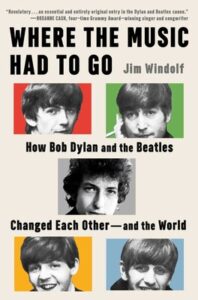
Excerpted from Where the Music Had to Go: How Bob Dylan and the Beatles Changed Each Other—and the World. By Jim Windolf. Copyright © 2026. Reprinted by permission of Scribner, an Imprint of Simon & Schuster, LLC

Jim Windolf
Jim Windolf is a features editor at The New York Times. He has published articles, reviews, essays, and humor pieces in Vanity Fair, The New Yorker, New York magazine, Rolling Stone and other publications. Additionally, his short fiction has appeared in Ontario Review, 3:AM Magazine, Puerto del Sol and other literary journals. He lives in New York City.