On the Struggle to Be a Good Man in Vivek Shraya’s I’m Afraid of Men
Costa Beavin Pappas Considers the 2018 Memoir
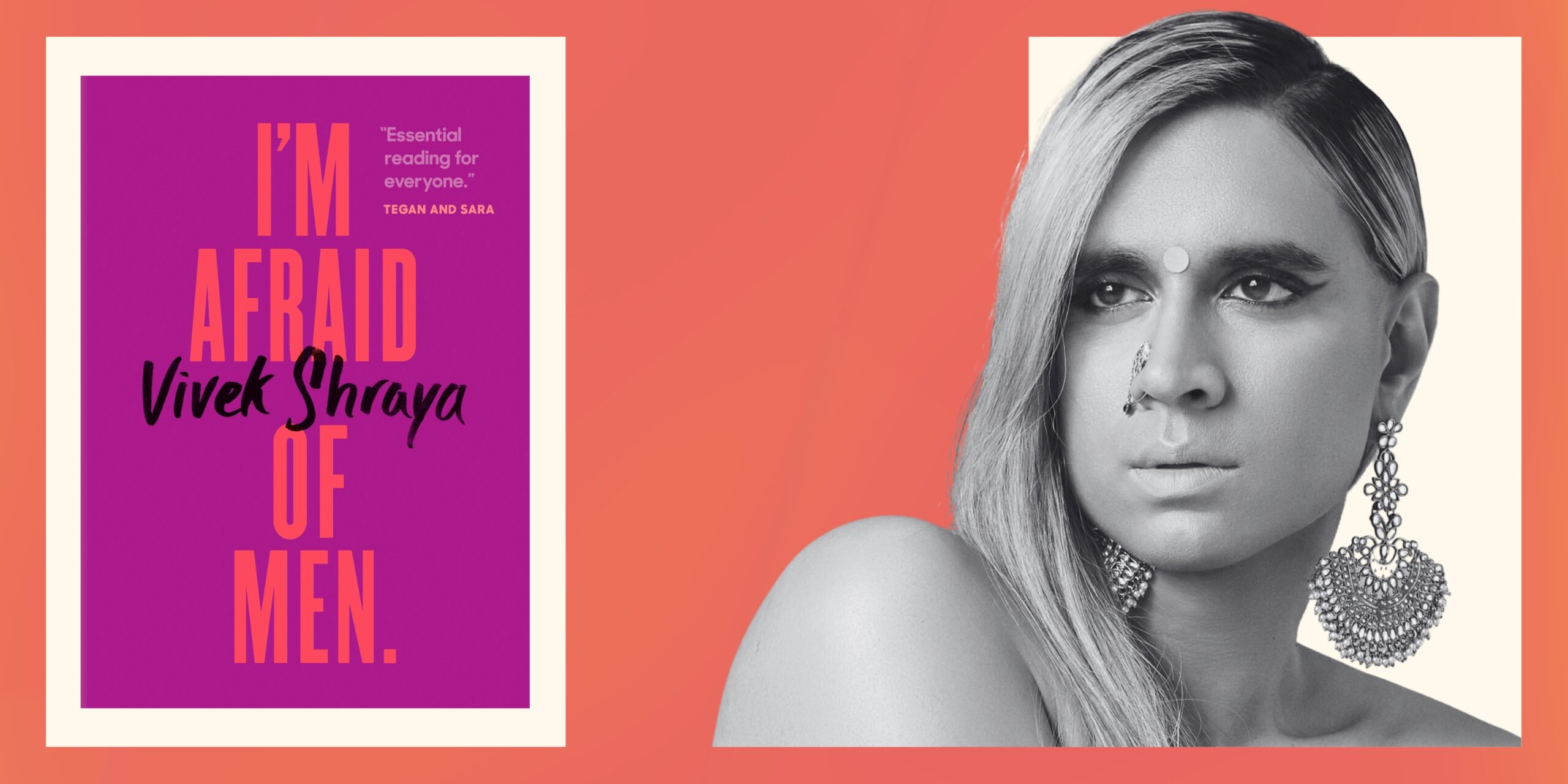
“I’m afraid of men because it was men who taught me fear,” Vivek Shraya writes as the opening line of her memoir, I’m Afraid of Men (2018/Penguin Canada). The short memoir, at just under 100 pages, tackles one interconnected topic after the other—love, fear, identity, the performance of gender… In her pursuit of answers, the Canadian multimedia artist and filmmaker sketches a reimagining of manhood that is neither binary nor an alibi. Instead, the story deconstructs the restraints of manhood that inherently impact everyone from the sheer weight, expectations, and fear that has propped up a patriarchal-centered portrayal of manhood.
The seven-time winning Lambda Literary Award finalist released her memoir in 2018, in the midst of the rapidly intensifying cultural and legal debates around trans rights. Nearly ten years later, the discussions raised from the text are just as pertinent. Shraya’s memoir doesn’t focus on the political aspects of transness, but the social. Within this framework, her writing excels in its duality: the concept of fearing men and yet caring for them on an individual and otherwise broader level. It’s this ingrained tension that ignites cultural standstills—“I hate all men” vs. the reactionary argument of “it’s not all men.” Shraya’s work enters the conversation through a different framework, instead, centering self-healing as the lens to reckon with her own fraught relationship to men and manhood.
Often, self-healing requires a reckoning with the past—understanding what it means to come of age under the weight of gendered expectations, and sifting through the debris of adulthood to ask which parts belong to you and which belong to gender.
The prose feels like a manifesto and therapy session in one, alternating between the first-person and second-person as she confronts moments of her life. As she recounts the story of a high school crush who she had discovered had threatened to harm her because of her perceived attraction to him, she writes, “I can’t summon any other word or sound to articulate the shock of having my belief in our mutual attraction crushed and simultaneously finding out that you want to hurt me physically.”
But Shraya turns the lens onto herself as well. The years leading up to her transition were a cycle of performing, failing, briefly succeeding and yet within said success, still failing. The success itself cost a disavowal of who she was all while, as she wrote, being obsessed with the idea of “being a good man.”
What do we call a good man who has done wrong things? Or, how—or, can we even—separate a man from his mistakes?
Often, Shraya centers this ethical debate of a man’s goodness around her relationship with Nick, a slow-burn friend-turned-“good” boyfriend, until there’s a crack: she discovers he cheated. “My first instinct is to not tell any of my friends what you’ve done, because you’ve become the embodiment of masculine hope to all of us,” she writes in a passage. “I don’t want anyone to lose hope.”
There proves a fundamental, existential dilemma. What do we call a good man who has done wrong things? Or, how—or, can we even—separate a man from his mistakes? Within this moral dilemma, Shraya writes along a fascinating intersection about gendered goodness–what makes a man a “good” man vs. what makes a woman a “good” woman?
“We rarely hear, ‘I thought she was one of the good girls,’” she writes. “Women who behave ‘badly’ are ultimately not given the same benefit of the doubt as men.”
She goes in deeper, writing alongside her dynamics with men and women—queer and heterosexual. She discusses her fear of women, of the women who embody the traits of the patriarchy and who defend said patriarchy. As she writes, “I’m afraid of women who’ve either emboldened or defended the men who have harmed me, or have watched in silence.”
One particularly insightful moment into gendered dynamics comes from an exploration of her confusing relationship in conjunction with queer men. Shraya writes of the male-dominated (white) gay bar culture, and how she tries to understand her own place in these systems. In one line, she writes, “…queerness is associated with freedom from boundaries. Thus, any boundary is inherently un-queer.”
What brings Vivek’s story full circle is her confrontation with her own pursuit of mythical goodness, and expecting it from others. “When I was a man, I too was obsessed with being a good man. And I too failed—not at masculinity but at achieving and upholding goodness.” She writes, “Instead of yearning for a good man, what if we made our expectations for men more tangible? What if, for example, we valued a man who communicates?”
Almost like a breakthrough in therapy, the rocky road of self-reflection and healing ultimately leads to a realization: breaking the binaries of gender also means breaking the binaries that structure our moral expectations—goodness versus badness. Shraya seems to find comfort within this grayness, and in the autonomy that comes from shifting the question from who is good and who is bad to who is good for me. In doing so, the memoir arcs outward, moving from a personal reckoning with gender towards an open-ended, existential understanding for readers to grasp on their own.
For anyone who has been afraid of men, Shraya’s work might not alleviate the fear, but it will set you free from expectations.

Costa Beavin Pappas
Costa Beavin Pappas is an arts and culture writer with bylines in the Los Angeles Times, ELLE, Oprah Daily, ARTNews, BOMB, and the Northwest Review, among others. He splits his time between New York and Cairo, where he is working on his debut novel.