On the Rise of Pitchfork and 21st-Century Music Criticism
Ronen Givony on the Early Days of Music Reviewing
In 1994—when a young Jeff Bezos started Amazon, and Yahoo! went live, and Netscape launched the first commercial browser for the World Wide Web—a friend of Ryan Schreiber’s introduced him to the Internet. A recent graduate of Hopkins High School, in suburban Minneapolis, near Paisley Park, he was a fan of college radio, a sometime record-store cashier, and a voracious reader of the music press.
From local zines (The Squealer, Cake) and the alternative glossies (Magnet, Puncture, Ray Gun, and Spin) to legacy magazines (Rolling Stone), the world of print, professional and amateur, was flourishing—an era when arts journalism and the written word held sway. “It was the height of ’90s zine culture,” he said, “so there were all these sort of DIY fanzines floating around.” At a nearby Borders bookstore, there was an entire shelf of smart, opin-ionated publications like Q and Mojo, where he spent hours, engrossed.
In 1995—when Match.com, The Drudge Report, Salon, and Craigslist all debuted—he started a webzine called Turntable from his childhood bedroom, using a dial-up connection. “All my friends were doing Xeroxed zines, and some small local papers were able to get interviews with artists that I really liked,” he later said. “I thought, ‘It can’t really be that difficult if these guys are doing it. Why them and not me?’ ”
Was it preferable to have 100,000 diehard fans, or millions of casual ones? Should one aspire to the widest possible platform, or was there necessarily a compromise involved?
It was a monthly publication in its infancy. Before Turntable, Schreiber hadn’t written much. He didn’t know a single person at the record labels, so he improvised. He called the public library and asked if there were any listings in the phone book for a Sub Pop in Seattle, or a Merge in Chapel Hill—and then he sat on hold. Each number took twenty minutes. Several hours later, he had the makings of a list.
He started calling publicists for artist interviews. They asked where they should mail promotional CDs. “Once I found out that they could send me free music,” he said, “I was like, ‘Game over. This is what I’m doing.’ ” He interviewed a young band from Duluth named Low, as well as David Byrne, Ben Folds, and Modest Mouse. His parents had a fit each time the phone bill came, but he had found a vocation. He got himself on mailing lists for labels large and small, from Capitol to Kill Rock Stars. It was a decade when the line dividing indie bands from major-label ones was all-defining, unambiguous, even a matter of allegiances: a stance the Internet was making obsolete.
Around the time that Schreiber was discovering the Web, the Berkeley punk temple 924 Gilman Street would banish Green Day from its stage—where they had played as teenagers—for the infraction of signing with a major. In 1994, the zine Maximumrocknroll devoted a whole issue to the topic (“Some of Your Friends Are Already This Fucked: Everything You’ve Wanted to Know About Major Labels”), illustrated with a dark, demonic octopus to sym-bolize the major media conglomerates.
When Schreiber was in high school, Kurt Cobain wore a shirt that said “CORPORATE MAGAZINES STILL SUCK” on the cover of Rolling Stone; Nirvana sold T-shirts that read “FLOWER SNIFFIN / KITTY PETTIN / BABY KISSIN / CORPORATE ROCK / WHORES.” And in the pages of The Baffler magazine, the engineer-musician Steve Albini wrote “The Problem with Music,” a jeremiad itemizing the exploitation of the major labels—and by extension, the corporate world at large:
Whenever I talk to a band who are about to sign with a major label, I always end up thinking of them in a particular context. I imagine a trench, about four feet wide and five feet deep, maybe sixty yards long, filled with runny, decaying shit. I imagine these people, some of them good friends, some of them barely acquaintances, at one end of this trench. I also imagine a faceless industry lackey at the other end, holding a fountain pen and a contract waiting to be signed.
It was the same debate within the indie world that would define Pitchfork’s trajectory in the decades to come. Was it preferable to have 100,000 diehard fans, or millions of casual ones? Should one aspire to the widest possible platform, or was there necessarily a compromise involved? Is it inherently unethical to get in bed with a massive corporation—or simply a concession to reality?
Percentages would soon become their signature two-digit score, on a scale from zero to ten. The Pitchfork era had begun.
In 1996, the year he turned twenty, a CD-ROM company named Turntable sent him a cease-and-desist, “which scared the fucking shit out of me,” Schreiber said. In keeping with the pugilistic criticism of the day, he changed the name to Pitchfork: a reference to the movie Scarface, where Al Pacino’s pitchfork tattoo was code for an assassin. “When I started out, it was about really laying into people who really deserved it,” he told The Washington Post. “To me, it underscored that we were going to be tougher as critics.”
Pitchfork’s origins in adolescent earnest-ness were most reflected in the weight assigned to grades. Much like The Source and Rolling Stone, the site evaluated records on a scale, but one designed for scientific precision. The scores were given as percent-ages initially: if seven out of ten tracks were interesting, it got a seventy percent. But then, the math was rarely so straightforward. The website’s first review was of Pacer, by The Amps, a project of Kim Deal; it got an eighty-two percent. “Kim Deal set out to record a different kind of rec-ord and came out with one that’s so terrific, it won’t leave my discman [sic] for at least three days,” Schreiber wrote. Percentages would soon become their signature two-digit score, on a scale from zero to ten. The Pitchfork era had begun.
It was a golden age for indie bands—Sleater-Kinney (8.3), Yo La Tengo (8.1), Neutral Milk Hotel (8.7)—and Pitchfork’s coverage reflected as much. Their calling card was Anglophone guitar groups of the ’90s, but they also wrote about Steve Reich (5.8), Grace Jones (8.1), Albert Ayler (9.8), Noam Chomsky (8.5), Lauryn Hill (8.0), and Julio Iglesias (7.0). They champi-oned melodic indie rock like 69 Love Songs (8.0), The Lonesome Crowded West (8.9), and Keep It Like a Secret (9.3); innovative electronic music from Amon Tobin (9.8) and DJ Shadow (9.1); and Twin Cities groups like 12 Rods and Walt Mink, who both were given perfect 10s.
They didn’t shy from sacred cows: they panned The Flaming Lips (0.0) and Sonic Youth (0.0). They were particularly fond of The Dismemberment Plan’s Emergency & I (9.6), which they picked for their “Top 100 Albums of the ’90s” before it was even in stores. At times, their judgments were perverse, like when they wrote about Pet Sounds (7.5) (“passe and cliched [sic]”) or The Boy with the Arab Strap (0.8) (“Maybe next time”). Reviews were penned by Schreiber and his friend Jason Josephes at a clip of two per day, and usually a single paragraph. The writing ranged from functional to incoherent.
They had 300 daily visitors after a year and more CDs than they knew what to do with, so they published a call for writers.
But on the whole, their taste was sound, their batting average high, and people noticed. One day, they got an email from a record store about a banner ad. Schreiber asked for $500. “They were like, ‘Sounds great!’ ” He started calling magazines to ask about their rates.
There were some record labels keen to advertise—publicity budgets had yet to be slashed—but revenue was nominal, time-intensive, and a conflict of interest to boot. “Selling ads was just a slog. The ads were dirt-cheap,” Schreiber said. “It was almost like asking for donations. And these were [labels] whose records we were already reviewing. It was kind of odd that you’d be talking to someone about ad stuff and then it would switch to editorial. It just wouldn’t feel right.” It was an ethical predicament at every level of the media: from Vice up to The New York Times, the long-established firewall that separated editorial from busi-ness would become increasingly porous.
They had 300 daily visitors after a year and more CDs than they knew what to do with, so they published a call for writers. Among the first to answer was Mark Richardson, a future editor-in-chief, and Amanda Petrusich, who went on to The New Yorker. The terms were onerous: reviewers had to file twice a week for six whole months with-out payment, aside from free records—at which point, they earned a fee of $20 per review, and $40 for a feature. (To be fair, it was the Mesozoic phase of the Internet; no one was making much.) Schreiber was twenty-three. He ran the website from his parents’ house during the day, and worked at night in telemarketing.
By 1999—when Napster went online, and Coachella had its first festival—the site had reached 2,000 daily readers. Using eBay, Schreiber pruned his records and moved to Chicago. He now could post reviews and features from some fifty writers, in genres that the site had long neglected: hip hop, metal, and dance, to name a few. He also had competitors: PopMatters (est. 1999); Drowned in Sound and Chromewaves (2000); Tiny Mix Tapes and Glorious Noise (2001); Stereogum, Fluxblog, Cokemachineglow, Stylus, and Dusted (2002).
What set Pitchfork apart? For one, their unflagging productiveness and drive. They published two reviews a day, then four, then five, which added up to twenty-five a week: a round-the-clock compendium of rising talent, sunken treasure, and emerging trends. They gave the art of criti-cism a significance and urgency. Where Spin and Rolling Stone would run reviews toward the back, by the classifieds, the Pitchfork team knew that a new album could still be an event, as was the case on October 2, 2000, with Radiohead’s Kid A (10.0).
A fan himself, Schreiber knew well how many were champing at the bit for OK Computer’s follow-up, and had been doling out a steady drip of articles before release. “It’s clear that Radiohead must be the greatest band alive,” Brent DiCrescenzo wrote in an extravagant review. Schreiber tipped off several fan sites in advance and watched as over 5,000 readers poured in. “I remember the date like a birthday,” he told Billboard. “The web traffic was literally off the charts. I used a very small, local ISP and had a basic hosting plan, and the analytics maxed out beyond a certain point.” By mid-2001, the site was up to 3,000 reviews, and 30,000 visitors a day.
The Washington Post, The Guardian, Slate, and Wired were writing of “the Pitchfork effect”: the site’s ability to lift an artist from obscurity at its whim.
They brought a palpable delight to the often-jaded world of criticism. The Pitchfork writers actually enjoyed listening to music—a rarer trait among the industry than one might think. What they lacked in gravi-tas, erudition, or grammar, they compensated for with absolute belief, exuberance, and desire for all things new. In “Top 100 Favorite Albums of the ’90s,” Schreiber wrote eagerly: “Since Pitchfork’s conception in November of 1995, I have been waiting patiently for the day when we would be able to bring you this feature.”
In a review of Yo La Tengo (9.7), Jason Josephes wrote, “The greatest band in the universe is back with their ninth studio release, I Can Hear the Heart Beating as One. What a terrible title!” They weren’t afraid to plant a flag. In 1999—when Rolling Stone had Limp Bizkit, Kid Rock, and Eminem among their singles of the year—the Pitchfork year-end list included Godspeed You! Black Emperor (9.0), The Beta Band (8.8), and Bonnie “Prince” Billy (10.0). Where Spin would name Nirvana’s Nevermind the “greatest” album of the ’90s, it only came in sixth on Pitchfork’s Top 100—behind Guided by Voices, Liz Phair, and My Bloody Valentine, their number one. (At the same time, their “Top 100 of the ’90s” had a single hip hop album—by the Beastie Boys—and, aside from Amon Tobin, not a single artist of color.) But most of all, they did the work that almost no one else would do.
They plowed through hundreds of promotional CDs and MP3s, one-sheets and press kits, day in and day out. They took a chance on groups that most had never heard of, based on simple curiosity. On February 2, 2003—when Rolling Stone had Shania Twain on its cover—Schreiber wrote about a recent discovery: a Toronto band named Broken Social Scene (9.2). “It’s a bit late to be talking about New Year’s resolutions, but mine was to dig through the boxes upon boxes of promos that arrive at the Pitchfork mailbox each month, and listen intently to hundreds of them in one sitting, in an attempt to discover those rare, impossibly great bands that would otherwise slip through the cracks.”
For all the wonders of the Internet, you had to sift through mountains of well-intended flops, misfires, and mediocrity—or find a trusted guide. In March 2003, the Best New Music section launched, highlighting young artists such as The Books (8.4) and Sufjan Stevens (8.5); musicians in mid-career like Deerhoof (8.3) and The Wrens (9.5); and even the occasional pop star, such as Jay-Z (8.0), Cee-Lo (8.3), or Kanye West (8.2).
By 2004, the site was up to 115,000 daily visitors. The staff had grown with budding writers such as Nitsuh Abebe, Tom Breihan, and Julianne Escobedo Shepherd; the quality improved by leaps and bounds. The Washington Post, The Guardian, Slate, and Wired were writing of “the Pitchfork effect”: the site’s ability to lift an artist from obscurity at its whim.
“Obviously, I never foresaw that it would get quite this big,” Schreiber told the New York Observer in 2004. “I was sort of ambitious about it, but it’s obviously gone so far beyond my expectations that it’s hard for me to believe that this is my job.” Meanwhile, the staff had raised concerns about their pay, or lack thereof. The tension boiled over when the site’s financials were left on an unprotected server and posted online. They revealed that Pitchfork had been making more from ads than some were led to believe. The rates were raised to $80 for reviews and $110 for features. To grow the company, Schreiber hired his first full-time employees: Chris Kaskie, who sold ads, and Scott Plagenhoef, as managing editor.
A turning point in terms of real-world influence came on September 12, 2004, with an ecstatic review of Funeral (9.7), the second album from a rising band named Arcade Fire. “Ours is a generation overwhelmed by frustration, unrest, dread, and tragedy,” wrote David Moore. “Funeral evokes sickness and death, but also understanding and renewal; child-like mystification, but also the impending coldness of maturity.”
It soon became the fastest-selling album in the history of Merge Records, and its first to reach the Billboard 200. An equally significant appraisal ran in late September, when Travistan—the awkwardly entitled solo effort by Travis Morrison, of The Dismemberment Plan—would notoriously receive a 0.0 rating. “One of the most colossal trainwrecks in indie rock history,” went the review by Chris Dahlen, and with it, much of Morrison’s career, as stores declined to stock the record, and college radio chose not to play it either. With an authority held once by Rolling Stone, the eight-year-old upstart could make or break an artist instantly, somewhat to their surprise. “I don’t think it occurred to them that the review could have a catastrophic effect,” said Morrison. “Literally, the view changed overnight.”
By 2005—the year of Illinois (9.2), LCD Soundsystem (8.2), and Silent Alarm (8.9)—a Best New Music nod could catapult an artist to a worldwide following, or at a minimum, a semblance of stability. It meant the difference between an agency, a label scout, a manager—and, in turn, a license deal, a festival offer, another year to make a living from your art. It might have only meant a minimal amount of sales, in the age of file-sharing.
But in the vacuum left by Napster, the MP3, and the decline of print, a different kind of currency emerged: authentic human enthusiasm. From music blogs like Brooklyn Vegan, Productshop NYC, Largehearted Boy, Gorilla vs. Bear, and Aquarium Drunkard, there was a feeling of opportunity, excitement, and disruption in the air—a sense that amateurs online would constitute a new and democratic A&R, untainted by the star-making machine.
__________________________________
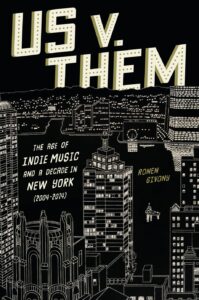
From Us V. Them: The Age of Indie Music and A Decade in New York (2004-2014). Used with the permission of the publisher, Abrams Books. Copyright © 2026 by Ronen Givony

Ronen Givony
Ronen Givony is the founder of Wordless Music, an orchestra and concert series that has worked with artists across genres, from Sigur Rós and Mica Levi to Terrence Malick and Paul Thomas Anderson. A curator for music festivals and venues in the United States and abroad, he is the author of two other books: 24 Hour Revenge Therapy (or, The Strange Death of Selling Out) and Not for You: Pearl Jam and the Present Tense. Born and raised in South Florida, he now lives in Carroll Gardens, Brooklyn.