On the Power of Maia Kobabe’s Gender Queer, One of the Most Banned Books of Its Era
Nico Mara-McKay Considers the Groundbreaking 2019 Graphic Memoir
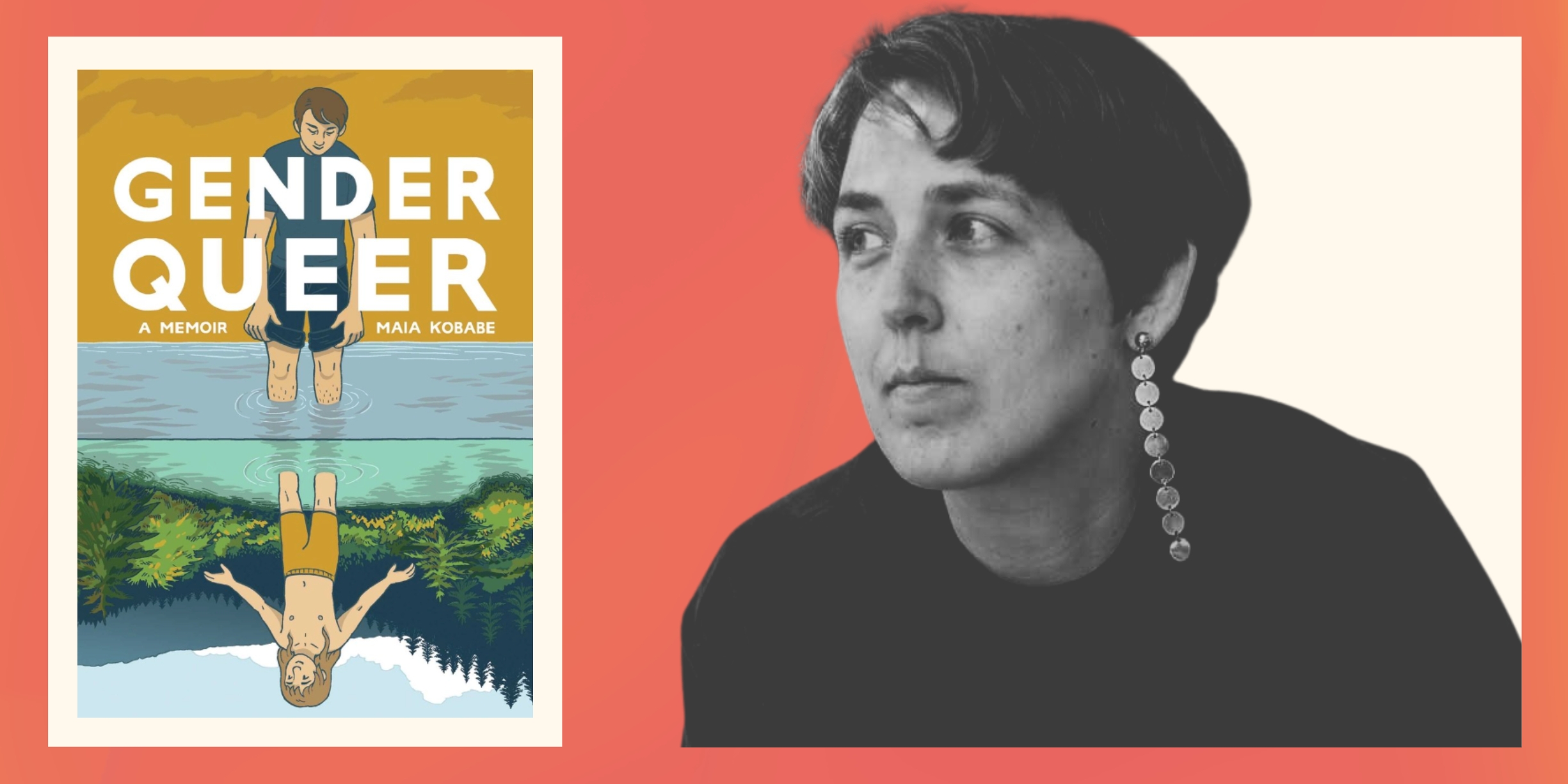
Maia Kobabe’s graphic memoir Gender Queer is a coming-of-age narrative that explores gender identity, sexuality, and the long, often circular process of coming out. First published in May 2019 by Lion Forge comics (which later merged with Oni Press), the book was met with widespread acclaim.
In the years since its release, however, Gender Queer has become one of the most challenged books in libraries across the United States. It topped the American Library Association’s list of most challenged books from 2021 to 2023, and ranked second in 2024. The backlash speaks less to the contents of the memoir itself (which few fueling the debates have read), than to broader conservative anxieties about queer and trans visibility.
Kobabe’s memoir unfolds roughly chronologically, documenting eir process of self-discovery through experimentation, reading, and navigating evolving relationships. Central to the challenges Kobabe describes is the lack of language available to articulate eir experiences at an early age. Without words that fit, understanding oneself becomes exponentially more difficult. Gender Queer supplies this missing vocabulary in clear and accessible language that will resonate with trans readers of any age, while also making these experiences legible to those who haven’t shared them.
Homeschooled for part of their childhood, Kobabe struggled early on with social expectations around gender that everyone else seemed to understand instinctively. Many of the early experiences Kobabe relates have echoes in my childhood: the glow of pleasure when other children couldn’t tell whether I was a boy or a girl, confusion about not being allowed to go topless as a small child, and complicated feelings about body hair and presentation.
For Kobabe, as for myself, these problems intensified during puberty. Kobabe depicts dysphoria marked by horror and shame at menstruation, disgust at reproductive capacity and expectations, relief at flattening bras, fantasies about breast cancer as an excuse for removal, sensing a phantom penis, wishing to be a boy or wanting a body that didn’t undergo these unwelcome changes. These moments are presented with candor and unguarded honesty; they are not sensationalized but rather presented as lived realities. They capture the sense of betrayal many trans people feel towards their bodies during puberty.
In response, Kobabe develops coping strategies to mitigate the effects of eir changing body: favoring baggy clothing, wearing pants in all seasons to avoid having to deal with body hair, wearing underwear marketed towards boys, dressing like a teenage boy well into adulthood. E also quietly gathers data by tracking arousal patterns and experimenting with sex toys, as well as through reading and talking to others.
Gender Queer has never been reviewed in The New York Times on its own terms, though it has been mentioned at least 27 times in discussions around censorship that frame it as “controversial.”
Moments of gender euphoria emerge throughout: a shorter haircut, clothes that feel more right, and being seen as “not a girl.” For Kobabe, the goal was not to embody masculinity, but to move towards something more androgynous; it was “more about not being female than being male.” This quiet, nuanced articulation of nonbinary experience is one of the book’s many strengths.
The memoir captures powerfully the anxieties of adolescence when questions about gender and sexuality spiral: Which label fits? How can I be sure? What if I’m wrong? Novels, manga, music, and fanfiction are referenced throughout the memoir as touchstones in Kobabe’s search for understanding and community. Revelations arrive slowly, “like little gifts,” particularly when Kobabe encounters Spivak pronouns (e/em/eir), which spark a sense of excitement.
Finding language and role models proved difficult. Early references to trans people were rare, but moments of learning, such as practicing pronouns for a nonbinary professor, are depicted with clarity and grace. Kobabe demonstrates how practice turns intentional effort into fluency, a lesson communicated with remarkable efficiency through the graphic medium.
Gender Queer also captures the challenges of self-advocacy and the fear of asking others to change: to use the correct pronouns, to see who Kobabe actually is. Correcting others and asking to be seen correctly requires immense courage. The memoir captures the exhaustion of repeated misgendering, each little cut as it wears one down. Kobabe conveys the quiet pain of being misgendered in ostensibly non-hostile environments and the fear of being perceived as inconvenient or rude. Yet, the joy of recognition when a coworker uses the correct pronouns in an email lands with equal force, illustrating how affirming it can be to simply be seen.
While the book contains a small number of images of nudity, they are presented with unguarded vulnerability, including depictions of distressing medical experiences. These illustrations underscore why books like Gender Queer matter: they show trans readers that their experiences are shared and that they are not alone.
Coming out, Kobabe shows, is not a single event, but a looping process that is repeated with friends, family, coworkers, students, and even oneself. When that process relies on unfamiliar language, the burden of explanation can feel endless; yet, without the chance to learn and practice, others are denied the opportunity to develop a broader understanding of human diversity.
Despite its impact, Gender Queer has never been reviewed in The New York Times on its own terms, though it has been mentioned at least 27 times in discussions around censorship that frame it as “controversial.” Some commentators have even refused to use Kobabe’s correct pronouns—an omission that directly echoes struggles depicted in the memoir itself.
Illustrated with warmth and heartfelt openness, and colored by Kobabe’s sister Phoebe Kobabe, Gender Queer began as a way to explain eir identity and sexuality to eir parents and extended family who supported Kobabe, but lacked understanding. In doing so, it has become a resource for countless others.
Gender Queer shows struggle without despair, confusion without cynicism, and growth without tidy conclusions. The people in it are depicted as messy, earnest, and trying their best. As a genderqueer person in my forties, this is the book I wish I’d had access to as a child.

Nico Mara-McKay
Nico Mara-McKay (they/iel) is a historian, writer, editor, and occasional curator whose work focuses on histories of gender and sexuality through lenses of embodiment and identity. They write about queer and trans history, culture, and community at nicomaramckay.com and ephemeralrecord.com, and share updates on Bluesky @nicomaramckay.com.