On the Particular Joys of Etymology and Polyglot Prose
Geoffrey D. Morrison on Learning and Teaching Languages As a Fiction Writer
I teach a very strange North Sea Germanic language called “English” to other people for work. I teach other people’s languages to myself for fun. Spanish and Norwegian are my mainstays, but I dabble intermittently in Catalan, Portuguese, Italian, and French, and would be very happy to properly learn Scottish Gaelic one day. I don’t call myself a “polyglot” because I don’t go barging into Sjømannskirkene or taquerias trying to make Youtube content. I am just someone who can speak a couple of foreign languages passably well and read semi-comfortably in a handful more, made easier because Norwegian is just what Yorkshire dialect would be like if 1066 never happened and the others are all in the same Romance family. I think that my work and my fun have done something to me as a writer of fiction, and today I want to try to articulate what that “something” is.
A discussion question to start with: does it mean anything that both Stéphane Mallarmé and James Joyce were enthusiastic learners of foreign languages who made their livings as English teachers? I want to say that it does. Mallarmé claimed to have learned English just to read Edgar Allen Poe, and spent decades teaching the language in lycees, by most accounts not very well (he apparently made his poor uncomprehending pupils translate King Lear). Joyce, who taught English at Berlitz schools in Pula and Trieste, is supposed to have known up to thirteen different languages; when he was nineteen years old he even wrote a fan letter to Henrik Ibsen in Dano-Norwegian. Together they are probably the nineteenth and twentieth centuries’ most famous exponents of the pun, the mishearing, the mondegreen as fundamental tools of ostensibly “serious” literature, and their works revel in sound’s ecstatic possibilities. Mallarmé plays in one poem with the homophony of the French “cygne” (swan) and “signe” (sign), and in his Divagations wanders around repeating to himself the cryptically suggestive phrase, possibly a hangover from a lifetime teaching English prosody, “La Pénultième est morte” (“The Penultimate is dead”). Joyce, in Finnegans Wake, has his Neolithic double-act of Mutt and Jute say things to each other like “Ore you astoneaged?” I think this is a sensibility that the teaching and learning of languages readily cultivate for those open to it.
The waxing and waning fortunes of languages are inevitably historical and political questions, and these questions are likewise delirium-inducing if we sit with them honestly.
A very simple example from my own teaching life: once a student whose first language was Korean asked to borrow “a fen”; she meant “pen,” but Korean speakers sometimes have trouble differentiating English p and f sounds. “Fen” is of course a word in English—an old, beautiful, and somewhat underused one—and the idea of asking to “borrow a fen” immediately places us in a totally different register, one where surreal recombinations of unexpected ideas are suddenly possible. Ore you astoneaged yet? It’s a good cygne if so.
What applies to my teaching applies just as surely to my learning. Recently I was trying to recall the Spanish for “to frown.” The answer is “fruncir el ceño,” literally “to furrow the brow,” but my brain wanted to say “fruñir,” a word that doesn’t exist. I concluded that I had essentially mashed “fruncir” and “ceño” together, doubtless with interference from the English “frown.” I was so annoyed at myself that I decided to compare the etymologies of “frown” and “fruncir” to see if they had anything in common. I would feel slightly better if so. However, what I found was totally unexpected.
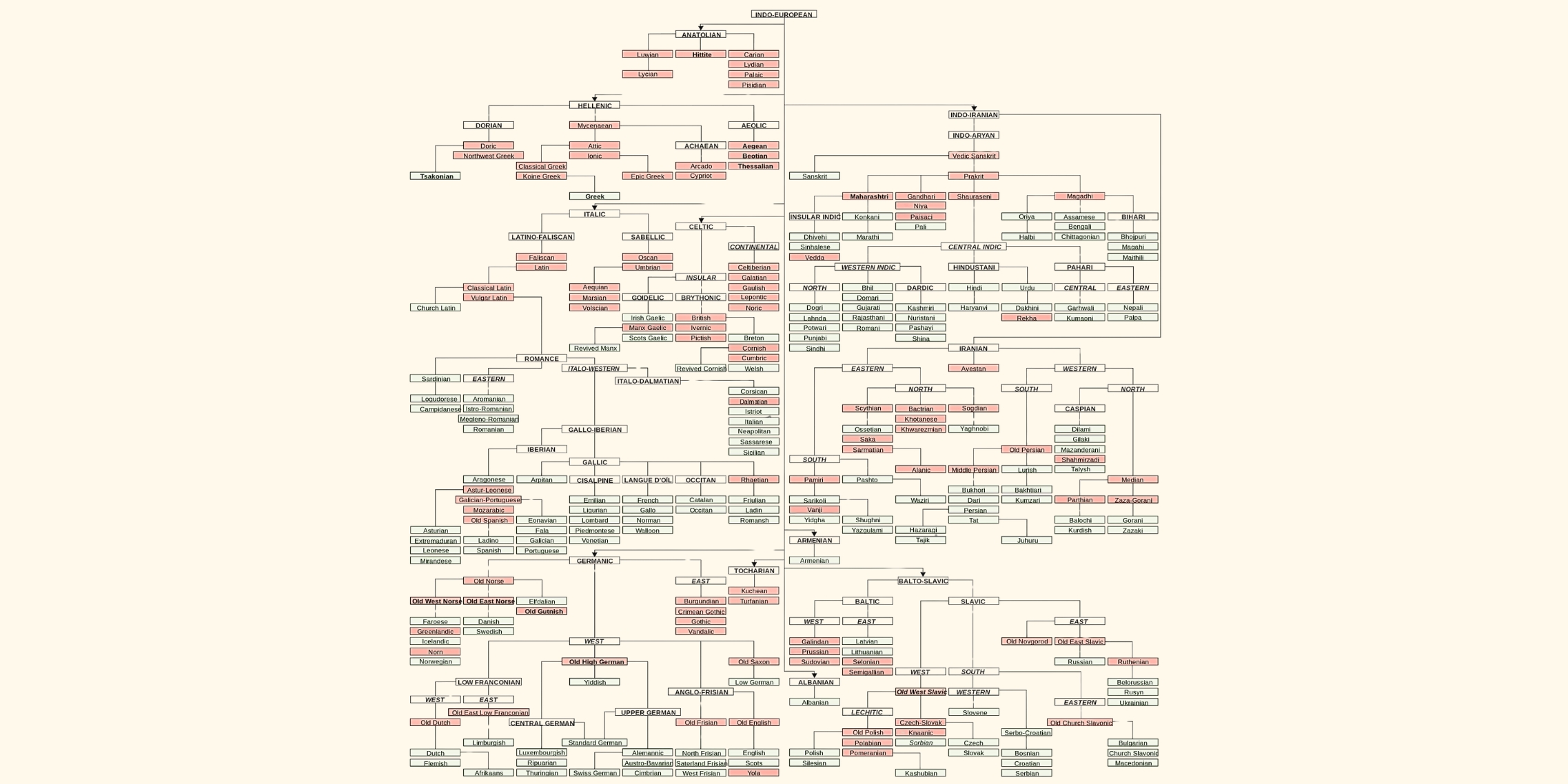
It turns out that English “frown” comes from Old French “frognier,” which itself likely comes from “*frogna,” meaning “nose,” in the now-extinct Celtic language of Gaulish. Gaulish gave French its infamously tricky base-twenty counting system, where eighty is “quatre-vingts,” but only a few hundred Gaulish-origin words persist in modern Metropolitan French. So the “*frogna” connection excited me a great deal. It would also mean that “frown” is a distant cousin of Welsh “ffroen” and Breton “froen” (“nostril”) and, with a shift from f to s, Irish “srón” and Scottish Gaelic “sròn” (“nose”). When “frognier” was borrowed into Spanish, however, it did not become “fruncir” but rather “enfurruñarse,” meaning “to get angry”—one of those pinch-hitting low-frequency vocab words that I’ve probably learnt, forgotten, and re-learnt several times over. I have vague memories of associating it with frowning, so I’m pretty sure I once made some link between “enfurruñarse” and “fruncir el ceño,” and that this also contributed to my erroneous “fruñir.”
Spanish “fruncir” comes from a different Old French word, “froncir,” which may itself come from “*hrŭnkjan,” a word from another now-extinct language called Frankish. Frankish was a Germanic language, as English is, and though it contributed the name of France and the French people it comprises only about 10% of the vocabulary of modern French. You can almost hear in “*hrŭnkjan” its English Germanic counterpart, “wrinkle.” Yet “froncir” itself was also borrowed into English, and survives, albeit just barely, as “frounce,” a word Milton once used in connection with curly hair. So by turning my frown, uh, al revés, a whole constellation of words now stand before me: frown and frounce; enfurruñarse and fruncir el ceño; Celtic noses and Frankish wrinkles.
It must be said that my writing voice in English sometimes feels stiffer nowadays, less blithely sure of itself, always fighting to keep my tongues from getting twisted. But at bottom I like having this problem very much.
This constellation is, I think, beautiful, in a way not completely distinct from delirium. Not least because the waxing and waning fortunes of languages are inevitably historical and political questions, and these questions are likewise delirium-inducing if we sit with them honestly. Anyone who “frowns” in English, cualquier persona que se enfurruñe en español, is unknowingly partaking in a game of linguistic pass-the-parcel that stretches back to a Celtic language which faded away in the face of Roman and then Frankish cultural dominance, and whose living relatives (Breton, Welsh, Scottish Gaelic, Irish) have had to struggle mightily for survival, including under conditions of colonialism and repression.
It’s dizzying to take stock of just how laden with historical significance any given language is—and, I venture, especially hard to do if we never stray from our mother tongues, which we so often take for granted. This is another reason why learning a new language is so meaningful for a writer. The defamiliarization we feel while picking our way, lost, through a new verb system or word order, can be brought back home with us, finally allowing us to see ourselves from the outside in.
It must be said that my writing voice in English sometimes feels stiffer nowadays, less blithely sure of itself, always fighting to keep my tongues from getting twisted. But at bottom I like having this problem very much. It keeps me on my toes, demands of me unconventional solutions. At certain junctures I perceive that my vocabulary and syntax are acquiring too Latinate a character, which makes my dashing the other way, towards the blunt straightforwardness of Norwegian, a welcome break. I’m also more conscious of how fakey it is to use English to write the thoughts or dialogue of characters who are supposed to be speaking something else, and will do everything I can to draw attention to it—up to and including momentarily using the other language’s writing system or rendering one of its idioms literally, even if it sounds unusual to English ears. In The Coffin of Honey, I have a Farsi-speaking character say “the weather is for two people” because that’s how you would paraphrase the lovely “havâ do nafaras” (هوا دو نفره است), an expression evoking the romantic allure of rainy, misty days.
None of this has made my writing life any easier. But I think of what the late Michael Silverblatt once said—“The books I love the most made it harder for me to live”—and conclude, happily, without even frouncing the brow, that the same is true for the languages I love. They pose challenges it is an honor to attempt to be equal to.
____________________________
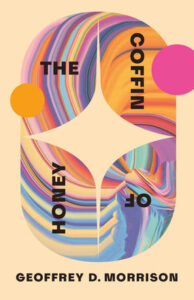
The Coffin of Honey by Geoffrey D. Morrison is available from Coach House Books.

Geoffrey D. Morrison
Geoffrey D. Morrison is a language teacher and trade unionist who lives on unceded Squamish, Musqueam, and Tsleil-Waututh territory. His debut novel, Falling Hour (Coach House Books, 2023), was longlisted for the Dublin Literary Award and a finalist for the Ethel Wilson Fiction Prize. The Coffin of Honey is his second novel.