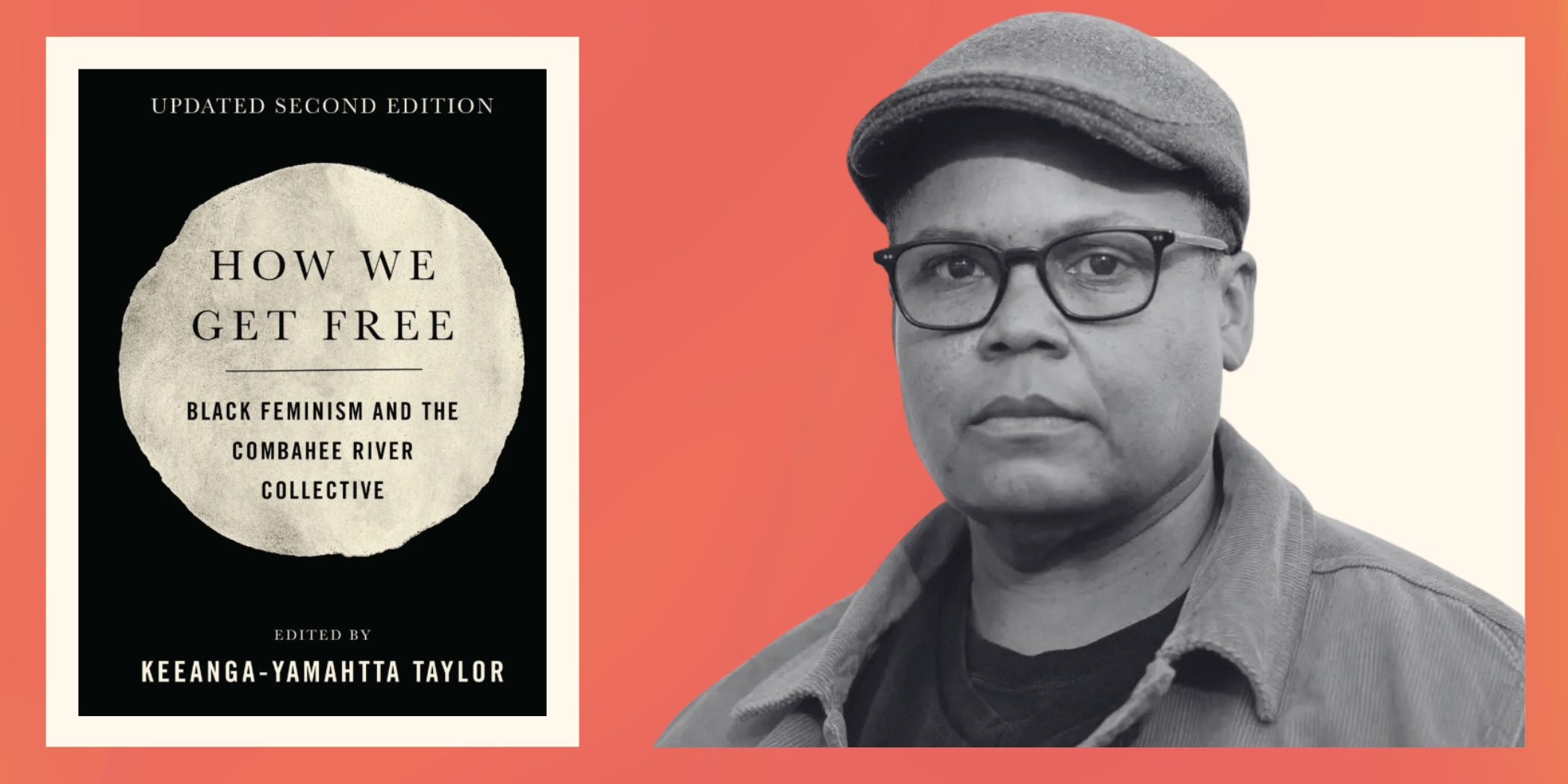
On the Origins of Genuine Intersectionality in Keeanga-Yamahtta Taylor’s How We Get Free
Alexis Clements Considers the 2017 History of the Combahee River Collective
Keeanga-Yamahtta Taylor’s How We Get Free: Black Feminism and the Combahee River Collective was published in December 2017, less than one year into Donald Trump’s first term as President. At this point we know too well just how much damage a Trump presidency can do in a short period of time. But that first year of the first term came as a shocking eye-opener for many and a grim inevitability for those who had long been calling attention to the deeply rooted racism and violence of the US.
No matter where you fell on the spectrum between those poles, the question of how to change things for the better was top of mind. And Taylor’s well-timed compendium offered insights from a group of women whose thinking had, often without any acknowledgement, already changed our ways of seeing the world.
For those unfamiliar, the Combahee River Collective (CRC) is a group of activists and thinkers whose foundational work underpins two concepts that are widely used, though often misunderstood or intentionally misused: identity politics and intersectionality. What began in 1974 with a loose intention to create a Boston-based chapter of the National Black Feminist Organization (NBFO), after two years of consciousness-raising, political study, and activism, became a key site for exchanging and developing ideas that would later influence the broader society.
During those early years a committed group of participants began to develop an antiracist, antisexist, leftist political analysis built on their lived experience as Black feminists, many of whom were also lesbians. Leaving behind the “bourgeoise-feminist stance” of the NBFO, the group named themselves after the waterway upon which Harriet Tubman led hundreds of formerly enslaved people out of bondage during a critical raid in the Civil War. And in 1977, CRC members Barbara Smith, Beverly Smith, and Demita Frazier penned the group’s eponymous statement, a text that has been influencing the culture for decades. That statement, which is often the primary and only contact people have with the CRC, sits at the center of Taylor’s book.
How We Get Free’s polyvocal format provides an approachable and easily digestible way to understand a rich and still-rippling current in Black feminist thought.
Many readers will know that legal scholar Kimberlé Crenshaw, in a 1989 paper, first used the term intersectionality to describe the fact that for those attempting to find a legal remedy for experiences of discrimination: “intersectional experience is greater than the sum of racism and sexism.” However, the broader thinking behind that concept was first articulated by the CRC in their 1977 Statement. In fact, Crenshaw actually references a book co-edited by CRC member Barbara Smith in the first sentence of that much-cited paper.
Pushing back against feminist groups centering the concerns of white women, Black liberation efforts focused on Black men, and even fellow Black feminists whose political work neglected to address class struggle or the issues faced by lesbians, the CRC Statement spoke of the inability “to separate race from class from sex oppression because in our lives they are most often experienced simultaneously.”
How We Get Free, published on the heels of Keeanga-Yamahtta Taylor’s 2016 book, From #BlackLivesMatter to Black Liberation, carries forward Taylor’s interest in making sure the leftist threads within Black liberation struggles are given their due and understood as crucial components of that work. As Demita Frazier says in her interview with Taylor for How We Get Free: “One of the things that really stood out was that we had an analysis that the NBFO did not. We had an economic analysis. Because we were all either nascent or just fully blown out-and-about socialists.”
Comprised primarily of interviews with the three authors of the Combahee River Collective Statement, as well as #BlackLivesMatter co-founder Alicia Garza, and commentary by historian Barbara Ransby, How We Get Free is not a comprehensive history of the CRC. Instead, its polyvocal format provides an approachable and easily digestible way to understand not only a rich and still-rippling current in Black feminist thought, but also offers readers a glimpse of the wry, thoughtful, sometimes weary, but deeply resolved friends and sisters who helped give it shape.
Looking back on this now, a year into Trump’s second term, it’s notable that this 2017 book also anticipates the increased recent attention on the idea of solidarity and coalition-building, which is at the center of a number of more recent books and essays. The CRC coined the term identity politics in their Statement, but their intended meaning runs directly counter to the ways it is often invoked today. From Barbara Smith:
We were not saying that we didn’t care about anybody who wasn’t exactly like us. …I always tell people, the reason “Coalition Politics: Turning the Century” is the last piece in [Home Girls: A Black Feminist Anthology, edited by Smith] is because that’s what I wanted people to leave the book with: the idea of working together across differences… that’s the only way we can win.
And so it’s not altogether surprising that How We Get Free, which didn’t get the attention it deserved back in 2017, has now, a little over a year into Trump’s second term, been re-released in a new edition. Historian and activist Barbara Ransby is right to point out in her commentary that the CRC Statement is not a blueprint: “We have our own work to do, in our own time.” But what Taylor’s thoughtfully compiled collection of conversations and reflections does offer is the example of three women building transformational ideas, engaging in organizing and activism, while also living their lives. These are not lofty figureheads, these are real people who care deeply for the world around them.
Glimpsing elements of their lives and personalities helps to ground their work, demonstrating that revolutionary political thought and action does not originate in ivory towers, but instead amidst our everyday realities. In this book, we learn about their laughter, shared meals, gatherings with friends and compatriots, missed meetings, and search for the energy to recommit. And we also learn that at the center of their politics was a refusal to leave anyone behind, least of all themselves. As Taylor says in one of the last sentences of the book: “Let us end the economic system that devours the people we love.”

Alexis Clements
Alexis Clements (she/her) is a writer and filmmaker based in Brooklyn. Her documentary film, All We’ve Got, which focuses on LGBTQ women’s spaces, has screened around the globe and is airing on PBS stations around the US. Her hybrid film & prose project, There Must Be a Word, is currently exhibiting in the 2026 Every Woman Biennial. Her podcast, The Answer Is No, focuses on artists sharing stories about the conditions under which they are asked to work. Her writing has appeared in The Guardian, The Los Angeles Review of Books, BOMB, Hyperallergic, and Bitch Magazine, among others.