On the Ethical Problems of Clinging to My Sighted Life
How Deni Elliott Adapted to Her Progressive Blindness
The letter that my eye doctor had sent to the state’s agency included diagnosis and prognosis, and it described my functional limitations: some trouble reading print and computer text, more trouble finding landmarks when walking and identifying obstacles in my path.
By the time the social worker called to schedule her meeting with me, Paul had gone back to California. He and I never did get around to talking about my new legally blind status. I didn’t bring it up. Paul had a lot on his mind as he prepped for his classes and did his research. I could guess how that conversation would have gone. He would have asked me what this new label meant for our life together and how it might impact him. I wouldn’t have had an answer.
All I knew was that my vision had been getting noticeably worse for more than five years. If I hadn’t been avoiding eye doctors for longer than that, I might have been labeled legally blind sooner. I gave up regular ophthalmologist appointments once I became an adult. I’d had enough of that as a child. Growing up, I’d gone to the ophthalmologist four times a year. When I learned how to make graphs, I imagined the results of these quarterly examinations as a downward progression, with plateaus between drop-offs. Sometimes there were steep drops. All the visits resulted in stronger eyeglass prescriptions that helped for a little while, but the overall trajectory never changed.
As an adult, I’d kept alert for anything that might help my vision in a significant or permanent way. If I heard of a possible treatment, or a doctor who seemed particularly creative, I made an appointment, always hopeful that I had finally found the right doctor in the right place at the right time. In retrospect, I can see how deluded I was about my eyesight, but I also couldn’t deny that everything usually turned out just fine for me.
I wanted to feel grateful instead of annoyed that she had decided what I needed without knowing me or my life.
I thought of my life as a series of what Aristotle, the ancient Greek philosopher, called “happy accidents.” It had been a happy accident that I’d had parents who’d forced me to stretch beyond my limitations, even if that focus on achieving made it difficult for me to seek help. It had been a happy accident that I’d had teachers and professors who’d convinced me that I could succeed. Choosing to be an ethics professor also felt like a happy accident. I’d learned in college that I thrilled to theoretical analysis and concept building—to creating guidelines for determining the conditions in which certain acts are or are not ethical. Growing up during the civil rights movement and anti–Vietnam War protests, I wondered about the ethical obligations of government and social institutions like medicine, law, journalism, and education. I didn’t need eyesight to do the work I loved.
Trying on the idea that there might be no cure for my limited vision helped me to think about the future differently. I was weary of pretending to see what I couldn’t. I was running out of work-arounds to compensate for the vision I didn’t have. I blocked out three hours early every morning to complete the most visually dependent tasks of my job—grading papers, reading academic articles, writing for publication. Those were the hours when I could read text fastest and most accurately. I might be able to tack on another hour or two in the late afternoon if I could work under natural light. As I had never explored accommodations for visual impairment, I was curious and hopeful about what new technology the social worker might offer. Maybe there would be tools that I could use in the privacy of my home office. Then I would know what, if anything, I needed to tell Paul.
On the day of our meeting, the social worker arrived at my door, introduced herself, and entered my house, her arms full of equipment and paperwork. When she spied the kitchen table, she dumped everything she was carrying onto it and excused herself to go back to her car for more. She added that to the pile, looked around, crossed the kitchen, and started down the few steps into the living room. “We’ll talk in here,” she said.
Whose life is this anyway? I wondered silently as I followed her into my living room and then sat while she listed the litany of services that the state could provide me due to my newly diagnosed disability. I didn’t interrupt, but I mentally crossed off each service as she described it. I didn’t need someone to teach me knife skills or how to measure ingredients for cooking. My mom had done that and more before I even started school. I knew how ripe cantaloupes and perfectly baked bread sounded when tapped. I knew how fully cooked meat felt when bouncing back against a finger push. But when she started to talk about computer skills, I listened more closely. I asked about how to use voice control on my Apple computer. She said we would come back to that.
I wanted to feel grateful instead of annoyed that she had decided what I needed without knowing me or my life. The state’s interest, she told me directly, was to keep me employed.
She stood and we walked into the kitchen. We took inventory of what she had dropped on the table. There was a battered oversized computer keyboard with bold black letters on bright yellow keys. “That looks like kindergarten surplus,” I thought. There were some computer disks containing software that she said would read emails out loud to me, speak words as I typed them, and transcribe my dictations into typed sentences. I perked up at that until she added that, unfortunately, the software was designed for PCs rather than Apple computers.
One piece of equipment made the entire meeting worthwhile: a flatbed scanner that could magnify documents by a factor of thirty and display them on a twenty-seven-inch screen. After we plugged it in, she showed me how to adjust the size and contrast of the text so that any student papers, books, or academic articles that I laid on the scanner bed would appear on the screen at the magnification level and contrast that worked best for me. This setup could live quietly on the desk in my home office. This had promise.
I struggled with the contradiction of being an ethicist and now knowing that I was legally blind.
She moved on to how the state would help me navigate the physical world. She had arranged for me to meet with an orientation and mobility specialist, who would teach me how to use a long white cane for navigating when I walked. “Not likely,” I thought, imagining how that might look to my colleagues. Yet I still thought that a white cane might be good to have while traveling. I wouldn’t use it around Paul or on campus, but it might come in handy if I was in an airport that was new to me or trying to get through a crowd.
I mentioned to the social worker the name of an optician I’d found who specialized in low-vision devices. I appreciated what she had brought, I told her, but only the scanner and screen seemed like they would be helpful for me, and the optician might be able to introduce me to more options.
The social worker said that I was free to meet with whomever I wanted—at my own cost, of course—but the resulting recommendations would make no difference to what the state could offer for accommodations. Directly coping with my vision loss was new territory to me, and I hadn’t thought about building an argument to defend my belief that I should be able to choose accommodations that fit my needs. I got it that it was in the state’s interest for me to stay employed, but having equipment that supported my research and writing would help me stay employed in what I did best. This wasn’t a job; it was my whole career.
Finally, it dawned on me that, to her, as a client, I had no credibility regardless of my education or experience. This was the first time that, as an adult, I knowingly encountered a professional who thought they knew my needs better than I did. I suspected it wouldn’t be the last. I didn’t appreciate this dose of paternalism.
Her intervention made me feel even more desperate to cling to my identity as a successful professional woman who was not really disabled. I would continue to keep my visual limitations as private as possible. I had a still valid driver’s license that I had kept secret from doctors and now social workers. I was grateful that no decision-maker I encountered had ever asked me directly if I drove or bothered to check with the Department of Motor Vehicles.
I felt like a living example in one of my lectures on deception. Is there a morally relevant difference between information that is legitimately private and information that someone chooses to keep secret? I was back to my lifelong professional quandary: What information did I have a duty to disclose, and to whom? As I had managed to legally get a driver’s license when I was seventeen and had legally transferred it when I moved out of state, I decided that I had no duty to share the fact that, occasionally, I still drove a car.
I had lived alone most of my adult life, and I rationalized that I had decades of experience in determining if the conditions—weather, light, time of day, route, and destination—were safe for me to drive in. When I could not get a ride from a neighbor heading to or near the university, I drove to work and back, stopping at the dumpster, the post office, and the grocery store along the way. I timed everything to account for the daylight and traffic. I talked my way out of any event that would require me to be out after dark. As I had internet access to the library, I needed to be at the university only two or three days a week and only during daylight hours. I used my new scanner and screen as I completed work for my classes and research from my home office. I drove infrequently and with planning and caution.
When the light was right and it was time to drive to school, I made my way down four miles of mostly private gravel road to the state road in the valley. The dusty road contrasted nicely with the greens of the trees and grasses on either side. The only traffic to worry about was an occasional deer or chipmunk. When I reached the state highway, I turned right, despite the university being in the opposite direction. If I turned left, I would have to cross a busy two-lane road that had no traffic light at the intersection. I knew from experience that someone could literally drive a Mack truck into the large black splotch in my right eye’s periphery.
So, I turned right and drove an additional mile to the next traffic light, where I drove into a parking lot, circled it, then waited for the traffic light to block oncoming traffic before turning left. I then drove ten miles north to the university well under the speed limit, staying in the right lane, making a right turn to my usual spot on the far edge of one of the university’s parking lots.
I struggled with the contradiction of being an ethicist and now knowing that I was legally blind. While my license had been legal, I was sure that it no longer was. I knew that my justifications for driving were as murky as my vision. Even if my neighbor with Alzheimer’s continued to drive to the dumpster and to the post office, I knew that offered no justification for my actions. She was wrong; her family was wrong not to take her car keys away. I was wrong in driving at all. I had to admit that I was not being my best, ethical self.
“We are all ethically challenged,” I told my students on the first day of class as I did in every ethics class every semester. I use a confessional tone: “No person always makes the best ethical choice. No person is always the best they can be. Even when we try our hardest to make the right choice, we often fail because our analysis is faulty.
“Have any of you ever, even once in your life, knowingly chosen to do something that you knew was wrong or that you knew might hurt someone?” I waited for the question to sink in, then added, “Oh come on, I’m not going to ask you to reveal the circumstances.” I smiled as I heard the students chuckle. I knew that one by one hands went up. We had all had that experience.
I was already good at shifting my gaze or compensating in other ways for some of the major splotches in my mid- and long-distance vision.
“Yep, that’s right,” I said. “We’re all human. We make mistakes. Being ethical starts with admitting that we make mistakes but doesn’t end there. What makes a person ethical is having the ability to acknowledge intentional mistakes, unintentional mistakes, and the willingness to keep trying to be a better person. It is hard to accept, but always true, that each of us can be a better person than we are right now, today. Moral development is a lifelong journey.”
I told them that my job as their ethics professor was to help them learn to analyze their own choices using sound criteria. I could not model moral perfection. Instead, I would be an example of a person who analyzes their choices and actions day after day, always seeking new information and deeper understanding.
“I am often wrong,” I said, “and I accept that I am always incomplete in my reasoning. I never have all the information I need to make the absolute best decision. Knowing that keeps me open-minded. I am ready to change my mind when confronted by new evidence or a new level of understanding.” My words gave me comfort. I promised myself I would drive only when I absolutely had to get somewhere and there was no other choice.
As I drove along my memorized route to the university, I sometimes thought of an ancient map with its mythical creatures drawn to portray unknown territories. There be beasties beyond US Route 93, bigger than my vision could handle. I could drive safely only if I didn’t stray from my familiar path. The transition from being a legal “high partial” driver, who could see light, color, traffic signs, and shapes of moving vehicles and pedestrians, to a no-longer-legal-to-drive visually impaired individual was a struggle.
When I’d turned fifteen, old enough for a learner’s permit, I approached my parents with the argument familiar to every teenager: an additional driver in the family would reduce the parents’ need to chauffeur. I was ready to explain to them how I would compensate for my low vision.
I reminded them that with the good lighting in the ophthalmologist’s office, the visual acuity in my left eye sometimes reached the magical 20/70 designation required for a driver’s license. While the ophthalmologist said I had low vision, he agreed that I might qualify as having high partial vision and may qualify for a driver’s license, probably with restrictions. I was already good at shifting my gaze or compensating in other ways for some of the major splotches in my mid- and long-distance vision.
I told my parents that driving would be safer for me than walking. In a car, I wouldn’t trip over uneven places on the sidewalk. Driving, I wouldn’t get hit in the face by tree branches that I didn’t see coming. I wouldn’t walk into poles too thin for me to notice.
All that I needed for a learner’s permit was a parent’s signature, proof of their car insurance, and their willingness to spend weekends shepherding me to empty parking lots so that I could safely get a feel for how to handle a car.
I remained calm, compelling, and rational, exuding maturity. I knew that my parents were reluctant to say no when I tried to get beyond my visual limitations. I wasn’t surprised when they agreed to my getting a learner’s permit. There were, after all, layers of examiners between a driver’s license and me. As I could not drive without a parent in the car, they could determine if or when I could progress beyond maneuvering the car in a large empty parking lot.
And yet. From an older and wiser perspective, it seems to me that supporting a visually impaired teenager’s request for a driver’s license was reckless at best. They were probably caught in their own bind of convincing me that I could do anything regardless of my low vision. They also wanted to hope that someday I’d have normal vision. I don’t deny my show of teenage rebellion. I knew I was holding my parents hostage. After fifteen years of being told I could do anything if I tried, I was calling their bluff by daring them to deny me.
__________________________________
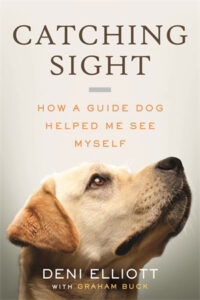
Excerpted from Catching Sight: How a Guide Dog Helped Me See Myself by Deni Elliott with Graham Buck. Copyright 2026. Excerpted with permission by Beacon Press.

Deni Elliott
Deni Elliott, D.Ed. is an American ethicist and ethics scholar, active in ethics scholarship and application since the 1980s. She is professor emeritus at University of South Florida.