On the Death of Branwell Brontë and the Shadow of Grief It Cast Upon His Literary Family
Deborah Lutz Considers the Impact of a Brother’s Absence
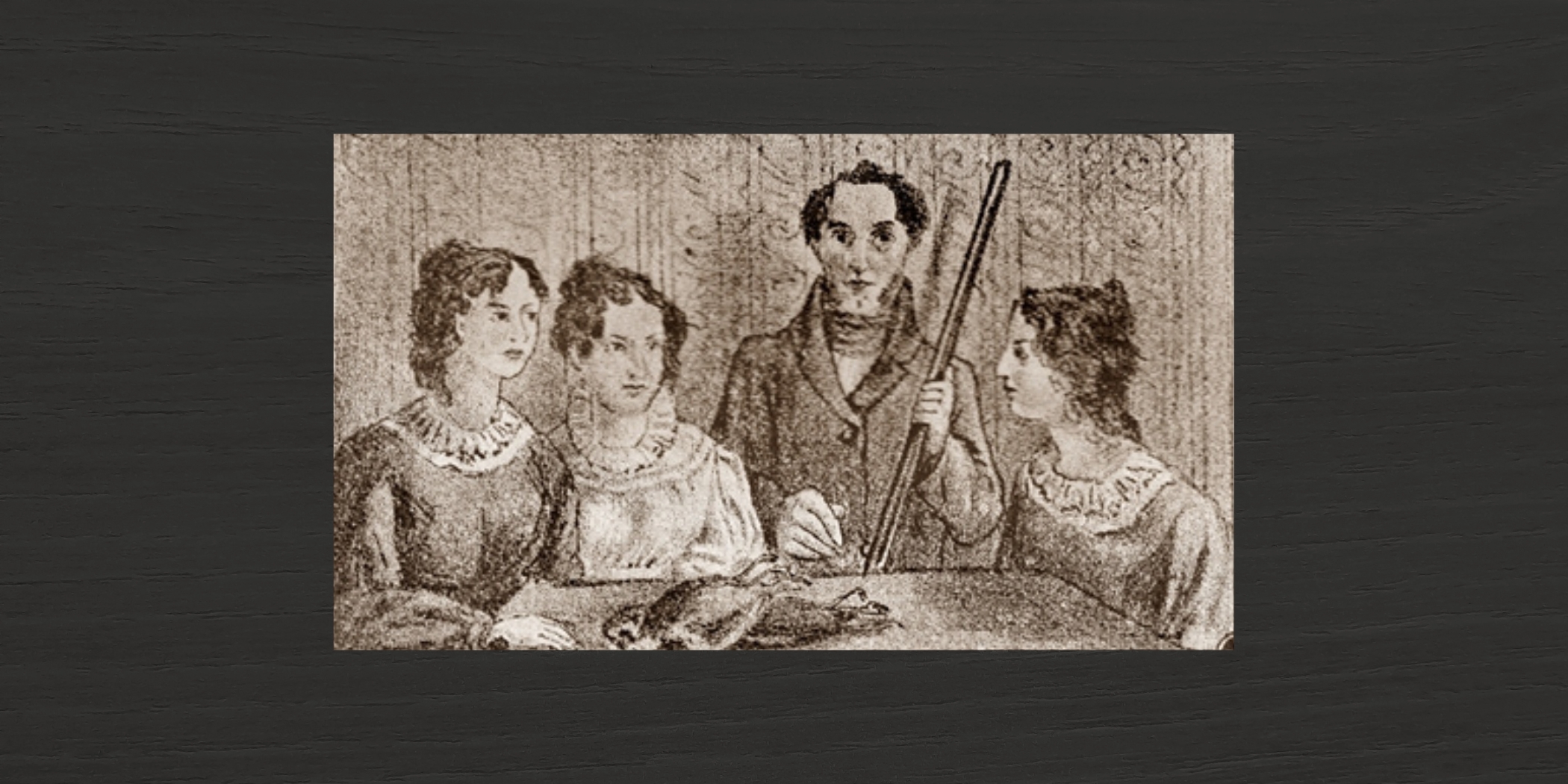
Through August and into September, Emily Brontë watched her brother kill himself, not with a pistol shot to his head or hanging with a rope, as he had threatened, but with drink. He mostly stopped eating, and what he did manage to consume wasn’t absorbed because his body was shutting down. A lung ailment, surely tuberculosis, prevalent in Haworth at the time, also plagued him, making everything worse. His broken heart from his great love, Lydia Robinson, was, to his mind, reason enough to die. (He had heard she was planning to marry someone of her class.)
But one wonders if he would have found some other excuse to abuse his body. Emily and her siblings had read for years in the newspaper of those who shot themselves, cut their own throats, and swallowed poison. There was Ellen’s brother William Nussey’s self-drowning in the Thames. Fictional renderings of suicide had been a Brontë staple for a good while: Jane Eyre has Bertha Mason throwing herself off the roof of Thornfield Hall to her death. In Wuthering Heights, both Catherine and Heathcliff die in part by willing themselves into the grave—so much so there is worry that they won’t be allowed burial in the churchyard. (Heathcliff says of Hindley Earnshaw when he drinks himself to death: “That fool should be buried at the crossroads, without ceremony of any kind.”) Branwell’s sisters wrote about it, but he lived it. In a way, he acted out an Angrian adventure, rakishly dying for love. He was his own true-life tragedy.
Emily was there watching the “awe and trouble” of the death scene.
Her dying brother surely called up great sympathy in Emily. She could be “full of ruth for others,” Charlotte noted. Her sensitive and sublime renderings of such states in her fiction and poetry exemplify this ruth. Branwell’s end came suddenly and as a surprise to his family—and even to himself. Though he had been very ill, somehow no one saw its fast approach.
On September 22, he was out walking around Haworth. He spent the next day in bed, and the one after that he was gone. He was conscious until the last agony. He had resolved on dying standing up, and at the very end he struggled to get on his feet. It was a Sunday morning, September 24, 1848. He was thirty-one.
Emily was there watching the “awe and trouble” of the death scene. So sad and strange, Tennyson says in a poem, to mark the new day—the pipe of birdsong, the “glimmering square” of the window growing brighter as the sun rises—with “dying ears” and “dying eyes.” Emily must have seen others die—neighbors, townsfolk, animals—although she was probably too young to remember much of her mother’s and sister’s ends. While the experience was heartrending and unspeakably terrible, it was also probably riveting for a writer preoccupied with dying moments, corpses, and post-death states. With Branwell standing up to death—almost like throwing himself into it, or perhaps struggling to escape it—he didn’t die “quietly as a lamb,” as Catherine does in Wuthering Heights. She “drew a sigh, and stretched herself, like a child reviving, and sinking again to sleep.”
Charlotte attempted to turn her brother’s sad end into a good death of the evangelical variety—seeing, she hoped, his heavenly future written on his still countenance. “When the struggle was over—and a marble calm began to succeed the last dread agony—I felt as I had never felt before that there was peace and forgiveness for him in Heaven.” Did Emily think that his death was a release from time and the mortal coil, an “escape into that glorious world” (as Catherine Earnshaw calls it)? If so, she felt some sense of relief for him.
Emily and Anne were “pretty well” days after Branwell’s death, Charlotte reported. Their father was bereft. He had prayed fervently at Branwell’s deathbed and refused at first to be comforted. His only son, his great hope, had been lost, without accomplishing anything of lasting importance. Charlotte struggled to surmount her anger and bitterness toward her once-dear sibling.
“The removal of our only brother must necessarily be regarded by us rather in the light of a mercy,” she wrote. “I do not weep from a sense of bereavement—there is no prop withdrawn, no consolation torn away, no dear companion lost—but for the wreck of talent, the ruin of promise. . . . nothing remains of him but a memory of errors and sufferings.”
His remains now occupied that space Emily had often imagined in poems.
Martha and Tabby cleaned his body, combed his hair, and put a suit of clothes on him, including a shirt made by one of his sisters. The attending doctor registered Branwell’s death as “chronic bronchitis—Marasmus” (severe malnutrition and wasting), but everyone ascribed it to tuberculosis (consumption). Charlotte immediately took to bed for a week with a headache and stomach pain. Emily, who was herself ill with a cold and cough, and Anne supported their father, purchased mourning stationery, and had elaborate funeral cards made embossed with a tomb, drapery, grass, and flowers. They tended to the mourning dress for the family, probably by altering, refurbishing, or redyeing dresses they already owned. Anne wrote to William Smith Williams to explain that a “severe domestic affliction” rendered Charlotte unfit for “even the light task of writing to a friend.”
For four days Branwell’s body was stretched out on a bed, and Emily, other family members, and possibly friends, like Martha’s father John Brown, sat with him. They would have cut locks of his distinctive ginger hair for keepsakes and spread evergreen branches and flowers around him. Covering mirrors and opening windows were common practices after a death in the house. It’s unlikely that they had a postmortem photo taken, given that the technology, still fairly new, was expensive and not very portable.
In a few years, however, the dead were often memorialized through photographs, in part because of the “lovely appearance of Death” as Charles Wesley exclaimed in a popular hymn. “With a solemn Delight I survey / The Corpse, when the Spirit is fled, / In love with the beautiful Clay, / And longing to lie in its stead.”
Patrick had his old friend William Morgan perform the funeral service on September 28, which was attended by a “crowd of sympathizing spectators,” the local newspapers reported. The stone slate closing the vault that housed his two sisters, his mother, and his aunt opened once again. Branwell’s coffin was carried from the house and placed next to the other family caskets. His remains now occupied that space Emily had often imagined in poems. Finally, Branwell’s friend John inscribed his name on the family memorial plaque. “We have buried our dead out of sight,” Charlotte said, quoting Genesis.
Emily must have read the glowing obituary in the Leeds Times. It told of his talents and accomplishments, his “great natural quickness . . . and a solid judgement.” Those surrounding him were “charmed and captivated” by his “mental endowments” and “remarkable conversational powers.” This served as a painful reminder that, of all of the siblings, he had been the one most likely to make his way in the world. But his shy, taciturn sisters had somehow surpassed him.
The family felt profoundly Branwell’s absence from the house. There remained his oil paintings and the many books marked by his handwriting in the margins—now mere traces of him. His manuscripts and letters were left abandoned. The bright boy who came into their rooms with his toy soldiers to start world-making would not return, and no reconciliation or words of forgiveness would ever reach him.
__________________________________

Excerpted from This Dark Night: Emily Bronte, A Life. Copyright (c) 2026 by Deborah Lutz. Used with permission of the publisher, W. W. Norton & Company, Inc. All rights reserved.

Deborah Lutz
Deborah Lutz is the Kelly Professor in Nineteenth-Century English and American Literature at Pennsylvania State University. A Guggenheim, Cullman, and NEH Fellow, she is the author of The Brontë Cabinet, Pleasure Bound, and other works. Her writing has appeared in numerous journals, including the New York Times. She lives in Pennsylvania and New York City.