On the Beautiful, Terrible Villains of Reality Television
“What, you act like I have a new face or something.”
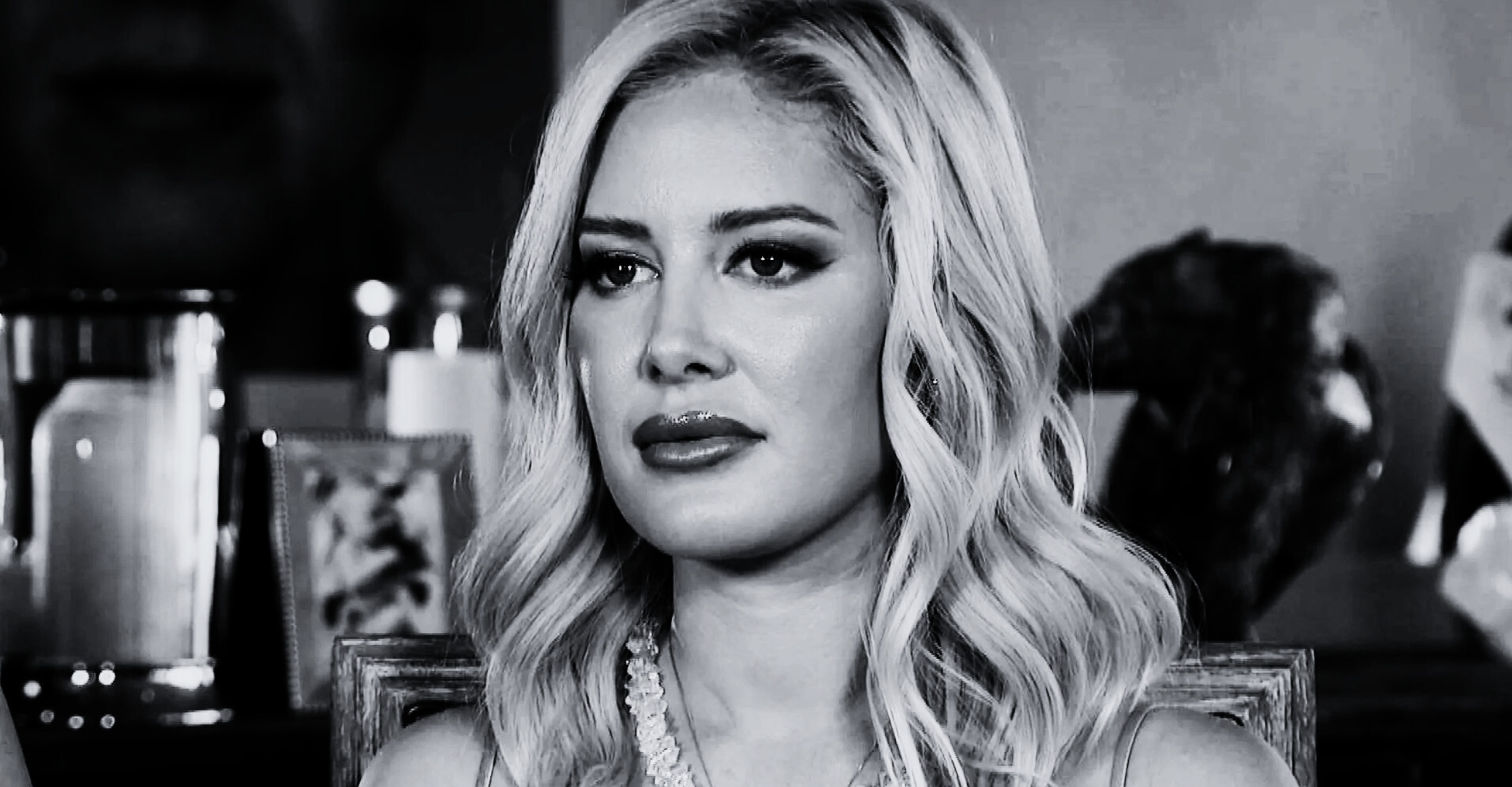
A few minutes into the premiere of the sixth and final season of The Hills, a black Suburban drives up to a chalet-style home with a wreath on the front door on a snowy day. “Crested Butte, Colorado,” the title on the screen says. Heidi Montag’s parents’ house. Then there’s an interior shot of a bookshelf—one book by Anne Lamott, When Mothers Pray by Cheri Fuller—and a photo of young Heidi behind them. The doorbell rings, and the scene shifts to a shot of Darlene, Heidi’s mother, greeting her daughter at the door, Heidi’s back to the camera.
“I knew you were gonna cry,” Heidi says. “Oh, it’s so nice to be home.”
This is the beginning of a breakthrough moment not only for reality TV but for the United States overall.
The camera still doesn’t show Heidi from the front and instead shows more framed snapshots of the family before Heidi sits with her mom on a couch and her visage finally appears on-screen.
“What, you act like I have a new face or something,” Heidi says with a hint of a smirk on her otherwise immobilized features.
Heidi’s being ironic. She does indeed have a new face, the product of a barrage of cosmetic procedures that had been publicized in the months leading up to the episode airing. The audience has tuned in to see the big reveal, which her mother was experiencing in person. This was before the storylines on the Kardashians rehashed what people had already read in the tabloids. Heidi was pioneering how reality TV could turn old news into melodrama, eroding any distance between entertainment and fact.
She has changed her fundamental truths. She is not as real as she appears to be.
“It takes a little getting used to,” Darlene says, looking at her daughter. “Are you happy?” she asks, to which Heidi responds that she’s feeling a lot better. “What all did you have done?” Darlene asks, and Heidi answers: “I got a slight eyebrow lift, and that’s why I had these staples in my head . . . I had my nose redone. I had my own fat injected into my cheeks. I had my ears pinned back. I had injections in my lips. I had my chin shaved down. I had my breasts redone and my back shaped. And then I had a little bit of inner and outer lipo done.”
Darlene tells Heidi that she risked her life to have these elective procedures. “I just feel like that when you left home, you had more confidence and more self-esteem than any person I’d ever met in my life,” Darlene says. Heidi responds by saying that she’s toyed with modifying her body since she was young and that she has “always wanted big boobs.” She says she wanted even bigger implants, but they wouldn’t fit.
It’s no surprise that this conversation is about a body, takes place in a home, and is between family members. Homes are safe spaces where the most intimate private truths can be discussed by the people who hold each other most dear. Your family and your body are the last things you have left when everything is stripped away. But Heidi showing everything that she did to change her body makes her mother uneasy along with everyone in the audience. She has changed her fundamental truths. She is not as real as she appears to be.
“It sounds to me like you wanna look like Barbie,” Darlene says.
“I do wanna look like Barbie.”
“Nobody in the world could have looked like Heidi Montag,” Darlene says.
Now Heidi doesn’t even look like Heidi. Some new entity has taken her place.
“Are you telling me you don’t think I look good?” Heidi asks. “Maybe you should rephrase the question.”
Heidi persists.
“I thought you were more beautiful before,” Darlene says before the scene ends with Heidi in tears.
A makeover typically makes someone better than they were before. In Darlene’s eyes, Heidi’s makeover was a failure, or something worse: the loss of her daughter to the pressures of reality TV.
Heidi doesn’t make it through that season of the show. A rift grows between her and her friends and sister in Los Angeles, one arguably created by her new husband, Spencer Pratt. He is alternatively aggressive and indolent on the show, apparently unemployed, sequestered in their modernist hillside home, and resentful of anyone who takes his wife’s time away from him.
“The only thing Heidi does is read and write poetry and pray and read books,” Spencer tells their friend, Kristin Cavallari. “I don’t let her go on TV, no computers.”
Heidi was bound for something different.
Spencer becomes seemingly paranoid and erratic, obsessed with the healing power of crystals to the point that his friends begin to find him odd. “These people don’t know how [bleeped] dangerous I am,” he says at a nightclub, where he shows up emotional and gets in a fight with his friends.
Heidi stands by her man. “Spencer didn’t change me,” she tells Cavallari. “I changed myself.”
Heidi is the empowered frontier woman, setting off from her parents’ Colorado lodge to reinvent everything about herself out west with a wild man.
For this, she was the villain. Eventually Heidi’s sister, Holly, gathers with the other women on the show, and they mourn Heidi’s transformation and decide to cut the couple off. “So, we’ll just stop talking about them, all of us,” Stephanie Pratt, Spencer’s sister, says. Holly delivers the closing remarks. “I just feel like she’s gone forever,” she says before sobbing.
Since the beginning of The Hills, Heidi was the foil to Lauren Conrad. Like Becky Sharp, the willful, wicked lead of William Makepeace Thackeray’s Vanity Fair, Heidi rolled her eyes at her dutiful counterpart. The show starts with Lauren and Heidi enrolling at the Fashion Institute of Design and Merchandising, and Heidi skips class on her first day. She’d much rather get into the working world immediately and scores her dream job at a public relations and event planning company, but she’s soon bored of that, too, glumly staring at her work computer calendar showing “9:00 a.m.: Start work, 6:00 p.m.: Finish work” repeated endlessly.
Heidi is unlike Lauren, who strives for Teen Vogue internships in Paris and New York, and even less like Lauren’s intern rival, Emily Weiss, who would go on to found the billion-dollar beauty brand Glossier and become an emblem of girlboss feminism.
Heidi was bound for something different. While on The Hills, she landed magazine covers and released music. She and Spencer published a book, How to Be Famous: Our Guide to Looking the Part, Playing the Press, and Becoming a Tabloid Fixture, with a cover mimicking a celebrity gossip magazine. They appeared on the second season of the Survivor-esque reality series I’m a Celebrity . . . Get Me Out of Here! Heidi was an influencer before there were influencers, bravely making money for having a kind of recognizable name when people said she shouldn’t.
In this world, there’s something reassuring about a villain.
In 2010, on an episode of ABC’s Nightline she sits down for an interview with journalist Juju Chang to discuss her surgeries and her career.
“A lot of people think this is what’s wrong with American culture is precisely what you said, that you think it’s an honor to be famous for being famous,” Chang says.
“I’d rather be getting a paycheck for being famous than working at my parents’ restaurant,” Heidi says.
“But I would argue that there’s virtue in the hard work,” Chang says. “I would rather work at the restaurant.”
“But that would be your path,” Heidi says, unbent.
After The Hills, Heidi released more music and appeared with Spencer on other reality shows, such as Celebrity Big Brother and Celebrity Wife Swap, but she never matched the level of fame that the MTV show brought her. Her star rose too soon. Along with Spencer, she was one of reality TV’s first great villains, creating a name for herself by being unvirtuous in the eyes of commentators such as Chang and winning an audience in the process. But she suffered in the earnest millennial era with its faith in America’s meritocratic myth, that by working hard in a service job, maybe at your parent’s restaurant, you could get ahead.
She wasn’t an outcast just because she didn’t want to work in a restaurant, though. She was seen as evil because, as she was quick to point out across her body, she was “fake.” She was a sellout and a phony when those accusations still mattered. But her crime was just doing what Adam DiVello, The Hills’s creator, had been doing so successfully: taking advantage of Americans’ faith in video to portray reality to create a new reality for herself.
Heidi was a harbinger of the literally cutthroat times to come, when Real Housewives would return every season with a face changed by a neck lift to be celebrated for their ability to change themselves to suit the game they’re playing. Had she arrived a few years later, Heidi’s reception would have been very different. She was too early to benefit from the future she helped create.
As the 2010s went on, the machinations of reality shows became repetitive and transparent. The novelty had worn off. Americans got used to seeing how reality was rigged on and off their screens and started to root not for the canned hero ordained by invisible higher forces but for the wicked one winking through the screen, saying, “Let’s have some fun.” As 2016 approached and Donald Trump announced his candidacy for president, America was rooting for the villain.
How did we get here?
In Reality TV: Remaking Television Culture, media scholar Mark Andrejevic writes of the 2000s: “Contemporary image culture teaches both the inevitability of contrivance and, paradoxically, the need to penetrate it—not just out of casual curiosity but in order to avoid the risk of being seen to be a dupe.”
He writes that amid the constant monitoring of public spaces and life after 9/11 and a general distrust of Washington and its since- disproven “truths” about weapons of mass destruction leading up to the 2003 invasion of Iraq, a “savvy skepticism with naive empiricism” spread. This contradictory belief that one could see through a widely believed lie while also falling for another untruth led to the spread of conspiracy theories and myths like the idea that the Earth is flat or that aliens built the pyramids. It’s a sort of paranoia gone wild, trained to shadowbox hidden forces and invent them should there not be enough at hand.
In this world, there’s something reassuring about a villain. Better the devil you know than the devil you don’t, and after the 2007 mortgage crisis, there were plenty of new seemingly invisible demons reshaping how millions of Americans lived, evicting families, accepting bailouts, quietly destroying American homes.
A villain isn’t talking about hope and progress while selling out the country to private equity billionaires who will nickel and dime it, buying up the sense of reality that so many clamor for. A villain is not posturing as a good person while greenlighting genocidal slaughter. In America after the lies of the second invasion of Iraq and the mortgage crisis, when the invisible forces controlling lives turned out not to be as benevolent as they claimed, sometimes it seemed that villains had more integrity than the heroes.
A villain is just Heidi Montag wanting to make money for being famous. She just wants to follow her own path. Her “flaws” are on the outside, and she’ll enumerate the ways in which she’s tried to fix them, not squirrel them away so they can do damage in the dark. Villains may not be perfect, but at least you know who they are.
Reality TV, despite all the moral hand-wringing and critical disdain surrounding it, has never really been so different from other kinds of American media. It fits neatly into the broader cultural landscape of torn social ties, disconnection and alienation, and the hunger for a life that feels more real and the belief that video somehow offers a cure.
The genre may actually be most similar to the televisual medium that sits on the opposite end of the respectability spectrum, vaunted as so critical to maintaining the American republic: the news.
Around 1980, channels such as C-SPAN and CNN pioneered the idea that videos could mediate the reality of a universe that is too large and complex to be wholly perceived for people with limited time, attention, and sensory abilities. They promised to make sense of the world, packaging reality into digestible forms. The basic production teams used to tape news segments in the field are the same as the ones used to create reality TV. They can consist of field producers, camera operators, sound mixers, and assistants, collectively known as ENG (electronic news-gathering) crews. ENG crews append human organs—a microphone extends an ear, a camera puts an eye where it could not otherwise be—and the simulation of sensory input is just tantalizingly close enough to the real thing to keep viewers coming back in hopes of getting more.
News outlets claim to deliver reality undistorted, but that’s not true. News media break reality down and repackage it into intelligible narratives. Viewers consume news that elicits strong feelings that people will keep coming back for. ENG groups record and package reality in similar ways whether they’re working for MSNBC or Bravo, but one is seen as protecting democracy and the other, destroying it.
Plenty have crowed about Donald Trump using reality TV techniques to get attention in the news as though he were denigrating a sacred sphere. But Trump’s success may come from realizing that news media and reality TV often operate in the same ways, delivering melodramatic feelings of reality while reporting election results, creating emotional arcs for votes to boot roommates from the Big Brother house or send a president to the White House. Voters want to feel real. They’re tired of a world run by hidden forces too complex too fully understand. Trump’s informality, his rambling speeches filled with jokes and bad dancing, make him seem more real than rival politicians who make eloquent promises to serve the country, then hand it to the spectral wraiths of private equity. Make America Great Again has a catchier ring than Make America Feel Real Again, but the same sentiment underlies both.
If the line between writers and nonwriters is blurring, then so is the definition of storytelling.
It was the way that Heidi marched into this contested terrain of reality in video that struck such a nerve. She was aware of the power of video to make life on-screen seem more than real, a kind of reality- plus or hyperreality, more authoritative than someone’s unreliable lived experience. It’s a strange psychosis that extends even to the military, where people are now hungry for “predator porn,” or drone video proof of battlefield conditions, even when more than enough reliable information is available. Video is reality; someone’s story of what happened isn’t. Heidi was creating a new self, real enough for all to see.
But Heidi’s transformation also shows that despite reality TV’s supposed trashy radicality, it also appeals to oppressive norms and misogynistic ideas of what women should look like: big- breasted and blond. Reality TV isn’t just a product of technological innovation used for conservative purposes; it’s a product of reactionary American politics.
For years, using nonunion labor both in front of and behind the camera was one of the hallmarks of reality TV. Unions such as the Screen Actors Guild and the Writers Guild of America (WGA) had been organizing people working on scripted sets for decades, and reality TV offered network executives a workaround.
Media studies professor Misha Kavka has written about how federal deregulation in the 1980s made it easier for new channels to launch even though the overall audience size stayed the same. Advertisers had to spread their money around more at the same time that competition for talent increased. Over the decade, the average cost of a prime-time hour-long drama went up to more than $1 million, and producers were sometimes losing hundreds of thousands of dollars per episode. Cops was greenlit during a writer’s strike in ’88, and cheap-to-create clip shows such as America’s Most Wanted and America’s Funniest Home Videos showed how new kinds of programming could keep money flowing. Shows like this took off during this period.
Over the years, some workers on unscripted sets have successfully joined unions. They are still a small minority, but activists are trying to grow their numbers. Jed Holtz, an organizer for the Freedom Socialist Party and an art director on Food Network’s The Kitchen, is working with the WGA to organize people working in what he calls non fiction TV. The nonfiction label, as opposed to unscripted or reality, acknowledges that aspects of the shows may be scripted. Words such as a host’s introduction or the presentation of challenge rules are often written by people—ostensibly writers—who could logically be represented by a writers guild but aren’t because they’re usually also doing a variety of other production tasks. But Holtz is working with the WGA to organize all the workers involved in a production into single union instead of having different trades organize themselves separately. “It’s expanding the definition of storytelling in some ways,” Holtz says, but he also asks the question, “How do we as workers . . . gain what we deserve for our labor, regardless of what that looks like?”
If the line between writers and nonwriters is blurring, then so is the definition of storytelling. Videos are not just flat windows onto the real world; everything about them is constructed. Camera angles, lighting decisions, set design, background scoring, editing, and performances all tell the story even if there are no writers, per se.
Heidi is a storyteller. She conceives her lines and delivers them in the moment, reacting to the scripts of the people around her, such as the newscaster interviewing her.
Many have followed in Heidi’s steps—Christine Quinn, Donald Trump, the Kardashians—and they’ve been so successful because America had been heading in Heidi’s direction since its founding. She is the self- made soul, speaking the story of herself into existence, redefining the wilderness as she sees it, finding love and a home in the process.
This is the strange trajectory that hybrid homes get pushed along by the digital forces running through them. Video’s paranoia about the story of reality now runs through the places we live.
The Real World, Selling Sunset, the Kardashians shows, and The Bachelor show how homes are freighted with feelings, but they don’t explain why homes are just so foundational to the American psyche. Our homes, our selves. It might be a universal association, but Americans and their twisted economic system take it a step further. When it comes to your home, you have to own it, as any Real Housewife will tell you. It’s on their show that we start to see how deep the paranoia about reality runs.
__________________________________
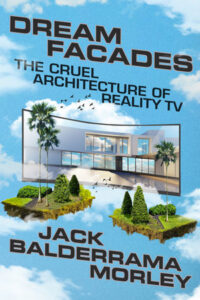
Excerpted from Dream Facades: The Cruel Architecture of Reality TV by Jack Balderrama Morley. Copyright © 2026 by Jack Balderrama Morley. To be published on March 3, 2026 by Astra Publishing House. Reprinted by permission.

Jack Balderrama Morley
Jack Balderrama Morley is a former/recovering architectural designer and is now the managing editor at Dwell. Their writing has appeared in The New Yorker, Dwell, and The Architect’s Newspaper, among other places.