On the Auction Block: Jack Kerouac’s Record-Breaking Manuscripts
Jean-Christophe Cloutier Considers the History of Kerouac’s Posthumous Sales
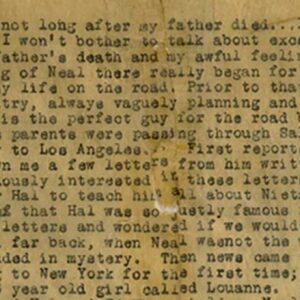
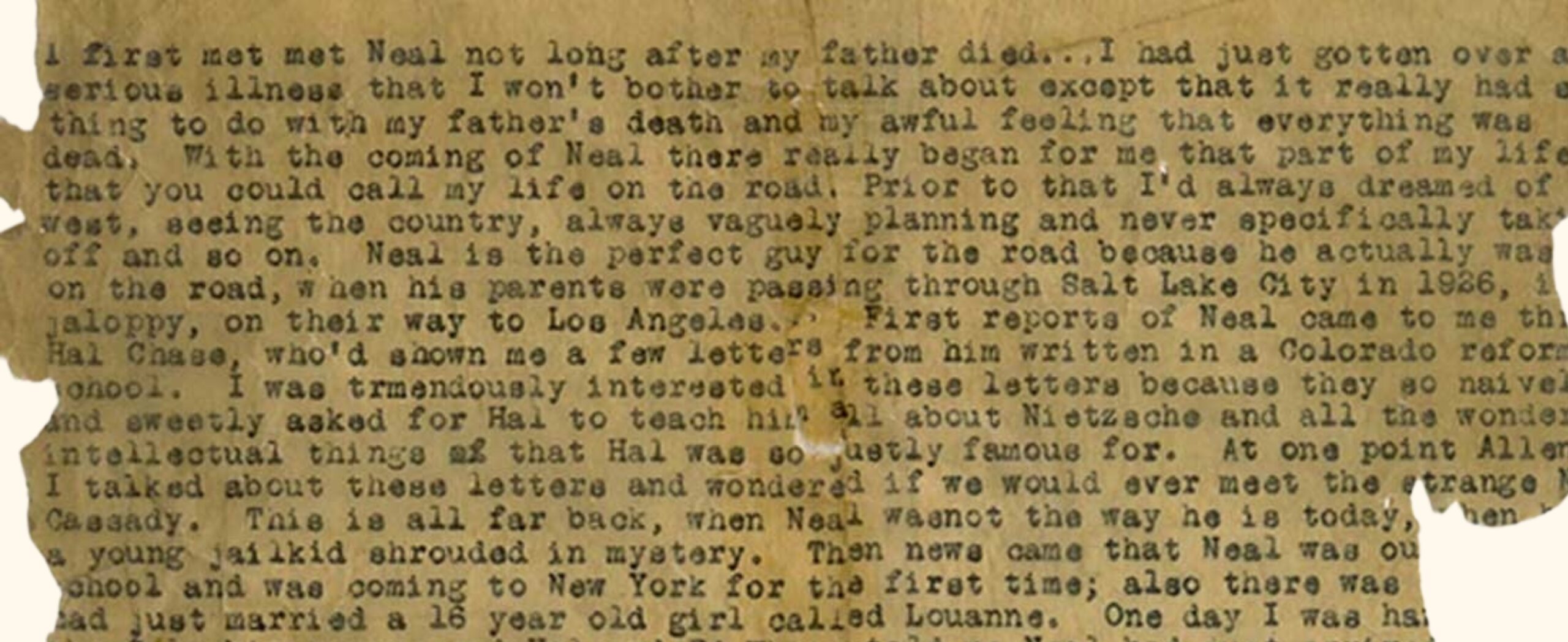
Just a few weeks ago, on March 12, 2026, which would have been Jack Kerouac’s 104th birthday, the On the Road scroll sold at auction at Christie’s in New York for a whopping $12,135,000. This marks a new and historic record: the artifact is now the most expensive literary manuscript to sell at auction regardless of period or origin.
Twenty-five years ago, this same scroll had already sold for what was then a record price: in 2001, Jim Irsay, erstwhile owner of the Indianapolis Colts, had purchased it for $2.43 million, then the highest paid price for a literary manuscript from the 20th century. In 2020, the Mills College copy of a Shakespeare first folio (or, F1) sold for $10 million, the previous record holder. If we take inflation into account, when the Huntington Library in Pasadena purchased most of the Duke of Devonshire’s book collection for $750,000 in 1908—including the first quarto of Hamlet, still only one of two surviving copies—the adjusted price tag might fall upwards of $30 million. But that was for a collection, not a single artifact.
Unlike Shakespeare, Kerouac has never really had much backing from the academic establishment. But in our capitalistic world, where market value always trumps research value, interest in Kerouac has always been high—a lesson many academics prefer to unlearn or deny. Despite years of sneering from US critics—or perhaps because of it—Kerouac’s popularity and influence on generations of global readers and artists is undeniable. Bob Dylan put it this way: “I read On the Road in maybe 1959. It changed my life like it changed everyone else’s.”
Musicians, especially, have been drawn to Kerouac’s work, from the Beatles and David Bowie to Patti Smith, Tom Waits, Lana Del Rey, and Zach Bryan, who purchased the On the Road scroll last week.
Last year, a major documentary focused on the ongoing impact of On the Road was released: Kerouac’s Road: The Beat of a Nation. Premiering at the Tribeca Film Festival, the film includes the participation of big names like Josh Brolin, Matt Dillon, Nathalie Merchant, Michael Imperioli, David Amram, Jay McInerney, and more. Over the years, the world of fashion has often turned to Kerouac for inspiration: in 1993, the GAP released a series of posters with the slogan, “Kerouac wore khakis.” In 2018 Harmony Paris released their Fall-Winter « Kerouac » collection, and in 2022, Kim Jones unveiled his Christian Dior fashion line for men based on Kerouac.
Musicians, especially, have been drawn to Kerouac’s work, from the Beatles and David Bowie to Patti Smith, Tom Waits, Lana Del Rey, and Zach Bryan, who purchased the On the Road scroll last week. Bryan, in particular, seems dedicated to keeping Kerouac’s legacy alive: last year, he purchased—for over $3 million—the St-Jean Baptiste Church in Lowell, MA, a bastion of Massachusetts’ Franco-American cultural history, and the church where the author born “Jean-Louis Kérouac” was baptized in 1922, and where his funeral was held forty-seven years later, in 1969. In collaboration with the Kerouac Estate, plans are now underway to turn the space into a Kerouac museum, cultural center, and venue for performances.
Unsurprisingly, Kerouac’s influence is also pronounced among an array of writers who have dominated contemporary literature. Non-anglophone authors range from Norway’s Karl Ove Knausgaard, who cites Kerouac in My Struggle as an inspiration, to Chile’s Roberto Bolaño, who translated into Spanish several poems by Kerouac. The Cuban author Guillermo Cabrera claims Kerouac as a key forebear: he wrote Tres Tristes Tigres in a Spanish dialect inspired by street talk and phonetics, as Kerouac did, and wrote the screenplay to Vanishing Point (under the penname Guillermo Cain), a cult-classic road movie directly inspired by Kerouac. Japan’s Haruki Murakami—whose heroine in Sputnik Sweetheart not only models her writing on Kerouac but also her sense of fashion—likewise notes Kerouac’s imprint on his work.
This imprint can pop up anywhere; in 2020, during an interview with the Washington Post, former US President Barack Obama discussed some of the authors and books that had most influenced him. Included in Obama’s top five, alongside Toni Morrison, James Baldwin, Mohandas K Gandhi, and Shakespeare, was On the Road. In her graphic memoir The Secret to Superhuman Strength (2021), the cartoonist Alison Bechdel undertakes a sustained dialogue with Kerouac’s Buddhism and follows in his footsteps in climbing Matterhorn Peak in Sierra Nevada.
Kerouac’s turn to Buddhism in the mid-1950s is another important aspect of his multifaceted cultural legacy. The poet bell hooks, for instance, credits him for modeling a form of “resistance to that old patriarchal kind of Buddhism that was all about obedience to authority.” This Kerouackian strand of countercultural spiritual resistance continues in contemporary pop culture, as evidenced by Jason Sudeikis’s Ted Lasso character who reads a battered paperback edition of The Dharma Bums on the plane that will take him to the UK in the pilot episode. The trendy eyeglasses company, Warby Parker, named after obscure Kerouac characters, gives away a copy of The Dharma Bums to every new employee.
The King of the Beats has always attracted a fair amount of attention from collectors—especially since his passing in 1969.
Poet, playwright, and editor Amiri Baraka, towering figure in the Beat world and the Black Arts Movement, considered Kerouac “a giant of swift exacting poetic insight” and included no fewer than four Kerouac pieces in The Moderns (1963), Baraka’s groundbreaking “Anthology of New Writing in America.” Even when Kerouac was placed alongside his countercultural peers, Baraka recognized in him a unique “occurrence as a style of American writing,” where he stands “absolutely alone.” And now, with this new auction record, Kerouac stands alone once more.
The King of the Beats has always attracted a fair amount of attention from collectors—especially since his passing in 1969. Kerouac had left everything to his mother, Gabrielle-Ange Lévesque, who outlived all three of her children but was already in ill-health at the time. Kerouac’s third wife, Stella Sampas, filed for and obtained one-third of the Kerouac estate, under a legal entitlement extended to widows by Florida law, and when Gabrielle died in 1973, total ownership passed on to Stella.
During her stewardship, Stella more or less left her late husband’s papers untouched and refused most requests by scholars and biographers to access its contents. Bootleg anthologies nevertheless began circulating in the early 1970s—often known as the “collected uncollected” Kerouac, as demand remained high. Private collectors and institutions sought to acquire whatever they could get from the Kerouac Estate.
When Stella passed away in 1990, her brother John Sampas—an antiques dealer by trade—took over control of the estate. After appraising the extent of the collection, Mr. Sampas realized that Kerouac had left behind an impressive array of unpublished manuscripts—and slowly, posthumous works began to be released. Learning on the fly the myriad temptations and possibilities that come with handling the estate of a coveted literary figure, Sampas began selling a few items to various repositories around the country—notably the New York Public Library and the Harry Ransom Center in Texas—as well as to some private individuals.
Through his contacts in the antiquarian book world, Sampas began looking for potential buyers and was put in touch with Michael D. Horowitz, a book dealer and archivist who specialized literary appraisals. Horowitz suggested he reach out to a young actor named Johnny Depp who was dating his daughter, Winona Ryder, at the time. According to the bill of sale’s invoice, Depp’s purchase included: raincoat, suitcase, travel bag, sweatshirt, rain hat, tweed coat, letter to Neal Cassady, and a canceled check to a liquor store, for a total sum of $50,640.
In 2001, the record sale of the scroll at Christie’s further prompted a mystery collector to come forward with another Kerouac manuscript, one widely thought to be lost forever: The Haunted Life.
2001 was a major Kerouac year on the literary market: not only did the On the Road scroll sell for $2.43 million, which was at the time a world record for a literary manuscript, but Glenn Horowitz, the famed rare book dealer, also arranged for the auctioning of 76 items from the Kerouac archive, the vast majority being letters, along with a handful of short manuscripts, and a signed check. And the bulk of the collection—what Sampas qualified as “95%” of Kerouac’s literary and personal archive—was sold to the New York Public Library that same year.
In their announcement, The New York Times underscored that NYPL’s “acquisition of the Kerouac archive began more than a decade ago when Rodney Phillips, the director of the Humanities and Social Sciences Library and a former curator of the Berg Collection, began buying items sold by the estate through George Minkoff, a dealer in Great Barrington, Mass.” And so, even prior to the main 2001 purchase, the Berg “had already, through purchase and gift, amassed the largest group of Kerouac papers in institutional or private hands.” As time passed, Sampas came to understand the value of keeping a such a collection together, and increasingly developed a growing sense of responsibility in his role as custodian to the Kerouac archive, even reacquiring some of the items he had sold into private hands.
In 2001, the record sale of the scroll at Christie’s further prompted a mystery collector to come forward with another Kerouac manuscript, one widely thought to be lost forever: The Haunted Life. Published posthumously in 2014 as The Haunted Life and Other Writings, the book is an unfinished handwritten manuscript Kerouac composed in 1944 when he lived near the Columbia University campus in New York. But even its author thought this one was lost to oblivion; in his 1968 novel, Vanity of Duluoz, Kerouac mentions the “Haunted Life” as the “long novel I had been writing… in pencil” and “lost… in a taxicab: never heard from it again.”
This unfortunate taxicab loss would have presumably taken place in 1944, and this occurrence can be more or less corroborated through a convenient little document in Kerouac’s archive, entitled, “If He can be Call’d a Failure who Leaves 1 ½ million Unpublished Words at 32.” Written in 1954, this notebook page lists the titles of novels that a then 32-year old Kerouac has written thus far, the year in which he wrote them, and his estimation of their approximate total word count. It’s important to remember that in 1954 Kerouac had only been able to publish a single novel, 1950’s The Town and the City; literary fame would only come when Viking finally published On the Road, in 1957, six years after he had composed the original. On his 1954 literary inventory, Kerouac had listed “The Haunted Life” with an added “(Lost)” in parentheses.
Therefore, the manuscript’s sudden resurfacing on June 18, 2002, on auction at Sotheby’s in New York, came as a shock and its provenance remained nebulous. In the Sotheby’s catalog, it was described as the “longest and most important autograph manuscript by Kerouac ever to appear at auction,” and was estimated to go for $100,000–$150,000. It was further listed as “an autograph fair copy, meticulously written in Kerouac’s hand and absent of marginalia, corrective marks, and significant grammatical errors—Manuscript in very good condition.” In the end, the manuscript sold to an unnamed bidder for $95,600 via phone—$80,000 was the “hammer price,” with the buyer’s premium bringing it up to $95,000.
When Todd Tietchen was hired to edit the manuscript for publication, he worked exclusively with a photocopy of the manuscript—the original remained with the buyer, a private collector named Mark Novak (as someone who was present at the moment of the sale confirmed to me). In his introduction to his 2014 edition of the book, Tietchen does not identify the seller (or the buyer), but shares what he had been able to find out, namely that “the manuscript had [apparently] been willed to the seller by his longtime domestic partner, who claimed to have discovered it decades earlier in the closet of a Columbia University dorm room.”
This narrative is plausible as Kerouac did spend parts of October of 1944 living in his friend Allen Ginsberg’s dorm room at Columbia. Tietchen speculates that Kerouac “had left the manuscript in Ginsberg’s room after accepting a berth on the merchant vessel Robert Treat Paine (only to jump ship in Virginia and head back to New York). Why he subsequently lost track of the manuscript,” Tietchen adds, “is impossible to say.”
Whether or not more “lost” Kerouac manuscripts will appear on auction—and whether any of these will keep breaking sales records—is equally impossible to say. One thing we can say is that even though interest in Kerouac is alive and well (despite what the professors would have us believe), Kerouac himself could never have come close to reacquiring any of his own creations on auction. As author Joyce Johnson, who was Kerouac’s girlfriend in 1957 when On the Road was published, reminded us in the wake of the latest sale of the scroll, “Jack was the poorest person I ever met.”

Jean-Christophe Cloutier
Jean-Christophe Cloutier is associate professor of English and comparative literature at the University of Pennsylvania. He is the author of Shadow Archives: The Lifecycles of African American Literature (2019) and of Big American Writer: The Bilingual Jack Kerouac, forthcoming in October 2026 from Columbia University Press.