On the 1966 Poem That Warns of Bio-Acoustic Die-Off and the Destruction of Our Soundscapes
David Farrier Revisits Basil Bunting’s Classic, “Briggflatts”
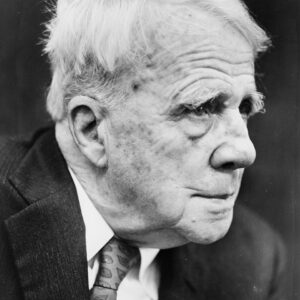
The poet Basil Bunting was as old as the century when he died in 1985. His life was bookended by the relief of Ladysmith and Thatcher’s defeat of striking miners. He was imprisoned in Wormwood Scrubs as a conscientious objector in 1918. In the 1920s he was at the turbulent centre of literary modernism, as (in Yeats’s words) “one of Pound’s more savage disciples,” until Pound’s vile politics proved unconscionable. (“Either you know men to be men,” Bunting wrote, “and not something less, or you make yourself an enemy of mankind at large.”) He claimed to have played chess with Franco in Tenerife in 1936. He was in military intelligence in Iran during and after the Second World War. Following the 1953 CIA coup against Mosaddegh, Bunting drove his family 6,000 miles back to his birthplace, in Northumbria.
“Briggflatts,” the long poem Bunting published exactly sixty years ago, in 1966, is called, “an autobiography.” But it recalls little of this eventful life. Instead, the poem records a lifetime in pursuit of what we might call deep listening. We’re only beginning to appreciate the richness of the natural soundscape—plants emit rapid, ultrasonic bursts when harmed, grow towards certain frequencies, such as running water, and release pollen in response to the vibration of pollinators; even soil is full of the sound of living things—and yet this realization comes as dissonance and silence become the norm. Dawn choruses are getting shorter and the oceans echo with the din of transcontinental shipping and deep-sea mining. We are, Bunting notes in the poem’s coda, “long earsick”; and yet, “a strong song tows us,” still.
Deep listening is a practice devised by composer Pauline Oliveros. Where hearing is involuntary, Oliveros writes, deep listening is “listening in every possible way to everything possible.” Bunting, too, understood that listening “connects to all that is.” In “Briggflatts,” deep listening means tuning into the resonance between things, “excepting nothing that is.” In Bunting’s poem, listening is the route to attunement: a practiced attention to the echoes in form and shape that reflect a larger, deeper sense of the relations that weave the living world.
When he was asked to lecture on “The Craft of Poetry,” Bunting said little about verse and gave instead an appraisal of the Codex Lindisfarnensis, an illuminated gospel made by Bishop Eadfrith c.698, on the tidal island of Lindisfarne, on the Northumbrian coast. The Codex is one of the greatest works of art produced in the British Isles, then or since, and the culmination of a Celtic-Germanic tradition of interlace, in which bird and animals drawn in the simplest lines are knotted into patterns of stunning complexity. The lines themselves have an animal life, as Bunting remarks in the poem, “easy and nimble as a lizard.”
Deep listening opens the senses, focusing vision, sharpening smell, and adjusting attention to the same “flexible, unrepetitive line.”
This same principle can be heard in any line from “Briggflatts,” where an unsparing condensation of detail discloses a rich musicality (“Who sang, sea takes, / brawn brine, bone grit”). But “Lindisfarne’s plaited lines” are more than mere analogy. The entire poem, which takes the Codex as its template, is testament to Bunting’s understanding that, “rhythm can be as visible in space as it is audible in time; and symmetry, and proportion, are as discernible in time as they are in space.” Deep listening opens the senses, focusing vision, sharpening smell, and adjusting attention to the same “flexible, unrepetitive line.”
This line is woven through “Briggflatts.” Its famous opening couplet—“Brag, sweet tenor bull / descant on Rawthey’s madrigal”—describe a braided song, life and land in concert. The poem begins in pre-war Cumbria, a landscape incessantly sounding itself (“becks ring on limestone / whisper to peat”), in which “a mason times his mallet / to a lark’s twitter.” The attentive mason is Bunting’s poetic ideal, and an elliptical account of Bunting’s itinerant youth outlines a deep listening apprenticeship, as he “scans / porridge bubbling, pipes clanking.”
Out of this clamor, a sense of resonance gradually emerges, of rhyming forms and echoing motion: ripe wheat sways in the wind with the undulating motion of the slowworm, a limbless lizard native to Northumbria (“Its swaying / copies my gait … every bough repeated the slowworm’s song”); “stars and lakes / echo him and the copse drums out his measure.” Where William Carlos Williams affirmed, “no ideas but in things,” Bunting found ideas between things.
The science of natural soundscapes is called bio-acoustics. A vibrant soundscape is a reliable indicator of ecosystem health. Tragically, much of what bio-acousticians record is “acoustic decay.” Acidification reduces the pH of seawater, which also diminishes sound absorption, so the stain of ship’s engine noise spreads further, muffling the songs of humpbacks and the codas of sperm whales. Animals occupy an acoustic as well as ecological niche: in Hawai’i, native and introduced species of forest bird use similar frequency ranges, blurring the boundaries of acoustic space. In some case, all that is left is silence. “Recordings made today will become tomorrow’s ‘acoustic fossils,’” warns sound ecologist Bryan Pijanowski.
In this rapidly detuning soundscape, we would do well to cultivate the kind of deep listening Bunting developed over his lifetime, and learn to perceive the “flexible, unrepetitive line” before it is unpicked entirely. The final part of “Briggflatts” features the Northumbrian saint, Cuthbert, in whose memory the Codex Lindisfarnensis was made, standing on the Northumbrian shore, “in love with all creation,”
as west wind waves to east
a just perceptible greeting—
sinews ripple the weave,
threads flex, slew, hues meeting,
parting in whey-blue haze.
Sound can sicken or heal. Just seven days’ exposure to shipping noise weakens the immune systems of blue mussels; but a process called acoustic enrichment, broadcasting the sound of a healthy reef, can attract marine life back to a bleached one, restitching the acoustic fabric of an entire ecosystem. In a world that is increasingly and troubling quiet, “Briggflatts” shows us how deep listening can tune our attention to the richness of “what’s lost, what’s left,” and what is still worth preserving.

David Farrier
David Farrier is the author of Nature’s Genius: Evolution’s Lessons for a Changing Planet, published in paperback on April 9. Nature's Genius was shortlisted for the 2025 Wainwright Prize for Conservation Writing and the Saltire Prize non-fiction book of the year.