On Taylor Swift and the Hard Art of Reinvention
Misty L. Heggeness Considers the Ways Women Respond to Economic Challenges and Setbacks
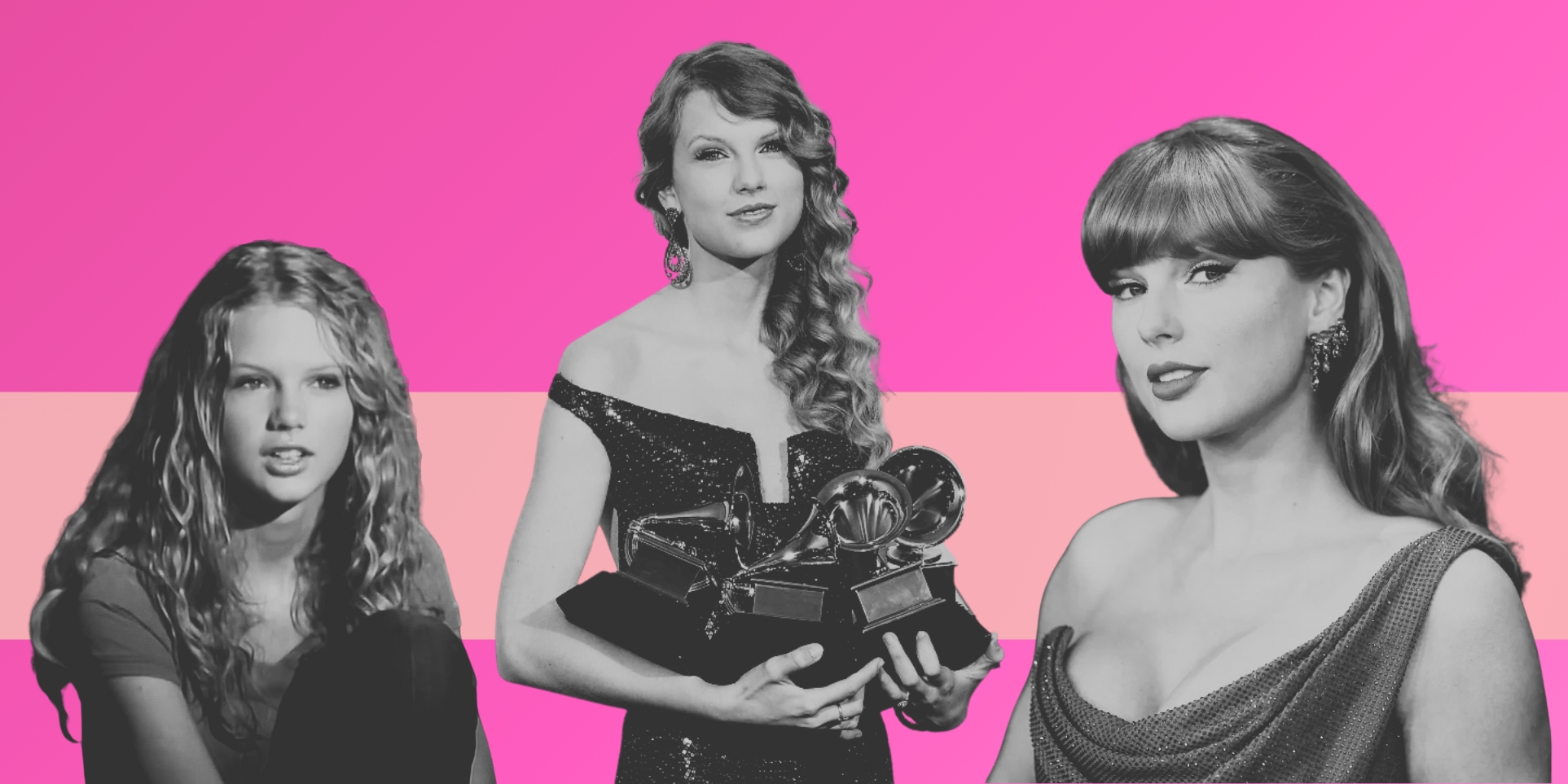
At the end of the music video for her song titled “Look What You Made Me Do” from her Reputation album, fifteen different Taylors appear next to each other in an airplane hangar, in front of a black plane with “Reputation” spray-painted on it. There are Red Taylor, 1989 Taylor, and Debut Taylor, to name a few. Each has her own persona and style. The lyrics of this song speak to drastic, determined reinvention, including lyrics boldly claiming a rise from the dead, or that the old Taylor is unavailable because she is dead. These reinvented Taylors provide evidence of how Taylor the artist transverses life, at least in her public persona, shedding one skin to harness the next layer of transformation.
Taylor has continuously reinvented her own image and whole-heartedly leaned into reinvention as a superpower. Women in societies across the globe understand the continual need for reinvention because we do it all the time, for survival and to advance in our careers and families. What does reinvention mean, and why do women reinvent themselves for survival? I argue that reinvention is our best secret weapon. It has propelled many of us forward and led us to increased economic agency.
*
Taylor’s career officially began in country music. She was a teenager who had been obsessed with pursuing a singing career since her childhood. She was not influential at first; she had to work for that, and knowing she wanted to be a singer so early in life did not protect her from having to reinvent herself, repeatedly.
Reinvention does not mean we have failed. It means we are alive, moving forward, and growing.
At the age of sixteen, Taylor made her mark on the Nashville country music scene with a debut album, but country music could not contain her for long. After releasing subsequent albums every two years, in 2014 she took a big risk with 1989, her first big step toward reinventing herself by moving into non-country genres.
As an early reinventionista, she proceeded with caution, first playing her new songs for friends and family in her home, then hosting 1989 secret sessions with superfans in New York, Los Angeles, Nashville, and London. Country artists at the time did not transition into other genres, yet Taylor had success moving into pop music. This would be just the beginning of Taylor’s reinvention story.
Whether it is a musical genre or her image, as Taylor ages, she continues to reinvent. When, in 2019, Taylor’s label was purchased, the masters of her first six albums, including Reputation, were sold without her consent. Unhappy that others in the industry were controlling her artistry and music, she spoke out publicly, directly to her fans, first asking them to help convince her prior label to allow her to sing a medley of songs from her first six albums at the American Music Awards ceremony—where she was going to be acknowledged with the Artist of the Decade award—and second, to allow her music to be used in an upcoming Netflix documentary titled Miss Americana.
After public encouragement from singer Kelly Clarkson and others, Taylor decided to regain control of her music by rerecording her first six albums. Owners and leadership at her old label tried to negotiate with her, offering to give her access to her albums “if she didn’t record ‘copycat versions’ of her old songs and if she stopped talking about them altogether.” Taylor again took to social media, saying, “The message being sent to me is very clear…be a good little girl and shut up. Or you’ll be punished.” Taylor was not willing to negotiate access to her autonomy and moved forward with the laborious act of rerecording old albums to regain control of them.
Taylor’s reinvention story has always been driven by a belief in her artistry and a refusal to be bullied or controlled by those with legal paper rights to her catalogue but no rights to her talent. She focused on communicating her issues publicly to garner support after private discussions failed. Fans and the larger community stepped in to support Taylor’s fight. Rerecorded albums carry the same name as the original followed by (Taylor’s Version). Radio stations began playing (Taylor’s Version) albums instead of the originals, and fans began listening to them on streaming services. Against the odds, Taylor had won, again.
On May 30, 2025, after rerecording four of her early albums, and backed by the financial success of the Eras Tour, Taylor announced that she had bought back the rights to her originals and now, finally, owned her entire music catalogue. Fans celebrated by streaming the music they had been boycotting for so long. Reputation moved to number one on iTunes, and Taylor’s old music dominated at least four spots in the top ten. By June 9, 2025, Reputation the album reentered the top five on the Billboard 200. After all the struggle, reinventions, and masterminding, Taylor had successfully reclaimed both her name and reputation.
“Swiftynomics,” the art of escaping the confines that limit women’s economic fulfillment, recognizes women’s power and autonomy and encourages women to follow their gut. Because we live in a world overwhelmingly constructed for the convenience of men, women must often change paths in order to overcome barriers to success and fulfillment. Eve Rodsky, author of the New York Times bestseller Fair Play, a book about invisible labor in the home, is one of many women leaning into reinvention.
*
The story of Eve’s youth provides insights into the art of escaping traditional societal confines and the power of harnessing our lived experiences to thrive.
The child of a single mom, Eve was in eighth grade when she took on the task of opening the family’s mail and managing household bills. One day she opened a truancy letter from the New York City Department of Education. Eve had missed enough school days that the city declared her truant.
Some time after that, her mother forced her to take the entrance exam for Bronx Science and Brooklyn Tech high schools. According to Eve, “It wasn’t an option. I could be truant. I could be wild. I could do all the things I was doing, but I had to sit for the test. I got into Bronx Science.” When Eve told her teachers, they did not believe her. They thought she had cheated.
Bronx Science was two and a half hours from Eve’s home. She would have to take the M line and a bus, walk three long avenues, then take the L train and another bus to finally arrive at the school. The night before school was to start, a different elite school, one located just across from their home, offered Eve a slot.
Eve believes her trajectory changed that day. Living across the street from school led to fewer temptations to skip. Being surrounded by smart, highly motivated high schoolers pushed Eve to take academics seriously. According to her, “Being in that [high school] environment for sure was [a] reinvention.” Over the years, Eve would reinvent herself multiple times. After high school, she attended the University of Michigan, and from there she went on to law school at Harvard.
She graduated, married, took a demanding job in corporate law, had children, got exhausted with the simultaneous demands of home and paid work life, quit her corporate job, wrote a book that details the disproportionate burden mothers often hold in household management and family caregiving, even when they also have jobs or professional lives, started to advocate for gender equality within the home, and founded the Fair Play Policy Institute, a nonprofit dedicated to creating awareness of the effects of unpaid labor on women’s lives.
Today, Eve continues to explore and reach for activities that stretch, pull, and push her, allowing her to live her best blended professional and personal life. She gave up on living a life defined by the boundaries of what is easy for men so that she could successfully live her best life on her own terms, in a world that values her time, effort, and priorities in their entirety.
*
Reinvention begins with a roadblock. Reinvention happens, for example, when one graduates with a law degree and then has a child and discovers one would rather stay at home with the baby than be in litigation all day long. It occurs when children become adults and stay-at-home parents decide to jump back into the paid labor market. Moving to a more flexible job to manage childcare or eldercare responsibilities can be a reinvention. Reinvention happens when musicians jump genres, like Taylor did from country to pop music. Reinventions drive our leaps from era to era. Most of us have experienced some form of reinvention in our lifetime—a change in the life path we thought we would take.
When women get stuck in life, many reinvent themselves within their careers, families, and communities. My research team and I surveyed around 300 respondents and asked if they had ever reinvented themselves (defined as switching employers, bosses, jobs, industries, or education toward a new or different theme, focus, or topic) along their career paths. Weighted to represent the US adult population, nine out of ten adults (89.8 percent) surveyed said yes. Ninety-one percent (90.9 percent) of women with an advanced degree had reinvented their careers (the percentage was similar for men), compared to 81.2 percent for women with less than an advanced degree. The top reasons respondents gave for reinventing were lack of opportunity to advance in the professional direction they desired and experiences that stifled their ability to grow. Others reinvented to better align work with personal life.
Reinvention is a fact of life. In our careers and work, most of us do it. Many women and parents feel shame or disappointment when they need to move on from one job or career to another, but reinvention does not mean we have failed. It means we are alive, moving forward, and growing.
Our economy has evolved from being primarily driven by manufacturing and agriculture to being a demand-driven service economy. This is due to economic growth and development brought about over time by increases in educational attainment and other factors. The jobs of our parents and grandparents are not like the jobs many adults hold today. Our economy continues to reinvent itself. As it does, our capacities, skills, aspirations, and goals evolve with it. It should come as no surprise that with elevated levels of education and innovations in all sectors, employees aspire to more. They also grow with these changes in the economy. If employers do not provide them with opportunities, they will find them elsewhere.
Throughout history, women have used their talents, skills, and wits to support issues, ideas, entertainment, and communities that are important to them. Women from regionally diverse areas and experiences all have something in common—a dedication to determining their economic agency in the world, a world that was not built for their convenience. Women are multifaceted and underappreciated in the labor market.
The labor market was built for those with care privilege. Care privilege is the advantage that comes from being able-bodied but having others cover your daily care needs, like making your meals, washing your clothes, cleaning your home, and caring for your children. The care-privileged often have no problem working 9:00 AM to 5:00 PM, Monday through Friday, or longer hours if needed. They do not have to figure out childcare. They are not constrained by school drop-offs and pickups. They advance in what is referred to as “greedy jobs” because others take care of their survival needs.
Women often find themselves in a bind when they attempt to work for pay in a labor market built by and for those with care privilege, because women rarely have care privilege at home. Often, traditional behaviors, expectations, and norms on the part of employers, industry, and even their own families hold women back from maximizing their career potential.
When it comes to reinvention as a mechanism that can help us thrive despite misogynistic behaviors in the workplace, we have a lot to learn from Taylor Swift. She has adapted genres and forced big changes in the music and entertainment industries because of her reinventions. These changes have pushed her forward, helping her thrive and advance along her own path. She uses her agency and the support of those around her to improve and reinvent. Many of us could benefit by mimicking her bravery and attitude toward a society not necessarily built for us.
*
At age eighteen, very few of us know what we want to do with the rest of our lives. Even when we think we do, life often gets in the way. Maybe your partner gets a great job offer in another state and you unexpectedly move, or the labor market is saturated with people seeking jobs in your field once you graduate from college or technical school. Perhaps you have children and your life priorities change, or you cannot find affordable childcare and need to adjust. Life always takes us down unexpected paths. The best we can do is to recognize the need for change, acknowledge that reinvention is a common human experience and an even more common female and caregiver experience and own it.
What we can learn from Taylor, from her ability to reinvent given the challenges she has faced, is the simple idea that our responses to the challenges in front of us matter.
Reinvention gets us unstuck. It keeps us moving forward when others might like us to stay right where we are so that they can continue to benefit from traditional power structures. Reinvention can make us more productive. It can put us in a fresh environment that better supports our mental and physical well-being. It can even lead to breakthroughs. Failure or change is often a key to eventual success. Just look to science. Scientists generally assume it is necessary to try multiple experiments or paths before finally finding the route to success. The same is true with one’s career and life.
The need for reinvention comes about not because the world is divided into men and women, old and young, but rather because people are diverse and come to the table with differing needs, wants, and perspectives. For example, the easy way to explain gender inequality is to believe, simply, that men hold women back. But this view is not empowering toward women and is often wrong. Misogynistic behavior holds women back. This behavior can be found everywhere, including where you least expect it, and to some extent within everyone.
Reinvention, and the belief that “Swiftynomics” is alive and well, exists because there are people in power, of all genders and diverse characteristics, who choose to support women living their fullest life outside of and within traditional gendered expectations when it suits them. Some of my best mentors, people who opened doors for me, have been men who share this belief. Some of my more ardent obstructionists have been women who felt I was too bold and assertive and was not following the informal rules for how I should act; I was acting “too male.”
We are driven by the external environmental challenges we face, our responses to them, and, more generally, how we choose to show up on any given day. What we can learn from Taylor, from her ability to reinvent given the challenges she has faced, is the simple idea that our responses to the challenges in front of us matter. How true we are to ourselves, how we respond to each situation we are presented with, big or small, affects both the era we are currently in and our next reinvention.
The more awareness we can develop to anticipate some of these environmental barriers and call them out for what they are—meaning we actively choose not to internalize them or react with shame, as though the barrier is our fault— is very powerful for women and caregivers. It influences our ability to be present and advance with a complete, whole identity. It drives our ability to succeed in the one life we are given. It gets us to reinvention faster by shedding that which does not serve us, increasing the chances that we end up living our best life.
*
Taylor’s continual reinvention has meant that her fan base is wide, diverse, and representative of the US population across various demographics. More than 129 million US adults identify as Taylor Swift fans. Her popularity is driven by the arc of her discography, which encompasses our emotional experiences as we age. Her music speaks of high school romance and tearful breakups, first loves, vengeance and revenge, rage, loss, and forgiveness. As Taylor’s music ages and matures, her fans age and mature with her. As she rerecords, younger generations are exposed to her youthful talent, which remains relatable to their experiences today.
It is no surprise that the Eras Tour raked in around $4 billion dollars on its North American tour alone, smashing records and exploding expectations. Taylor reportedly maintained control of around 85 percent of the revenue from her tour—something previously unheard of in the music industry. The benefit to local economies driven by her concerts was well documented.
Communities saw increases in local spending everywhere the tour went. Cincinnati estimated that an additional $48 million flowed into the city around the days of the concerts. Denver declared an additional $140 million. Los Angeles claimed $320 million in revenue-boosting activity. The US Federal Reserve even noted the impact of the Eras Tour on buttressing the local hotel industry in Philadelphia. Across the pond, London gained an estimated $314 million dollars in local spending when the tour descended on Wembley Stadium for a total of eight magical nights. Taylor has proven that, when one stays true to one’s authentic self, the power of reinvention is often lucrative.
__________________________________
Adapted from Swiftynomics: How Women Mastermind and Redefine Our Economy by Misty L. Heggeness. Copyright © 2026. Used with permission from University of California Press.

Misty L. Heggeness
Misty L. Heggeness is co-director of the Kansas Population Center, Associate Professor of Economics and Public Affairs at the University of Kansas, and former Principal Economist and Senior Advisor at the US Census Bureau. She is also creator of The Care Board, a dashboard of economic statistics built by and for caregivers that brings their economic contributions into the fold.