On Shirley Jackson’s The Haunting of Hill House Though the Lens of Childrearing
Lesley Jenike Considers What Motherhood Can Reveal About the Self
Once upon a time, Shirley Jackson lived in a shambling Vermont house and between sandwiches and screaming, baths, diapers, and stories, she wrote.
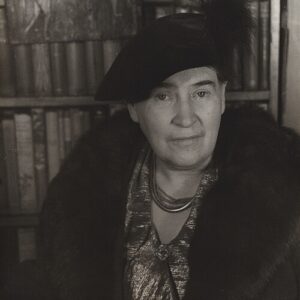
Shirley Jackson walked around her neighborhood feeling perilously close to disintegration. Shirley Jackson had four kids and dirty hair, plus psychic tendencies. It’s that house, she said. I can’t drive past it in the daylight again. Next time make sure it’s dark, OK?
What is it about motherhood and ghosts? The two just seem to go together, maybe because you love someone so much you can’t imagine losing them, but you do imagine it.
Once upon a time I lived in a 119-year-old house. I had two children, two mouths to feed. They weighed on me like cinder blocks, stultified me like pounds of dead leaves in my gutters. First, I housed them in my body where every night, trains rattled by with such fervor, I lost my bearings and forgot whose children they actually were, then my husband reminds me, They’re ours, and I sit up in bed and sigh with relief, if only because few things in life are real—one being that a train conductor lived here once upon a longer time ago with his sad-eyed wife and they come to me in my dreams, telling me this house of ours is ill, and that I’d better wrap my arms around it and soon before it all comes down.
*
Shirley Jackson’s most famous novel is The Haunting of Hill House. It’s about a sick house, sick with relentless reality, with the relentless fact of its realness. There is the realness of child abuse, of abusive religion, of the basic fact of family. There is the realness of relentless childcare, the care of elderly parents, of diminishing returns. There is the reality of loneliness. There is the reality of a hand belonging to—who knows?—cold-gripping yours at night for lack of a body of its own, a body of fiction, a body of magic, a body of dreams.
Shirley Jackson writes in The Haunting of Hill House’s opening paragraph,
No live organism can continue for long to exist sanely under conditions of absolute reality; even larks and katydids are supposed, by some, to dream.
The house’s illness comes from its abolition of imagination. Even the art, the carefully staged furniture, the fabrics, the damasks and toiles, the gourmet kitchen and well-stocked linen closet, are meant to induce absolute reality. The house’s horror isn’t its history, but its lack of one. It is the approximation of a life lived, of a doll house no one plays with. It typifies repressed rage or—not even rage—disappointment.
What is it about motherhood and ghosts? The two just seem to go together, maybe because you love someone so much you can’t imagine losing them, but you do imagine it.
Eleanor in Jackson’s The Haunting of Hill House speaks the ill house’s language when no one else seems able. They’re reading the signs differently, but to Eleanor, the house is just misunderstood. The house is just clinically depressed. The house is just a droopy teenager without sense of direction or a bellicose college roommate lying moribund on her bed when you get home, so you ask, What’s wrong? What’s wrong? but she just groans and rolls over.
The ill house feels our infinitesimal movements inside her and ignores them, which is worse than violence.
*
Once, before I was a house and when I was simply a woman, I met a very famous writer over dinner. I am a woman who writes too, mind you, and a mother at that, and therefore a ghost.
Despite this fact, I came prepared to fight the very famous writer over E. M. Forster because he dislikes Howard’s End and I adore it. It is a book about a house and the house is a woman’s province, so it’s my province.
Instead, we talked about other houses—not Howard’s End—specifically a certain house he remembered from childhood that by its very Scandinavian nature, and by its very Midwestern location, he said, was haunted. And I told him, I don’t think Scandinavians have cornered the market on ghosts. I told him, however, that I had a Scandinavian great-grandmother who ghosted herself away from her family. Born in Finland, raised in Boston, then wrecked in Ohio, the poor woman couldn’t exist as matter anymore. She fretted in her mind, all the while running smoothly and on time like a Swedish train. Her love was frank but also—like a cloud—limited. Then she up and left one day after breakfast.
Now that’s a ghost, I said. Now that’s one hell of a ghost. Because it isn’t her body which she took with her, but the lack of one she left behind.
*
Houses are made of trees. Sure, some houses are made of stone or brick or peat or snow or animal skins, but let’s face it, the house you’re in right now is mostly tree.
Once before I was a house or a tree or a mother or even a woman, I went to a party in a nineteenth-century monastery up on a hill that overlooks the Ohio River. The monks that used to live there made wine, prayed. Some were from Germany or were the children of German immigrants. They had cells on the topmost floor and a chapel in the basement. Yes, they made wine, wore oversized robes cinched with ropes, prayed, died, and went away, the residue they left behind—vaguely sinister—was like the chemical orange smell of floor wax in a Catholic school gymnasium.
A doctor bought the place and took his family to live in it. Once he’d done it over, he threw enormous parties to show it off—Halloweens, Christmases. There were concerts in the chapel, and we’d gather there for musical interludes, to wonder at the altar, once sanctified by God’s anointed, and now just an eccentric way to pass the time.
The doctor had a lion cub for a pet. He flew airplanes. He wore a bomber jacket everywhere at all times of the year. He also had a little family, a daughter about my age who padded across the black-and-white-tiled floor of the old vestibule with a stricken look on her face.
Once, when I was just a ghost, a young woman tried to burn a fire in a closed fireplace. She was living in the oldest wooden building in Cincinnati. Of course, the flue was closed, so the fire licked up the walls, left a smell like the fall, like ancient smokehouses and dung. Her illegal fire made the spirits in the place angry; they seemed to “come out of the walls,” she said. After that, she pretty much avoided the living room.
Once before I was even a ghost, I held the doctor’s baby lion while someone took a polaroid of me. The cub felt like gristle, taut, like a spasmed muscle in my arms. Its claws did not retract. I didn’t have time to look it in the eye. The photo never developed. When I returned the lion cub it was with great relief, as if handing back a screaming baby. Not for me, I thought. Wild animals are not for me.
Once, before I was a house or a tree, a ghost or a woman or even a girl, I lived in an old apartment in Columbus, Ohio, and my tortured imagination would throw books off a shelf up in the loft office. One of the books that repeatedly landed on the floor was The Tao of Pooh, a battered copy an ex-boyfriend gave me. Now my son toddles up to the bookshelf and casually knocks off Corduroy, The Cat in the Hat, This Pigeon Needs a Bath, Baby Beluga. This may explain something about ghosts.
*
Common wisdom dictates, if you want to know how fucked up someone is (or is not), make them draw a house, a tree, a person. This is called the House-Tree-Person Test. These three things, psychologists say, dictate the nature of our respective realities. How many rooms? How many branches? Is there a front porch, a back garden? Is this person smiling and wearing a triangle dress? Is this person gesturing hello or leave me alone? What kind of tree are we talking about here? And what kind of house? When a child draws a house, she always draws a door, and when she draws a door, she hardly ever draws a keyhole.
Houses can wait forever. If a room is removed whole-cloth and rebuilt somewhere else, it’ll retain its primary impressions, what meals were taken in it by what people, which trees were used to make it. It’ll rise to the level of consciousness on the regular, float above a single line meant to stand-in for earth, and what it loses in reality it’ll gain in metaphor.
The house in E. M. Forster’s Howard’s End is a woman’s house, that’s why Henry Wilcox has no real use for it. It once had a meadow and a pony. Its homeliness is also its wealth—small and bricked, perhaps no longer functioning in its original capacity as a home to farmers but retaining a gift for earthy pleasures by keeping green, by keeping humble. And when Margaret proposes that Helen stay there—one night! one night only! as she’s pregnant and in disgrace, the house’s femininity absolves her, ignores what Helen’s peers would say is shame, in particular the basement which, as Gaston Bachelard says in The Poetics of Space, is “first and foremost the dark entity of the house, the one that partakes of subterranean forces.” It was where Christmas decorations waited in boxes, pictures moldered, where my school uniforms were hung to dry on overhead pipes. It was the dark hole out of which my mother wrestled two suitcases in a dramatic show for my father, where a painting of a man in a uniform faced the wall, where the floor swelled with tree roots. “When we dream there, we are in harmony with the irrationality of the depths,” Bachelard tells us.
A child draws an oversized doorknob on her crayon door and a roof more like a head with its hair parted down the middle. A friendly lamb’s tail of smoke curls from the chimney.
“A key closes more often than it opens, whereas the door-knob opens more often than it closes. And the gesture of closing is always sharper, firmer, and briefer than that of opening,” says Bachelard. He writes, “When the house is happy, soft smoke rises in gay rings above the roof.”
But for children whose lives are rife with discord, violence, pain, even the drawn fire is dead, stiff, and its smoke rigid. The trees look like they’re closing in.
Examples of House-Tree-Person Test follow-up questions:
After the House:
Who lives in this house?
Where do we go when we are not here?
Where does the house go when we are not there?
Whose window is/was that?
How many children per room, head to foot?
After the Tree:
What kind of tree is this?
How much of it was cut down to make the house?
And how much to make the fire?
And how much to make the maypole?
Does it have fruit or flowers or leaves or nothing?
After the Person:
Who is she?
Is she young the way we remember her, the way we remember certain books we read when we were young?
Isn’t it true that the books we liked as children seem so narrow now?
And isn’t it also true that once in a while, a person strikes us as being the house and the person and the tree simultaneously,
And shouldn’t we admit that this is just another holy trinity?
*
A house can transcend its foundations and menace the street like a naughty kid. A house can show you its legs. A house can drape itself in lace and light a candle inside its skull.
A house can be something. A house can be a woman’s body haunted by the ghost of her children who are haunted by the ghost of her imagination.
“The forest is my house,” says the tree.
But a person lost in the forest asks, “Am I walking toward something I should be running from?”
A house can be something. A house can be a woman’s body haunted by the ghost of her children who are haunted by the ghost of her imagination.
A house can have—stuffed in the recesses of a closet once used for storing milk and eggs—the body of a woman. The family who lives here now say they try not to think about what happened—the murders, the exterminated, undetermined stars after a punch to the face and no one cares.
Still, at various times they all sometimes wake in the middle of the night to the invisible sensation of desperate love and exclaim aloud, “God! Whose hand was I holding?”
*
Bachelard says, “In every dwelling, even the richest, the first task of the phenomenologist is to find the original shell.”
Virginia Woolf begins her novel about a house—Orlando—with Orlando him/herself up in the attic taking whacks at the strung-up head of a dead North African. If, as Bachelard says, the attic of a house is our conscience, it takes centuries, several reincarnations, and a few gender changes for Orlando to rid him/herself of the conscious that tells them to repeat their family’s insane reality—of war, colonization, murder, xenophobia. At the end of the novel, Orlando is outside the house and outside of time because, as J. W. Dunne shows us, our dreams are a conflation of the past, present, and future. Orlando sees their house from a distance below them, small as an opalescent shell. It’s 1928, but the house is lit for a visit from Elizabeth I,
There stood the great house with all its windows robed in silver. Of wall or substance there was none. All was phantom. All was still. All was lit as for the coming of a dead Queen.
If the ill house is a house that can’t imagine beyond reality, I’m riding shotgun with Shirley Jackson past that house again, and she says, never in daylight, so I place one hand over her eyes and another over her mouth to make believe darkness, and I whisper instructions into her open ear, turn here. The house itself is a blind in snow. Once upon a time it was the kind of house filled with people too hard for dreaming except this one dream—of travelling back in time until the house is just a dark cave in some distant countryside. Let’s go back, Jackson says, meaning to the house of magic with its moon-colored brick, shot-through screen door, fruit in the centerpiece ripening to rot, the house of fiction in its deepest iteration, its truest self, where Shirley told her daughter, you were here all along. My body was just a tree you were hiding behind.
__________________________________
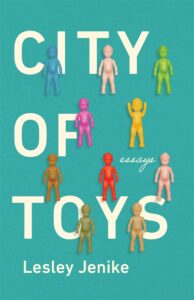
From City of Toys by Lesley Jenike. Copyright © 2026. Available from Mad Creek Books, an imprint of Ohio State University Press. “The Haunting of Ill House” was originally published in Phoebe issue 48.2 (May 2019).

Lesley Jenike
Lesley Jenike’s poems and essays have appeared in Poetry, Kenyon Review, and elsewhere. Her most recent collection is Punctum (Kent State). She teaches at the Columbus College of Art and Design.