On Self-Loathing and Kink in Jackie Ess’s Darryl
Sage Agee Considers the 2021 Novel
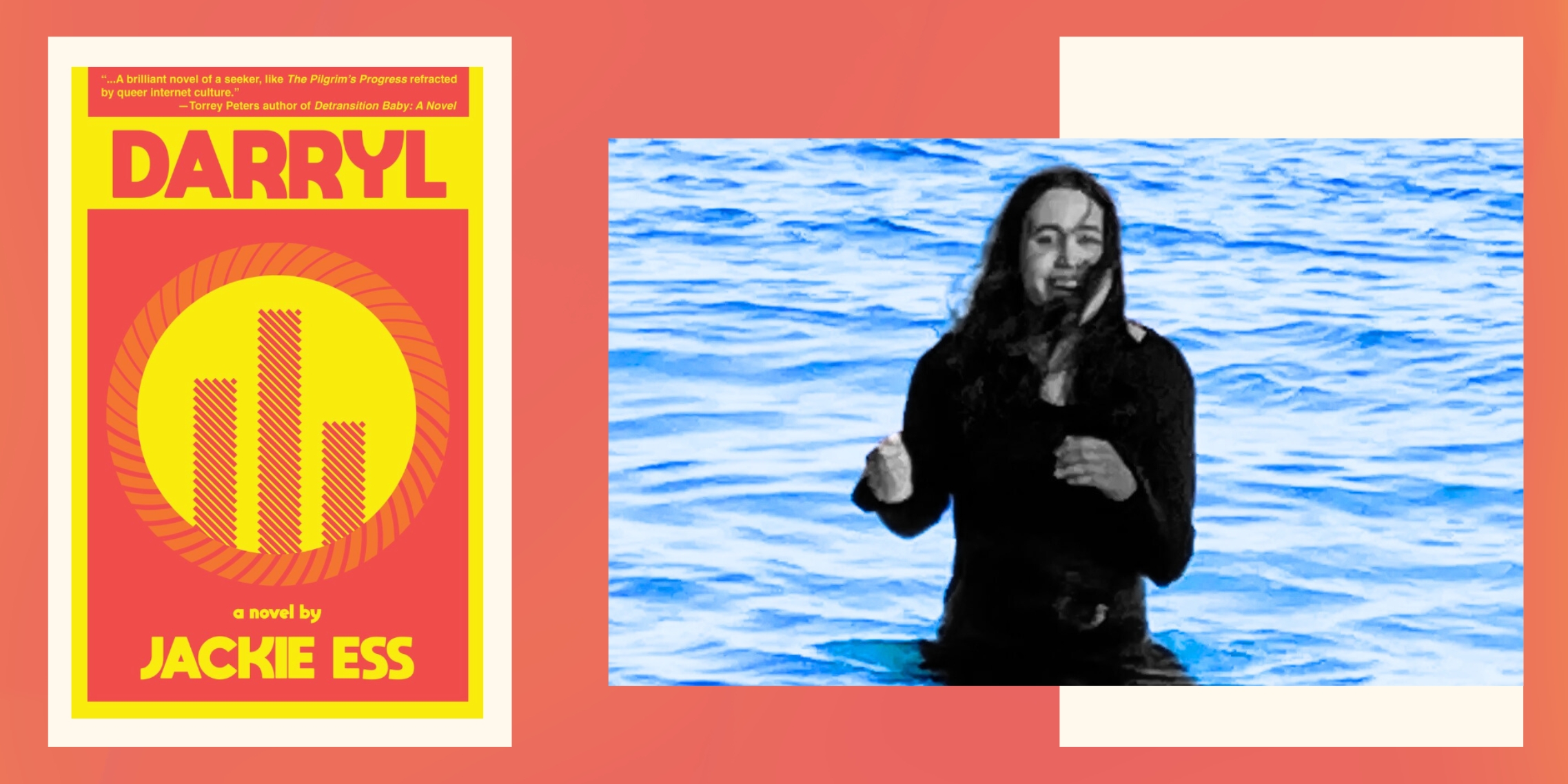
Being a cuckold is a lifestyle choice for Darryl Cook, in Bay Area Trans Writer’s Workshop’s co-founder Jackie Ess’s 2021 debut novel Darryl. This premise was enough to hook me when I first read the summary in the small press section of Powell’s Books in Portland, Oregon. What I quickly discovered was that Darryl was so much more than a cuck—he was a hyper-aware, devoutly cynical, family “man” deep in the identity crisis so many trans people can instantly relate to.
Set in a similar world to Dennis Cooper’s The Sluts, the collection of characters that Darryl shows us via the epistolary/diary format paints one of the most realistic portrayals of an Oregon experience that I, a lifelong Oregonian, have read: a somewhat grungy combination of derelicts, white yoga teachers, and potential psychopathic serial killers make up his complicated pacific northwest community.
Almost like reading something we shouldn’t be allowed to see, Darryl’s judgments of these characters are brash but contradictorily open-minded. Early on we meet Clive, a fringe “psychologist” seemingly specializing in sex and drugs. After Clive insists on watching Darryl and Mindy have sex in front of him, there is a moment that neither Darryl nor I can get out of our minds, where Clive shakes his head disapprovingly at Darryl as he climaxes. “Therapy shouldn’t be a British guy who looks like my dad making fun of how I have sex,” he says.
Beneath those judgements is a deep sadness that we have the privilege of watching Darryl dissect, analyze, and intellectualize almost to a degree of self destruction. Why is Darryl really into being a cuck? “When a guy is fucking my wife,” he says, “and they’re both telling me how worthless I am, I guess that’s the only time I really feel validated or seen.”
“If I was trans I probably wouldn’t be able to shut up about it either.”[/cpullquote]Darryl is so desperate to understand the reason for his melancholia, that he assumes a position of marginality based on the fetishistic world he exists in. In a 2021 interview for The Poetry Project, Ess describes the trouble men like Darryl get into when they observe power this way. “[T]hey are trying to sort of restore this position that they could only have through a kind of ignorance and privilege, or through utopia,” she says. “Sometimes the discomfort reflects an objective condition which we have only recently become aware of or put down our denial of.”
Darryl’s denial of self is obvious when on a drunken trip with his wife Mindy and her boyfriend Bill the bull, they meet a trans woman who introduces herself by her pen name Oothoon—likely a reference to a niche William Blake poem. Of course Darryl is quick to pass judgements, but also relates to her on a level that surprises him. She must be miserable and depressed and misguided as a trans woman, like he feels.
As the novel continues, we see Darryl become obsessed with this woman. Snarky lines such as “if I was trans I probably wouldn’t be able to shut up about it either,” reveal more than Darryl himself is willing to give directly.
What makes these fictionalized personal musings, and the novel itself, stand out so much is the self analysis in contrast with mainstream society itself. Take, for example, the first line of the book: “You live vicariously through celebrities, I live vicariously through the guys who fuck my wife. But sure, ok, I’m the weird one.” It’s quips like these that contrast Darryl with the rest of the world, when the onlooker who doesn’t know anything about him would see him as simply a white cisgender heterosexual man.
At times, his positioning within society makes it hard to empathize with him. Living off an inheritance, he has the ability to make bad financial decisions without considering the consequences. His passivity in situations that would enrage most people to the point of action is frustrating. He is narrating his own life through the filter of how he is perceived by the men who have sex with his wife. He is so philosophical at times it is hard to keep up with spiraling tangents about LeBron James or what it means to be a dead leaf on a tree.
“What if everybody else is a live [leaf], or a pinecone, or a nut? What are they going to do when they find out about me?” he muses. Like the dead leaves piling up on the driveway, Darryl is often unlikeable, or seen as simply a nuisance. His inner dialogue forces the reader to question whether or not they can like someone who doesn’t even like himself.
It’s the tragic humanity of Darryl that brings the reader back in, though. Throughout the endless self-justification and self-deprecation we find glimpses of hope. “Lately I feel like I’m ascending the scaffold all the time, except when I actually am, and then I feel bright and alive and in nature,” Darryl muses as we reach an unexpected resolution in the plot. “Go figure.”

Sage Agee
Sage Agee is a writer living in rural Oregon. His writing focuses on identity, parenting, culture, and the death landscape. When not writing, he works as a funeral director and runs the Trans Death Care Fund. He has written for The Washington Post, TransLash Media, The Modern Farmer, and writes regularly for TalkDeath, Earth Island Journal, Parents Magazine, and Business Insider. You can read his personal work on grief and identity at littledeath.substack.com.