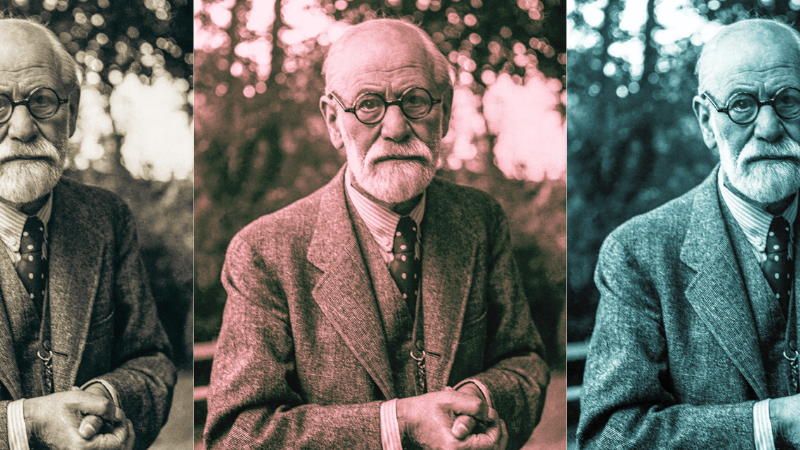
On Redeeming Freud
Stephen O’Connor Writes About the Connection Between His Father and Sigmund Freud
The inspiration to write a novel or story usually comes to me as a vague inkling that some image, situation, or statement (often a paradox) might open a doorway to a world rich in emotional and philosophical mystery. But in the case of my new novel, We Want So Much to Be Ourselves, inspiration came via something like an ambush. During the summer of 2016, I was driving to an artists’ residency where, after having devoted six years to a 600-page novel, I intended to work exclusively on short fiction.
At some point along the way, I started contemplating story possibilities. Almost instantly, an anecdote popped into my head that had been told to me decades earlier by a dear friend—a German Jew who had been born in Berlin early in the twentieth century. Sometime in the 1930s, while she and her mother were waiting on a dock in Italy to board a ship to Palestine, her mother suddenly declared, “No. I can’t do this! I’m German. I have to go home.” My friend boarded the ship alone, and her mother returned to Berlin, where she met the fate the Nazis had arranged for her.
Although hearing that my friend had suffered such an experience moved and shocked me, as a story it was simply too familiar to amount to the evocative and thought-provoking fiction I hoped to write. I might never have given it another thought, had not, only seconds later, two ideas come to me almost simultaneously. The first was that, if I wrote a story based on what my friend had told me, the father of the protagonist would be a psychoanalyst. The second was that whatever the story’s characters believed about themselves would ultimately be revealed as false.
I came away from this conversation feeling enlightened and proud of the work my father did.
As I drove, the story continued to evolve. It may have taken only seconds for the psychoanalyst father to replace his daughter as protagonist. I am not sure when it occurred to me that the father would be a student of Sigmund Freud, but certainly within minutes. By the time I arrived at the residency, so many scenes, themes, plots, and subplots had attached themselves to my friend’s anecdote that I realized I was already working on another novel.
Inspirations never reveal themselves all at once, and sometimes they have surprisingly deep roots. I didn’t realize, for example, that the two ideas that transformed my friend’s anecdote into a potential novel came from a single source: my own father, who was, in fact, a Freudian psychoanalyst. For many years during my childhood, I had no idea what my father did for a living. When I was very little, he told me he was a “head doctor”—which I interpreted as meaning he put bandages on people’s skulls. When I was around six, he would say his job was to help people with their emotional problems, but this explanation made no sense to me. What could an “emotional problem” possibly be? And how could such an indistinct and intangible thing be cured?
But then, when I was in middle school, I told my father about the puzzling behavior of a boy who claimed to be my best friend. “You have to remember,” my father said, “that most people don’t know why they do what they do. If you want to know who your friends really are, don’t listen to what they say; pay attention to what they do.” I had never imagined that people could be ignorant of their own motives, but after a moment’s thought, I knew that what my father had told me was true. I also knew that at least part of his job entailed bringing people’s understandings of themselves closer to who they actually were.
I came away from this conversation feeling enlightened and proud of the work my father did. But, alas, not long afterward, his casual drinking evolved into an alcohol-fueled campaign to destroy all the most important relationships in his life—which is to say that this man, whom I had always seen as wise and loving, turned out to be entirely unlike what everyone in our family, including he, himself, had believed he was.
While I never ceased to be fascinated by the workings of the unconscious, my anger and disappointment regarding my father made me deeply skeptical of psychoanalysis. When I was in college and first began to read Freud, I saw him as a misogynist who overemphasized sex and the experiences of early childhood and underemphasized more proximate causes of mental distress. I was especially contemptuous of his theory of the death drive, which he described as the psychological manifestation of the biologically programmed inevitability of death, an assertion I thought the equivalent of claiming that the universality of tooth decay implies an instinctive drive toward toothache.
Thus, I couldn’t quite comprehend why I was so eager to write about a psychoanalyst, and even wondered if what I relished was the reversal of power—that is, when I wrote about a psychoanalyst, metaphorically at least, my father’s fate was in my hands, and I could do whatever I wanted with him.
Of course, I had also chosen to place my psychoanalyst, Günter Zeitz, in Nazi Germany, which required a great deal of research. Early on I was astonished to discover that, far from rejecting psychoanalysis—commonly referred to as “the Jewish science”—the Nazis embraced it as the most effective treatment for what we now call PTSD, and as the best means for ensuring that Aryans lived up to the moniker “the master race.” In 1936, once all the Jewish analysts had been forced out of the Berlin Psychoanalytic Institute, Reichsmarschall Hermann Göring massively increased its funding and installed his cousin Matthias Göring as director. I could hardly think of a better place for Günter to be employed. I had already pegged him as a hapless idealist, not unlike my father, and so working in the institute would mean a constant struggle to live up to his ideals—although I had no idea what level of success or failure I wanted for him.
For Günter to already be a prominent psychoanalyst when Matthias Göring took over the Institute, I would have to have him study with Freud in the mid-twenties, which, as it happened, turned out to be precisely when Freud was developing his theory of the death drive. In Beyond the Pleasure Principle, published in 1920, he presented the death drive as parallel to the physiological mechanism that leads to the self-destruction of cells.
But while pain may be an inevitable consequence of the life drive, it is always inadvertent and unwitting.
And Civilization and Its Discontents, the book he was working on when Günter was his student, the death drive was more metaphorical, not so much a literal drive toward extinction as the super-ego’s attempt to restrain and control the pleasure-seeking and substantially selfish life drive. In my earliest drafts of We Want So Much to Be Ourselves, Günter shares my contempt for the theory of the death drive, but everything changed when I went to Auschwitz-Birkenau.
Near the beginning of my tour, I walked into a room where, on my right there was a vitrine in which a thick braid of extraordinarily beautiful golden-red hair lay on a table. As soon as I saw it, I was aghast with sorrow for the poor woman whose braid was chopped off so close to her skull; I could feel how terrified she must have been. But then I looked to my left where a vitrine longer than a city bus contained, according to the tour guide, eight tons of human hair. The massive multiplication of sorrow and fear represented by all this hair was more than I could take. I thought I was going to faint.
In the end, I was swept along by the crowd and, maybe an hour later, found myself standing on the windswept plain of Birkenau, looking at the ruins of the gas chambers and crematories, most of which the Nazis had attempted to destroy so that the advancing Russian army would not know the true horror of what they had done. What this meant was that the Nazis had known that what they had been doing was unforgivable, and so they also knew that as they destroyed millions of innocent lives they were simultaneously destroying their own humanity. I couldn’t see how else to explain this intersection of savage cruelty and moral suicide than through the death drive. And so I came to write the following speech, which Sigmund Freud delivers at Günter’s wedding, and which I believe is the single most important passage in the entire novel. Of course, the words Freud speaks are really my own, and just possibly, they are also my father’s.
“When I speak of love,” Freud says, “I speak also of the life drive—that collection of instincts impelling us to seek pleasure and do everything necessary for the propagation and survival of our species. But, of course, as some of you may be thinking, nothing causes more pain than the desire for pleasure—a fact attested to by countless love songs and religious texts. And, indeed, the life drive is patently absurd, given that it encompasses both love and jealousy, generosity and greed, selflessness and vanity, and a host of other incompatible impulses. Even so, I believe this concatenation of contradictions represents humanity at its very best.
Lately, I have come to think of the life drive as an inverse Quixote, who might seem to be tilting at windmills, but is, in fact, doing battle with monsters. Real monsters. These monsters—its antitheses—constitute that part of our nature that urges us to be sensible and strong, and that inclines us to see the life drive as trivial, weak, sentimental and immoral. And it is certainly true that our impulse to maximize our own pleasure must constantly be examined and restrained—for our own sakes and for other people’s. But while pain may be an inevitable consequence of the life drive, it is always inadvertent and unwitting. Whereas pain is a primary mode of these antithetical impulses, as are hate, fear, anger and shame. At their most extreme, they drive us toward destruction, not just of the loathsome or dangerous, but even ourselves.
If it is possible to rank catastrophes, I would argue that unrestrained indulgence of those impulses antithetical to the life drive is by far the worse of the two alternatives. However chaotic and foolish the life drive may be, it not only represents all those qualities designated by the term humane; it is, in fact, the life force, as it exists within us and operates in human society. And when we fail to recognize its consummate importance, we fail to recognize the sanctity of human life. The impulses antithetical to the life drive are manifestations of the death drive, and there is a good reason for their being called by this name—one that is, perhaps, particularly obvious during the present era, when an ever-growing number of people, inspired by a fanatic, are animated only by hate, fear, anger and shame. We are fortunate that, thus far, these would-be agents of the death drive seem unable to take their collective neurosis to its logical conclusion. But we would be fools to imagine them incapable of doing so. And I fear, gravely, that our ability to avert such a catastrophe may be rapidly diminishing.”
__________________________________
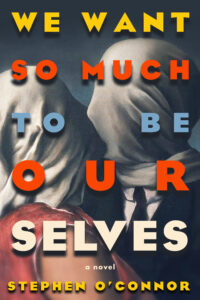
From We Want So Much to Be Ourselves. Used with the permission of the publisher, Bellevue Literary Press. Copyright © 2026 by Stephen O’Connor
Stephen O'Connor
Stephen O’Connor is the author of seven books including two novels, Thomas Jefferson Dreams of Sally Hemings and We Want So Much to Be Ourselves, and the short story collection Here Comes Another Lesson. His fiction has appeared in the New Yorker, Harper’s Magazine, and Best American Short Stories, among other publications, and his nonfiction has been published in the New York Times, Nation, Boston Globe, and elsewhere. He teaches fiction and nonfiction writing at Sarah Lawrence College and lives in Manhattan.