On Recognition, Truth, and Otherness in Shola Von Reinhold’s LOTE
Bianca Licitra Considers the 2020 Novel
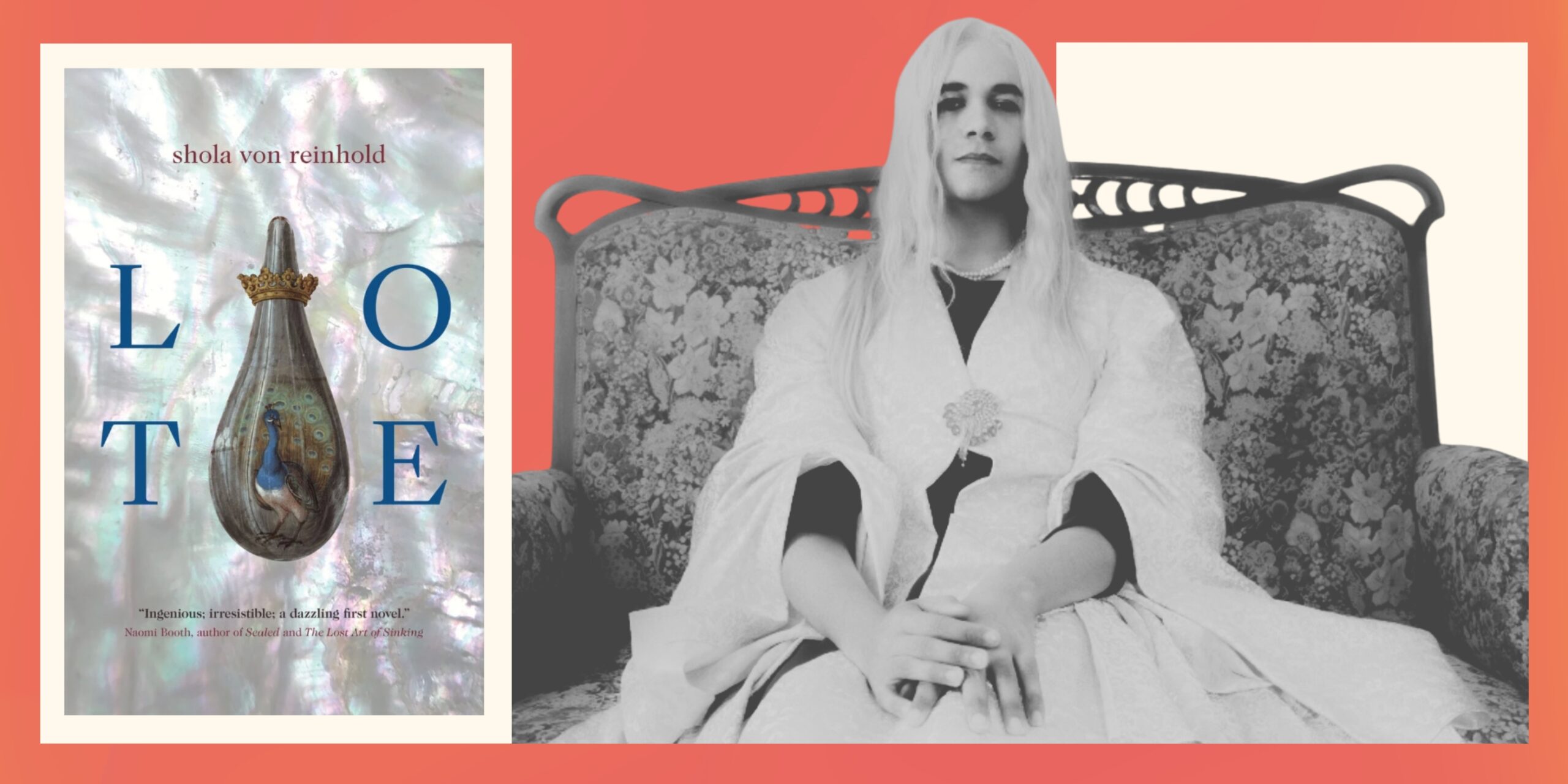
Steeped in irresistible, gaudy glamour, Shola von Reinhold’s LOTE weaves a web that is uniquely funny, undeniably queer, and often completely absurd.
The novel follows Mathilda, a fantasist preoccupied with the past. Driven by her own marginalization and desire for a life of pleasure, Mathilda has enacted Escapes throughout her life, repeatedly changing her name and circumstances to keep life’s drabness at bay. Getting by on scams and luck, she spends her time tending to a collection of euphoria-inducing Transfixions with a dedication that is often academic and frequently verging on spiritual.
Otherness, beauty, and excess are the common threads that tie Mathilda’s Transfixions together, and her to them. She did not choose these Transfixions. Rather, they seem to reach through time to find her, showing up in her life by chance and causing involuntary, pleasurable sensations: “Nocturnal gilding coats the bone… aerated waters on powdered eyelids…” Mathilda revels in them and I linger on these tiny details every time I reread LOTE.
While many of her Transfixions belong to the eras of the Bright Young Things and the Bloomsbury Group, others stretch as far back as the Renaissance, or even emerge as sensations alone, unattached to any name or history. At the story’s start Mathilda happens upon a new Transfixion, the obscure Black modernist poet Hermia Druitt, who sends her into a tailspin unlike any who came before.
As she tumbles down a Hermia rabbit hole, Mathilda has to plan her next Escape. Pursued by a trio of tasteless yuppies she used to know, Mathilda’s past begins to close in on her as they threaten to connect her former identity to her present self. Just when all hope seems lost, Mathilda is accepted to a bizarre artist’s residency in Dun. Though she isn’t sure how, the residency is related to Hermia, who once lived in the tiny town and used it as a home base for a secret society. Once in Dun, Mathilda gorges herself on strange delicacies while assembling disparate pieces of Hermia. As Mathilda discovers more about the resident “artists” and their incomprehensible philosophy, the truth about Hermia becomes increasingly complicated.
Trans histories are in limited supply, which may lead trans authors to fabricate their own for literary purposes.
Unlike the other Transfixions, Hermia was a queer, Black woman without a past. She seems to have been an escape artist, too, fashioning herself as a socialite within the Bright Young Things. Though Mathilda often thinks aloud about her otherness, her research into Hermia’s life proves more insightful to the reader than anything she shares about herself. Through chapters of academic text, snippets of what may be Hermia’s writing, and Mathilda’s own divination cards, the lives of her Transfixions come into focus—and so does she.
Von Reinhold is a trans writer, so I’m tempted to read LOTE as a trans book. But Mathilda only describes herself as queer, never defining what that means for her. Stephen Tennant, one of her primary Transfixions, is not only queer but famously gender-nonconforming. And from the excerpts, the reader learns that Hermia, too, is preoccupied with androgyny. In Black Modernisms, Mathilda’s primary reference for Hermia information, the author identifies “queer femme society” as one of Hermia’s influences. Still, the transness is only hinted at, never explicit. Maybe the reader is not meant to know the truth, or maybe there isn’t a truth to know.
LOTE evades categorization in more ways than one. The novel’s copyright page lists it as both a historical fiction and a detective and mystery fiction. I think of the novel differently. Rather than imagining a trans character who exists at a different point in history, von Reinhold is inventing a historical figure and exploring her through the lens of a contemporary character. LOTE reimagines the past through worldbuilding in the present.
Trans histories are in limited supply, which may lead trans authors to fabricate their own for literary purposes. Mathilda’s thinking, however, offers an alternative motive. As she ponders how she first came to learn of Hermia’s existence, struggling to remember and questioning whether she might be a figment after all, Mathilda thinks:
Were my Transfixions not, at least in part, vessels for something else? Did it matter if they had been real people?
By suspending disbelief and indulging in fabrication, von Reinhold, her characters, and readers along with them, may experience the pleasures and perils of Transfixion. Characterized primarily by a feeling of “violent familiarity,” an experience Mathilda compares to holy rapture and opium baths, Transfixion is intoxicating and fulfills a need in those who are othered, allowing them to feel recognized in a world where they are so often pushed to the margins.

Bianca Licitra
Bianca Licitra is a writer living in Washington, DC. Their work has appeared in 730DC and Washington City Paper.