On Lio Min’s Beating Heart Baby as “Portable Fortress of Dreams”
Alexander Chee Considers the 2022 YA Romance
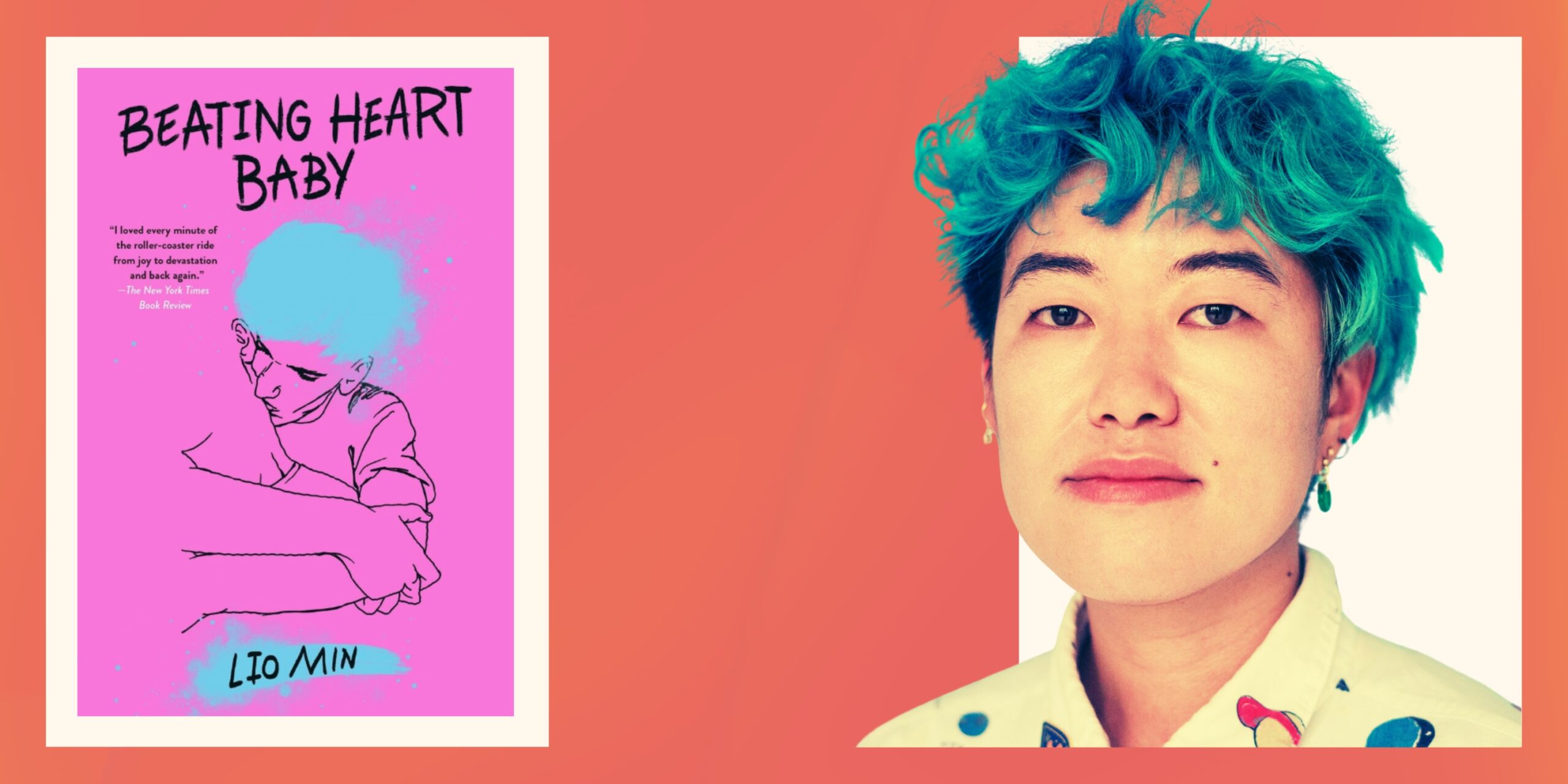
Lio Min’s 2022 novel, Beating Heart Baby, begins with a charming queer Filipino high school senior trumpet player named Santi being driven to his new high school by his beloved guardian, Aya, taking in the sight of “the city of a thousand cities,” as he calls it—as beautiful an evocation of Los Angeles as any I’ve ever heard.
Santi is now going to be a senior at De Longpre High School, his first day spent in large part by meeting the members of the Sunshowers, the school’s crack marching band, perhaps more popular than any particular sports team at the school. Aya is an alum as well, and her mentor from her own high school days there is Cap, the band leader, who immediately becomes Santi’s protector and mentor too. Most importantly, Santi meets the intense and beautiful Suwa, the star trumpet player. Santi quickly says the wrong thing to him, seemingly making an enemy of him off the bat. And while Santi quickly finds other friends in the band, he knows Suwa is the fierce and popular head of the trumpet section, placing him squarely in Suwa’s path. Suwa is the band’s beloved transmasculine Korean American hero, glamorous and quick-tempered.
But the two are more like than not. Both are also for all purposes motherless boys—Suwa’s mother died and his father survives her, full of an unanswerable grief. And Suwa, as Santi learns, is also a fan of “Exit Music,” a viral internet phenomenon that makes the path they will take to each other.
Santi and Suwa fall for each other despite Suwa’s spiky temper and Santi’s many blunders. Santi learns Suwa is alienated from his family by their transphobia and homophobia. Suwa is struggling with the loneliness of having an identity that once you claim it seems to remove your birth family from your life. Suwa can either feel at home in his life and body or everyone else does except him—not much of a choice, and one too familiar to basically any trans or queer person.
There’s another social pressure different for Suwa than many others, due to his being from a Korean immigrant family with conservative views on his identity. Every Korean queer person knows their family may react to their coming out by imposing a fairly traditional social death—cutting them off from the family, sometimes having a funeral for them or even exorcising them. Suwa’s father comes around for him in an arc that moved me deeply, surprising and intimately felt.
There’s a powerful meditation about trans identity woven into all of this, about choosing not just a gender, not just a name, but an artistic identity also, and love.
The novel had pleasures I didn’t expect, also, set as it is within Asian American Los Angeles, and the Asian American culture there—a pan-Asian cultural polyglot—finds expression in this school’s marching band, as great a model for how multiracial, multicultural diversity can find unity as any I can think of. I was a Korean American queer teen clarinetist who effectively was most of the diversity in my predominantly white high school 40 years ago, no marching band, and the support these kids have for each other even when they disagree was huge for me to experience. I didn’t even know to dream about it back then.
The novel’s second half begins after a mid-point climactic moment I can’t describe here without a bucket of spoilers but I can say the novel is structured like an album, a two-sided album to be specific, and we pick up again in Japan with Suwa, in their POV, who is living with his big sister in Tokyo after running away from Santi and his life in Los Angeles. He gets a fateful gig as an emergency replacement bassist in a band called Doki Doki Dreamboys, a drag band that plays at a maid cafe, where he is to play the set dressed as a Japanese school girl.
And if you don’t know what a maid café is in Japan, they are cafes where the waitresses typically dress as French maids from anime films, intensely sexualized but not inherently sex work. It’s a complex choice, one of several the novel brings up for Suwa. The novel’s concerns include what it means to be a queer artist in this century, making art. Who is the art for, and why, and what does an artist’s identity have to do with any of it?
We’ve left high school. We’re on the other side of the world, up to our thigh-high stockings in more obsessive music references and anime culture references to boot. Suwa’s little cafe gig gets him much more attention than he expects for a one-time performance he thinks almost no one will see, and it does seem like the choice for him is, can he let himself become a star, and if so, what does that mean about being trans? Can he come out not just as trans but as a trans artist at the age of 19 in a culture that needs him, it seems, to be more than just a musician?
There’s a powerful meditation about trans identity woven into all of this, about choosing not just a gender, not just a name, but an artistic identity also, and love. I would say the final result is a triumphant story about making the world wait for you until you’re really ready. Reading Beating Heart Baby was a transporting, confectionary, thought-provoking pleasure. Suwa’s determination to become himself is inspiring, as is the love he eventually finds, on his own terms, with his seemingly star-crossed lover Santi—star-criss-crossed? If that’s a thing. Maybe it is now. Romance as a genre apparently requires happy endings, and they do get one—that’s no spoiler then.
Lio Min’s debut establishes him as master of this world and several others, a knowing storyteller in the queer YA Romance tradition who guides his first-person present tense story into and out of several crashes like he’s Snoopy flying the Sopwith Camel. The drama has some of the tempo of a thriller, though no one dies, because underneath it all the question isn’t whether Santi and Suwa will find their way back to each other but more will Suwa be able to find a place in this world, as he is, and as he wants to be. As the current wave of attacks on immigrant and trans life and identity continues, this novel is like a portable fortress of dreams.

Alexander Chee
Alexander Chee is the author of the novels Edinburgh and the national bestseller The Queen of the Night, and the essay collection How to Write an Autobiographical Novel. He teaches creative writing at Dartmouth College and lives in Vermont.