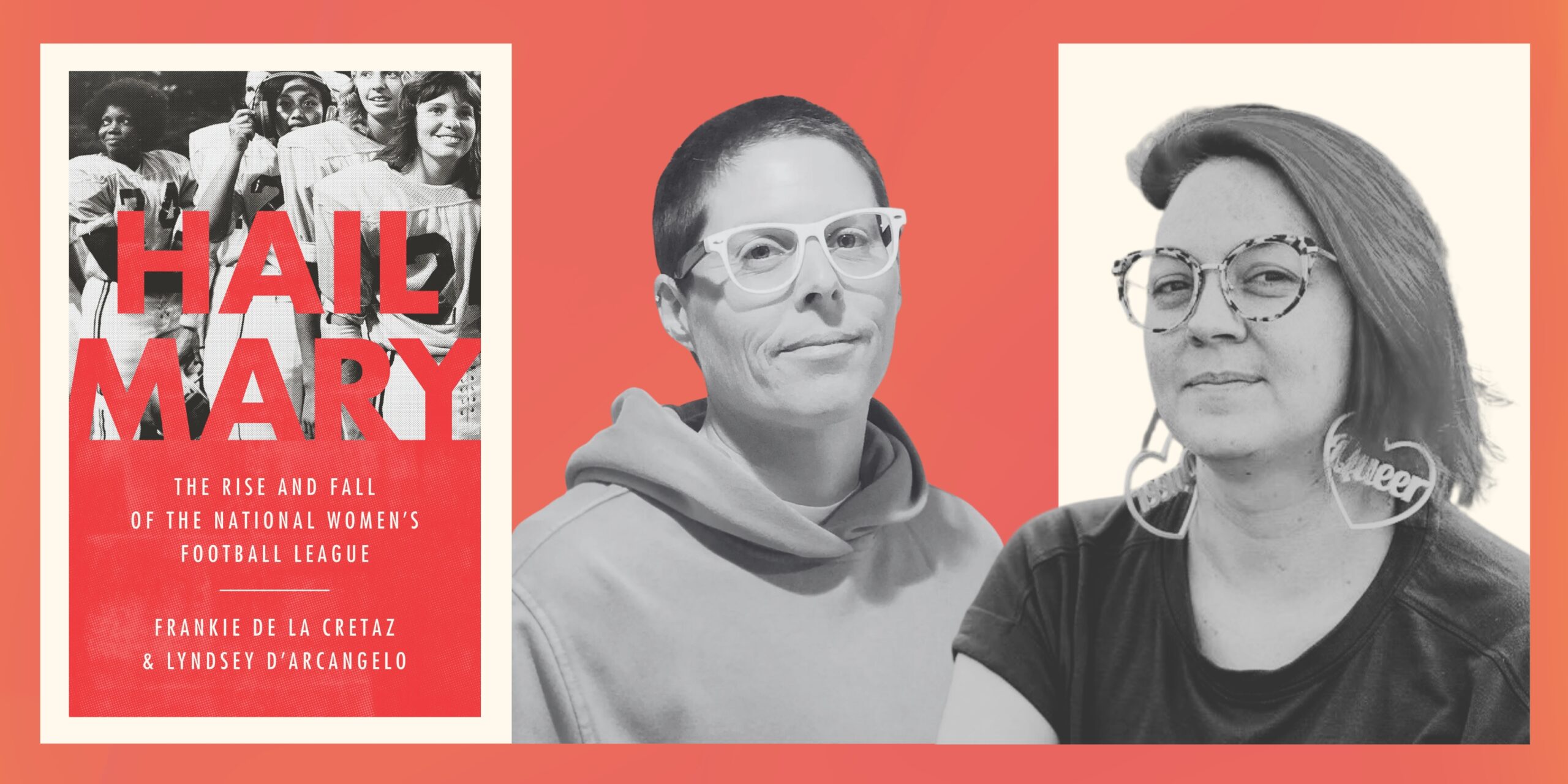
On Hail Mary, an Important History of American Women Playing Tackle Football
Julie Kliegman Consdiers Frankie de la Cretaz and Lyndsey D’Arcangelo’s 2021 History
You’d be forgiven for not knowing that the long, rich history of women playing American tackle football extends all the way back to 1896—a five-on-five scrimmage in New York City that was cut short by police, ostensibly for the players’ own safety. In fact, you’d be forgiven for not knowing much at all about women playing American tackle football. In a landscape where women’s sports have historically constituted a single-digit percentage of sports media coverage, pickings are slim.
That’s where the 2021 book Hail Mary: The Rise and Fall of the National Women’s Football League comes in. The authors, sports journalists Frankie de la Cretaz and Lyndsey D’Arcangelo, set out to give generations of rough-and-tumble women athletes their due. And they succeeded, painting a brightly colored picture of not just the little-known football league of the subtitle, but the past, present, and future of women in the sport more broadly.
Hail Mary proves an essential entry into the too-sparse canon of queer (yes, many of the players highlighted are queer) sports-history books, alongside other recent works like Michael Waters’s The Other Olympians and Katie Barnes’s Fair Play. Tasked with covering the story of 600-plus athletes from well over a dozen teams with a limited amount of reliable journalism and archival documents, de la Cretaz and D’Arcangelo had their work cut out for them in piecing together game scores and character profiles alike.
Perhaps nothing in the book illustrates the challenges faced by the women of the scrappy National Women’s Football League, which formally ran from 1974 to 1989 (though several teams predated the league) more so than a description of one Ohio billboard. The Toledo Troopers, the league’s most successful team, paid for an advertisement featuring Linda Jefferson, their star halfback, underneath the words “Pretty Tough.” The Black athlete is flanked by two white women—purportedly her teammates, but in reality paid models designed to market the supposed sex appeal of the whole endeavor.
The authors are careful to center the trials and tribulations of the players themselves, as opposed to the men who predominantly served as team owners, league officials, and coaches.
Granular, often infuriating descriptions like that one are ultimately what make Hail Mary sing. At times, reading the book is dizzying, due to the overwhelming level of detail for which the authors are quite obviously excited to find a wider audience. The narrative jumps across time and through different parts of the United States to chronicle bits and pieces of the NWFL’s legacy, from Cleveland, where a P.T. Barnum-type showman conceived in 1967 of a women’s football barnstorming gimmick, to the Dallas lesbian bars where one NWFL team bonded, and beyond. And through it all, the authors are careful to center the trials and tribulations of the players themselves, as opposed to the men who predominantly served as team owners, league officials, and coaches.
Belatedly recognizing and appreciating the achievements of professional women’s football players is the least modern sports fans can do. The women earned as little as $25 per game—or frequently zilch. Many teams did not provide the women, who spent time ample time practicing and competing on top of their day jobs, with health insurance or even all of the necessary safety equipment for such a physical sport. Crowds of just a few hundred to a few thousand attended games, which were not typically broadcast live. The women—mostly not vocal women’s libbers—played simply for the love of the game and the sheer fun of it.
Girls and women are increasingly playing football alongside boys and men, an idea that would horrify at least one of the NWFL players quoted in Hail Mary. Think of Sarah Fuller, the goalkeeper for Vanderbilt’s women’s soccer team who moonlighted as a kicker on the school’s football team in 2020, becoming the first woman to score points in a Power 5 game. Media frenzies like the one around Fuller do not occur in a vacuum. The book effectively situates them against the backdrop of seismic developments such as Title IX in the time of the NWFL, which didn’t exist long enough or develop enough of a following to turn a profit, in contrast to the juggernaut NFL on the men’s side.
Hail Mary might be even more relevant today than it was upon publication, in part due to the right’s disingenuous hyperfocus on ostensibly “protecting” women’s sports. (As the authors well know, there are plenty of ways to bolster the resources and attention given to women’s sports without throwing transgender athletes under the bus.) There’s also the recent but seismic Caitlin Clark effect of it all. Women’s sports have never been a hotter topic, and women collegiate, Olympic, and professional athletes have never had more acclaim, viewers, and media coverage than they do right now. The WNBA and NWSL are fixtures of women’s basketball and soccer, respectively, in our North American sports landscape. Other sports, including hockey, volleyball, baseball, and, yes, football, have one or multiple fledgling women’s leagues attempting to catch on. De la Cretaz and D’Arcangelo noted that, as of the time of writing, several women’s football leagues were fighting to gain traction and professional status. Naturally, some teams’ coaches and owners have direct ties back to the NWFL.
It’s a testament to the determination of the trailblazing women that the NWFL lives on in the bones of subsequent football leagues and in the hearts of younger generations of athletes. We can’t go back in time to cheer on the remarkable women of the NWFL in their heyday. But thanks to projects like Hail Mary, we can familiarize ourselves with their legacies and carry them forward as we continue to celebrate and elevate women’s sports writ large.
__________________________________
Read an excerpt from Hail Mary here.

Julie Kliegman
Julie Kliegman is a writer and editor in Queens, New York. They are the author of the forthcoming book Finding Renée Richards: The Groundbreaking Story of Tennis’s Trans Pioneer and Mind Game: An Inside Look at the Mental Health Playbook of Elite Athletes. Kliegman’s writing has also appeared in outlets including The Washington Post, Sports Illustrated, Bookforum, Slate, The Ringer, Defector, Texas Monthly, and Vulture.