On Falling Out of Love With Moscow
Svetlana Satchkova on Learning to Live With the Reality of Russia’s Present Form
I grew up in Moscow at the tail end of the Soviet era. Despite its grand title—the capital of the USSR—the city of my youth held little charm. Life, at least for my family, was defined by scarcity, monotony, and drabness. I spent my teenage years longing for something better, so intensely it made my body ache. After school, which was tedious in the extreme, my best friend and I had absolutely nothing to do. There were no extracurriculars offered. Apart from reading books from my parents’ modest library, we had little intellectual or aesthetic stimulation. For hours every day, we wandered our neighborhood, or others just like it, lined with identical apartment blocks, the occasional park with broken-down rides, and stores with empty shelves, in the futile hope of something remotely interesting happening to us. All the while, we lamented our limited, excruciatingly boring lives, wondering if anything would ever change.
From American movies that trickled down to us through illegal or semi-legal video salons, where VHS tapes were shown to paying audiences, we knew what our peers’ lives in the U.S. were like. They went to malls and restaurants, attended parties and football games, ate pizza, and drank Coca-Cola. How we craved all of it, along with Levi’s jeans and graphic T-shirts! It seemed so unfair that other people were living life to the fullest while we were stuck in a looping eternity of sameness. I never dreamed that I would see it all with my own eyes.
Yet after the Soviet Union fell in 1991, I moved to New York with my family. I tried to make up for everything I’d missed, devouring every kind of experience. I took and audited as many classes at NYU as I could, partied hard, shopped, went to exhibitions, film screenings, and concerts, and took up painting and dancing. But even though New York turned out to be as exciting as I’d imagined, and a place where I felt completely at home, I found myself missing Moscow, painfully, for no reason I could discern. Between semesters, I traveled there for short visits, and on one of those trips I fell in love with a man in a rock band and secretly married him.
When I found out I was pregnant, it became obvious that I would move back, because I wanted my child to grow up in a Russian-speaking environment. Or maybe that was just a pretext, because by then I had already realized that I loved Moscow so much I was willing to give up an entirely different life in America just to be reunited with it.
I love New York; it’s my home now. But Moscow was the city I loved first. I may never be able to go there again.
And so I arrived in Moscow, a twenty-one-year-old with a degree in philosophy and a newborn baby. It was 1997, and the decade known as the Wild Nineties, marked by economic hardship and chaos, was drawing to a close. The city felt vibrant and full of possibility, especially as Russia seemed firmly on its way to a democratic future. I began writing and published a novel, which eventually landed me a job writing features for a women’s magazine. My marriage didn’t last, and before long I was a single mother supporting myself and my son through freelance reporting.
In 1999, Vladimir Putin became prime minister of Russia, chosen by President Yeltsin as his successor. Seeing Putin’s face on television for the first time, I somehow intuited the terrible things to come. They came much sooner than I could’ve imagined. A series of apartment bombings struck several Russian cities, including Moscow, killing hundreds of people. Night after night, I found myself sitting in front of the television, gripped by terror as I watched the news. What if my building were next? Even more horrifying than death was the thought of lying there, trapped beneath the rubble, listening to my two-year-old son desperately crying for help.
The attacks were blamed on Chechen terrorists, but it soon became evident to anyone willing to look at the evidence with their eyes half-open that the FSB, which Putin had just headed, was the real perpetrator. He needed a pretext for another war in Chechnya, and the war became his ticket to the presidency. As it unfolded, more terrorist attacks and hostage crises followed, each more devastating than the last, and he used every one of them to consolidate his power and restrict freedom of speech.
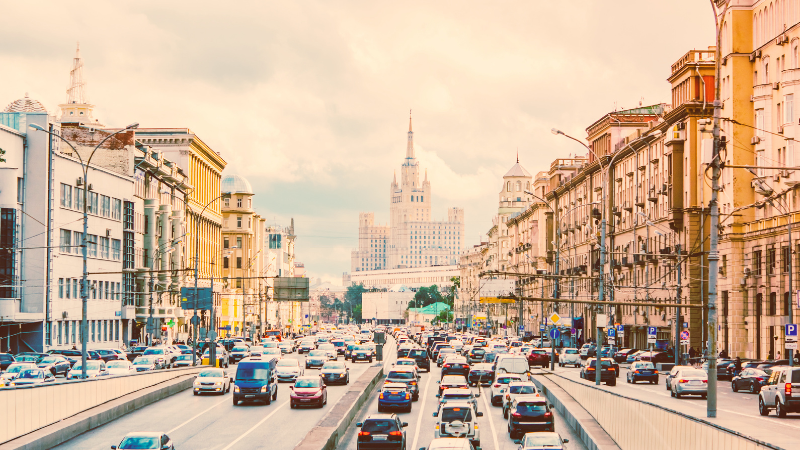
But despite all this, I loved living in Moscow. How can I explain it? I was young. Life felt meaningful and exhilarating. Moscow was a vast city with an incredible energy and a character all its own. Simply walking from the subway to my destination in the center was enough to make me happy. There were beautiful boulevards, sweeping bridges over the Moskva River, wide Stalin-era avenues lined with imposing granite buildings, and quiet nineteenth-century neighborhoods of pastel-colored mansions. There were museums and theaters, and clubs, and the feeling that the city never slept. And then there was the subway. Many of its stations look as though they were built for the tsars, clad in precious marble and adorned with mosaics, crystal chandeliers, sculptures, and gilded moldings. Trains arrive every three minutes, and the stations are so clean you could eat off the floor.
Even as the country’s leadership grew more corrupt and repressive, Moscow kept getting more dazzling. In the early and mid-2000s, Russia benefited from surging oil prices, and much of that money poured into the capital. The city was transformed. New parks, public spaces, museums, and cultural venues opened, along with stores and restaurants to rival those of any European capital. When Russians discovered karaoke, thousands of venues sprang up, from cheap sushi joints to lavish establishments where an orchestra and backup singers accompanied anyone willing to step onto the stage and, for a few minutes, feel like a star. The service industry reached a level of convenience that still seems almost utopian. You could order virtually anything around the clock, have a haircut at home at three in the morning or an MRI in the middle of the night—anything, really, as long as you could pay.
By ghouls, I meant anyone associated with the state apparatus, like the police or the secret services, whose main job was to identify those opposed to the regime and neutralize them.
By then, I was building a career in glossy magazines, quickly rising to senior editorial positions. For many people I knew and worked with, the city’s seductions made it easy to ignore the larger picture. People with good jobs enjoyed their comfortable lifestyle, traveled the world, and looked away when courts issued unlawful rulings, when dissenters were tortured in prison, and when the president effectively discarded the constitution, allowing himself to become a ruler for life. They learned to tune out a whole dimension of reality. When I occasionally voiced my concerns to friends, they would say, “What are you talking about? Life here is great.” Many attributed the country’s stability and prosperity to Putin, who in fact had little to do with either. Like everyone else, he profited from oil revenues, except that he and his cronies profited far more because they stole billions.
The logic of the regime was that it could never be satisfied with what it already had. It kept growing greedier and more violent, steadily chewing away at its citizens’ rights. I felt increasingly unsafe, as though I no longer had a place in Moscow. After Russia invaded Crimea in 2014 and another wave of repressive laws followed, I made the difficult decision to leave.
I couldn’t do it immediately. My partner at the time and I had to get married so we could apply for a U.S. visa for him. For the next two years, I existed in between. I knew I was leaving, and this time it was for good. I would walk through my favorite Moscow neighborhoods with my heart breaking because I didn’t know if I’d ever see them again.
Before I finally left in 2016, I had a conversation with my best friend in which I, yet again, tried to justify my decision. I said that the city had been seized by ghouls. By ghouls, I meant anyone associated with the state apparatus, like the police or the secret services, whose main job was to identify those opposed to the regime and neutralize them, but also all those men in expensive suits stepping out of expensive cars with expressions that suggested they owned the place: the oligarchs and corrupt civil servants. And they did. Moscow belonged to them now, not to people like me.
Out of that conversation grew my novel The Undead, which is, in some ways, a parting love letter to Moscow. The title refers not only to the horror film my protagonist, Maya, is trying to make, but also to the city’s new masters and to those living in a zombified state of willful ignorance. Maya, who is based on that very friend, belongs to the latter group. She enjoys her life and pays little attention to politics—until politics comes for her.
Readers often tell me Moscow feels like a character in my book. When they ask if I still love it, I honestly don’t know how to answer. I love New York; it’s my home now. But Moscow was the city I loved first. I may never be able to go there again. Under current laws, returning could mean many years in prison because of what I’ve published against Putin and the war in Ukraine. I’ve learned to live with it.
Svetlana Satchkova
Svetlana Satchkova is a Russian-born journalist and novelist who immigrated to the United States in 2016. She covers culture and politics, with bylines in the Rumpus, Newsweek, LARB, the Independent, and others. Currently a research fellow at the Jordan Center for the Advanced Study of Russia at NYU, she holds an MFA from Brooklyn College and lives in Brooklyn. Svetlana has published three novels in Russian; her English-language debut, The Undead: A Novel of Modern Russia, was released in January 2026.