On Dancing As Rebellion and The Problem of Embodiment
Sarah Domet: “I wanted to learn to be free on land. Dance seemed to be an answer.”
I remember, at forty, lying on the surgical table during my C-section, numb from the chest down. I couldn’t move and the anesthesia had given me the sensory illusion of not being able to breathe. While the doctors were busy extracting my baby, the anesthesiologist was in deep conversation about bands he liked. (Wilco, I recall; he’d seen them live. Twice.) “Excuse me,” I interrupted. I could not feel my chest rise or fall, or the pull of air into my lungs. “Am I breathing?”
In grad school I had read Dalton Trumbo’s anti-war novel, Johnny Got His Gun. In it, the protagonist is gravely wounded in war. He’s lost both arms and legs, and his mouth, ears, nose, and eyes. His body has become a prison. Yet, his embodiment persists. He feels the sunlight from the window graze his chest, and he’s once again anchored to time. This is how he begins to reorient himself to the world—not through his thoughts, but through his body. I’d written a seminar paper on this book titled, “The Problem of Embodiment.”
“Am I breathing?” I’d asked that anesthesiologist, almost apologetically. He pointed to my oxygen levels to show me I was.
In this moment, I grasped the problem of my embodiment, how it existed without agency—and how terrifying that could be.
I didn’t consider the problem of embodiment again for years, not really. I was busy raising my two kids. Motherhood thinned my attention, but not entirely.
I wanted to learn to be free on land. Dance seemed to be an answer.
For months I had watched the adult tap dance class in the studio space next to the one where my daughter took ballet. From the bench in the narrow hallway where I waited, I admired these tapping women who appeared so unselfconscious, so present in their bodies.
I hadn’t taken a dance class since I was seven, though I still remember that recital, how self-conscious I felt when I had to change in front of all the other performers in the giant greenroom. My leotard was red with a black tulle tutu held in place by Velcro, and the headband resembled a Spanish dancer’s. Soon after that recital, I begged to quit dance for soccer.
Dance was for girly-girls, and I was a tomboy. Soccer, softball, volleyball, basketball. In my childhood bedroom hung a life-sized poster of Michael Jordan with a Jordan-sized ruler I used to measure my height—tall—I was constantly told—for a girl. Later, I came to racquetball, tennis, spinning. When I was newly pregnant for the first time, I took up swimming. I loved the freedom I felt in the water—light and graceful, even at nine months. But when I got out of the pool it was back to lumbering around in my alien earth body.
I wanted to learn to be free on land. Dance seemed to be an answer.
I asked my friend Leigh for her opinion. She’s a trained dancer and a writer, too. She explained tap may feel safe and easier for me to get good at faster; it’s very controlled. She suggested, however, maybe I wanted a messier process. Hip hop, she texted me, would give me “the most full-body dance high→liberation.”
Plus, I could just wear sneakers.
That evening, feeling emboldened, I enrolled in a hip hop class. It felt like a dare to myself, something I had to prove. Never having attempted my first chest pop or body roll, I checked the box indicating, yes, indeed, I was interested in participating in the spring recital. I told my sister about this, and we laughed and laughed, and she promised to fly in for my inaugural performance.
One of my favorite jobs I’ve ever had was as a writing coach. The organization’s philosophy was simple but profound: “Take care of the writing by taking care of the writer.” At the time, I understood this as a reminder to make space—emotionally, intellectually—for the work. Slow down the process. Attune yourself. Pay attention. I gave pep talks, and TED talks, then real talk. Very often, I listened. Creativity, I believed, was housed in the mind, and taking care of the writer meant taking care of her thoughts and emotions, helping her locate her authentic self.
Perhaps this was a mid-life crisis masquerading as bravery.
I like to think I excelled at coaching; it overlapped with my job as a professor, but lent new depth and language to it. As a teacher and mother—and lifelong perfectionist—I was used to tending to others’ emotional needs, anticipating them. I could easily sit across from students and listen with full presence. I could disappear myself, like a therapist does, in order to help student work self-actualize. I could guide a student to excavate meaning from a story or wrangle a sentence or name the fear beneath a stalled scene. Where did you feel the most energy when writing this piece? I’d often ask. The answer pointed to what the student was excited about, usually the heart of their work.
I believed I understood what this question meant.
A month later, on a summer evening, I sat outside the studio in my car, my boldness evaporated. I began to doubt my decision. I was not Beyonce or even Beyonce-adjacent. I was a middle-aged woman with two kids, going through a divorce. I had already gotten my divorce haircut and I was researching tattoos and theme cruises and wall Pilates. Perhaps this was a mid-life crisis masquerading as bravery.
I willed myself inside. The walls of the dance studio were bright neon green, lined with shelves that held trophies from past competitions. I watched myself walk across the room in the mirror. A sign was taped to it that read, “look but do not touch.”
I felt that way about life sometimes, an observer but not a participant. I thought of all the times I cheered on my kids from sidelines or from bleachers or from the edge of a pool. I thought of all the things I’d put off until someday, or of my interests that had fallen away, one-by-one, beneath the pressures of obligation, or of all I’d wanted but convinced myself I could not have. Mostly, I thought of the longing I’d felt outside those tap classes, watching those women, wishing it could be me.
How would I describe that first class? Humiliating.
I’m not a natural dancer. My limbs felt stiff and cumbersome. I couldn’t keep track of all the moves, all my body parts. Our teacher, Ashley, taught us choreography to Chris Brown’s “Run It.” As she demonstrated, she counted in eights.
There at home, the audience gone, except my dog, I felt a buzzing in my body—like it was thawing out. Like it was remembering something.
Every time I’d fumble, Ashley, who’s young with a head of perfect curls, kept saying, “You’re okay, baby.” And I’ll admit, in that moment, I kind of loved being someone’s baby, which meant, for once, maybe someone would take care of me.
Still, I kept checking my watch. How much longer did I have to endure this torture?
Toward the end of class some students got out their phones to record the routine, but I was too self-conscious. Why would I want to record myself looking like an idiot? Instead, when I got home—my house quiet because my kids were away for the week—I danced for an hour in front of the mirror. My dog looked on in bewilderment.
There at home, the audience gone, except my dog, I felt a buzzing in my body—like it was thawing out. Like it was remembering something.
By five classes in, many students had already dropped out, so it was just me and a small group of young women, actual dancers. The gap between our ages and skill sets had widened, and so did my awareness of my body, how quickly it stiffened under scrutiny. My mind was telling me: you’re too old, you’re doing it wrong, you look like a fool. In the mirror, my reflection seemed to confirm this.
In class we were executing floor drops and body ripples. I hadn’t moved this way in years, unlike my classmates, Peyton among them. Tall, lean, fresh out of college, she moved with a fluidity I envied, like she was gliding through water. I watched her in the mirror to follow the routines. One day, while waiting on those benches before class, she told me she was never good at sports because she was too loose, too accustomed to dancing—coaches always told her to stiffen up. I laughed when she told me this because I was the opposite: always braced. Ready position, past coaches had called it.
That day, we worked on choreography for “Jenny from the Block.” The movements were quick and led organically from one motion to the next. In theory. After our umpteenth run-through, I pulled at my hair. When Ashley asked me what’s wrong, I pointed to Peyton in the mirror. “She’s so graceful,” I said. “My body doesn’t move like that.”
“Have you been dancing since you were a kid?” Ashley asked.
She already knew the answer.
“The mirror is there for you,” she said, drawing an imaginary line down her heart. “Compare yourself to yourself.”
Writing, to me, has always felt physical; when I’m writing well, I feel it—like nervous excitement before a competition.
That advice stuck. At home, I felt looser, more capable. I blasted “Jenny from the Block” and danced my heart out in front of the mirror. With nobody around, I was practically a J-Lo backup dancer. I was moving, grooving, nailing those quick turns. I felt fully alive. Graceful, even. In those moments, I couldn’t look at Peyton or Ashley or the others. I could only see one body in the mirror: my own.
When I was a writing coach and asked those students, Where did you feel the most energy when writing this story? I now realize I was really asking this: Where do you feel the story in your body?
Writing, to me, has always felt physical; when I’m writing well, I feel it—like nervous excitement before a competition. In my twenties I played in a sand volleyball league, on a team named Nacho Suckaz. Even after a pitcher of beer, I felt razzed and alert. In ready position. This same charged alertness shows up when a scene is working, when a line captures the whole of a character, when I’m fully present on the page.
The body is more honest than the mind; it gives us vital information. “Where do you feel it in your body” is something I’ve been taught to pause and ask myself, the first step toward processing what I need at any given moment. On the other hand, I’d been betrayed by my mind; I have believed or convinced myself of many things that were untrue.
As a writer, I’ve spent so much time in my head. Too much. Taking care of the writer implicitly recognizes that the writer is more than a bundle of emotions. She has a body, too, and it tells her things, if she listens.
However, for myself, I’d adopted a narrower view of what it meant to take care of my own writing. As long as I was writing—computering, my daughter used to call it when she was young—I was taking care of the writing. The work was proof of care. Publishing my first novel, The Guineveres, seemed to be permission enough to keep writing—an external locus of validation that required nothing from my body but stillness. My body was incidental, as it were, transporting my brain from one task to the next.
I had recently completed my second novel, Everything Lost Returns, but it had taken me years. I felt constrained, on the page and in my life—and these two areas frequently pushed up against one another. Had I become too compartmentalized? What limits had I accepted and how had I learned to argue for them? For years I’d helped students find their authentic voices, but how could I find my own?
Dancing in this way can’t help but feel like a rebellion. It engenders a sense of agency and reminds me my body, too, is a narrative.
The answer to these questions is never to think harder. It’s to come back to the body, to trust it. Sometimes the answer is to shake things loose, to move.
Hip hop is about the movements, but it’s also about swagger and attitude and taking up space. Its roots are deep in urban poverty and marginalization—and also deep in resistance. Some of my favorite moments in our routines are when we wave our hands like we’re saying, “Fool, please” or bounce across a room like we’re about to stir up trouble or flick our hair from side to side to say, “I’m fine, and I know it.”
Dancing in this way can’t help but feel like a rebellion. It engenders a sense of agency and reminds me my body, too, is a narrative.
I consider my body. My C-section scars. Above it are two small incisions, from a different surgery, and these all put together, resemble a smile. I have scars and bumps beneath both knees from a jogging mishap with my dog. I have scars from other old injuries—that time I sliced part of my thumb while cutting onions, or when I toddled into a fireplace as a kid, or when I fell over a fence I’d climbed one night in college, trying to take the shortcut home. I love how my body is a map of memories, each scar a story. But these aren’t the only memories. These aren’t the only stories my body can tell.
By late fall, I was still a bad dancer. Ashley told me to stop taking myself so seriously. The answer isn’t to care more—it’s to care less. In these moments, I thought of the Buddhist notion of detachment, of letting go not in terms of giving up, but in recognizing I didn’t have to cling.
I bounced, I chest bumped, I booty rolled, I gave sass. Sure, I looked like a fool, but I was having fun. My classmates cheered me on. In the studio I felt so different from the woman I was in my real life, the mother, the professor, the writer, the person so often restrained.
In that mirror-lined studio each week, I meet myself as I really am: a middle-age woman.
Outside of dance class, life was full of transitions and complexity and heartbreak—I was trying to relocate the center of me—but inside class, I didn’t think about any of this. The world distilled itself to the present moment. There, I felt at peace.
One night in class, I noticed other women waiting on the benches outside the hallway. Their daughters, I assumed, were in other rooms. Through the glass, they watched us. They watched me.
This spectatorship would have once made me dizzy with discomfort—my flaws on full display. I like to be good at things; projecting competence is something of a hobby. But in that moment, I didn’t feel uncomfortable at all. Instead, I felt something else.
I felt like a dancer.
I drove home from class that night with the windows down, exhilarated, joyful. There’s enormous relief in letting go of the facade of perfect containment or the need to perform goodness.
In that mirror-lined studio each week, I meet myself as I really am: a middle-age woman. A bad dancer. A person risking foolishness for freedom. These days I’m less worried about being seen and more concerned with seeing myself.
Being myself.
You never fully arrive in your life—and thank goodness for that. What a bore it would be to know that where you’ve landed is where you’ll always stay, to lose curiosity about what lies ahead. Dance as an embodied practice has reminded me I can become anything. I can meet myself again and again. The aliveness I feel on the dance floor is exactly what I hope to cultivate on the page. My writing is more authentic, more energetic when I’m fully inhabiting the body at the desk, when I’m messy and playful, when I write for me.
__________________________________
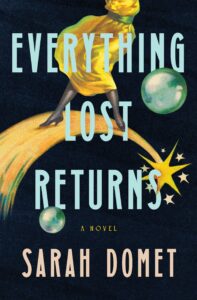
Everything Lost Returns by Sarah Domet is available from Flatiron.

Sarah Domet
Sarah Domet is the author of the novels The Guineveres and Everything Lost Returns, and the craft book 90 Days to Your Novel. She is a professor and the coordinator of the MFA program in creative writing at the University of North Carolina Wilmington.