I arrived at the Academy on a Tuesday in early September, one of the last weeks that the ferry would be operating for the season. My journey involved a train ride to a major coastal metropolis in the Northeast, then an hour’s trip by boat to the remote tourist town in which the school was located. I departed early in the morning and watched through the train windows as the sun came up over virtuosic fields of subsidized corn, obese cows, miserable horses, so-called rivers—green, rank, oily with pollution. My seat smelled strongly of old coffee and hard-boiled eggs. I fell asleep with my cheek pressed against the glass and awoke to the sensation of my right foot being squeezed through its shoe in a firm and rhythmic pulsing motion, as in a resuscitation. The man occupying the seat next to mine was leaning forward, torso folded at the waist like a collapsible chair, his face amazingly close to my knees. Upon noticing that I was conscious he jerked upright, lay back in his seat, and pretended to be asleep himself, putting on a series of ostentatious little gurgling noises, his head, with its hair the color of an unripe peach, lolling floppily upon its neck. I knew this was all a show designed to trick and tranquilize me, but the man’s babyish sounds were nonetheless soothing, and I was lulled easily back into sleep. I hadn’t had sex in a long time. There were certain thinkers who might claim that I had never had sex, though I was not one of these thinkers. I was pretty sure I had had sex on many occasions. I was twenty-eight years old. When I woke up again, the man was reading a magazine whose glossy cover featured a photograph of an aging celebrity, seated in a pool chair with her legs spread, wearing a striped tankini. In large yellow lettering, the caption read: I DON’T GIVE A D*** IF YOU CALL ME A FATTY.
I looked out the window at a tent city and some wet black birds strung out on an electrical wire. The birds unhinged their beaks as if to make a loud sound. Then they were gone. I looked away from the window. I couldn’t think of another place to look that wasn’t my seatmate, so I looked at my seatmate. He grinned back, as though his face had always been waiting for me in just this position, with its broad pink cheeks and its green eyes and its very straight teeth. His smile said that we were two people who knew one another, not intimately but socially, and that we had each consistently made a pleasant impression on the other. The man appeared to be in his sixties, around the same age as my parents, his hair fried by dye but showing its gray at the roots, where it had been lifted up and over his skull using a firm pomade. Inside my brain it was like an empty glass was being filled with water. I looked at my seatmate’s crispy hair and his delicate hands, and then I realized that we did in fact know each other, not intimately but socially, in that he was the father of my elementary-school classmate, Megan O’Donald, who had been the most beautiful girl in my grade.
I had not seen Megan O’Donald or this man, her father, Mr. O’Donald, in fifteen years. When I knew her, Megan O’Donald had taken Irish dance classes four times a week and performed at nearly every after-school assembly, wearing a stiff sequined dress and a golden wig of tightly coiled ringlets. Mr. O’Donald would stand in the front row, yipping and slapping a hand rhythmically against his thigh as his daughter tossed her tiny legs high above her waist, and many rows behind him Mrs. O’Donald would sit with her hands folded neatly in her lap, as if she were in church. When Megan O’Donald danced she wore a special green crown and the boy I loved stared directly up her skirt, panting. I hated Megan O’Donald’s guts. I did not at that time have the wherewithal to overcome my personal feelings for the sake of political solidarity with the cultural symbols of Irish nationalism, because I was eleven years old. But I had been fond of Mr. O’Donald, who had once given me a standing ovation during our drama club’s performance of The Pirates of Penzance.
The entire time I’d been looking at him, Mr. O’Donald’s grin had been stretching more widely across his face, like a balloon filling with air. I opened my mouth to say Hi, Mr. O’Donald, how have you been, and in that moment it became clear that Mr. O’Donald had no idea who I was. When he smiled at me now, he was not remembering my luminous gender-bending sixth-grade performance as the Major-General in The Pirates of Penzance. His mind was living in a place that was totally inaccessible to me. He was thinking about the shape and heft of my foot, or he was thinking about his daughter, Megan O’Donald, images of whom I still occasionally saw on social media, like all the other elementary-and high-school classmates I no longer spoke to, or he was thinking about something else. There was no way for me to know.
Megan O’Donald, I remembered from a photograph I had recently come across online, was pregnant now.
I closed my mouth and turned to look once more out the window. I saw what may have been a second or a third tent city, and then I pretended to fall asleep. Some time later I woke up. Mr. O’Donald was gone. His magazine remained splayed across the empty seat cushion. I put it in my backpack.
My ferry trip was comparatively uneventful, though there were rough seas and the top deck lay coated in a film of human vomit, like chowder.
*
My subsidized faculty housing would be ready for move-in the next morning; in the meantime, I was to spend my first night at an inn two blocks from the bay. With both hands I dragged my luggage toward my lodgings. The afternoon light sank into the blue harbor as the last tourists of the season ambled down the shoreline, grim-faced, confused. I had never before lived near the ocean. Fishing boats sat docked along the pier, bouncing on top of the water like a row of jolly babies. All around there was the pleasant rotten smell of dead fish in open air. It was low tide, and beyond the pier I could see the strip of beach where the water had receded, leaking seagrass and vacant crab claws.
I checked into the hotel, removed one sweater from my suitcase, pulled it on, went out, picked up dinner in a Styrofoam container, and slopped it into my mouth standing over my hotel room dresser, watching through the dirty window as darkness started to blot the sky. I switched the television set on and off, then lay down in my clothes over the bedsheets, which were embroidered with lacy orange conch shells. On my phone I reread a portion of an email my father had sent me two years earlier, in which he described the qualities of every item of clothing he had purchased that afternoon at the outlet mall. When I woke up it was night and my shoes were still on.
I put on my coat and walked down to the Old Pilgrim, a bar on Main Street that I had noted on my way in and hoped I might frequent during the school year. It was situated on the ground floor of a building that resembled every other building on the block: white wood slats with the paint peeling in spots, a squat triangular roof like an American toddler’s drawing of a house. On my way I passed the library, the post office, the town hall, signifiers of a shared civic life, low-ceilinged rooms where the homeless and the elderly might congregate, holding their paper tissues and their linen handkerchiefs. All closed for the evening. I could not find the moon. I kept my head bowed against the wind, my hands stuffed deep into my pockets. Stray bits of hair escaped my ponytail and stung my eyes.
Inside the Old Pilgrim the patrons all looked like fishermen, or what I imagined fishermen might look like. The men looked like fishermen and the women looked like fishermen. There was one child there with his mother, sitting on her lap, sucking at his thumb, and he looked like a fisherman, too. A redheaded woman who looked like a fisherman worked the bar. She seemed to dislike me instantly for reasons I could not ascertain. Was it the way I moved my body, floppily, twitchily, like a seal having a panic attack? That I stuttered when I ordered my beer? I put down a generous tip and watched as her face contorted into an expression of sincerest repulsion, lips flinching in their downward curve.
I settled with my drink at a table in the back corner, leaning against the wall to prevent myself from sliding off the stool. My glass was dirty and my beer was warm. A soggy light seeped into the room from the old-fashioned streetlamps outside, trickling through the front windows, thick with grime. I downed my beer and ordered another. At the surrounding tables patrons were talking, laughing, slapping one another heartily on the back. I tried to laugh, too, but whenever I made too loud of a sound those at the table closest to mine would stop speaking and glare at me. So I smiled silently, and nodded, and took dainty sips of my beer, picking it up with both hands, like an image I had once encountered of an adorable raccoon nibbling on something inappropriate—a pre-packaged toaster strudel, perhaps. This is my favorite bar, I whispered to myself. The fact that it was disgusting and that everyone obviously wished I wasn’t there made me feel it was a genuine working-class establishment, by and for the people, and that I too was one of the people, undeniably one of the people here tonight.
Beneath my feet, I noticed, the floors were so heavily slanted that they appeared to have been constructed for the convenience of someone who had one leg much shorter than the other. It was really nice, I thought, that a person with one very short leg could finally have somewhere to go that was comfortable for them. Tears filled my eyes. I was already a little drunk. My own legs were of equal length. But when it came to the world of the mind, it was almost as if one of my legs was much shorter than the other—in some psychic or spiritual sense, I mean—and I wondered if there would ever be a place where I could walk, metaphorically speaking, with ease.
Someone at the next table bought a round of shots for all their friends. I watched as they slugged back the tiny glasses, slammed them down on the table, and cheered. I went to the bathroom and purged the pulled chicken enchiladas I had eaten for dinner. They came up slimy, green with tomatillo sauce. When I returned to my seat, a faint citrus smell was wafting through the room; someone had dropped an overripe tangerine, which rolled until it hit the back wall, leaking a rivulet of juice around which a colony of hungry fruit flies swarmed. I pulled out my phone. In my family group chat, my sister had sent a series of images from the previous Saturday, when she had insisted that we go out for dinner before I moved away, to “catch up,” “just the two of us.” There was a photo of her platter of steak frites; a selfie in which she displayed a forkful of rare beef adjacent to her smiling mouth; an image of my empty chair, which she must have taken during the five minutes I had been in the bathroom between courses; and a final composition that featured my bowl of French onion soup, behind which slumped my body in its seat, photographed only up to the shoulders, so that I appeared to be decapitated.
Beautiful! my mother had typed.
I swallowed the rest of my beer and went outside to smoke. It was colder than it had been on my walk over. The air was damp and briny, a clammy towel on my skin. Sheets of fog hung low in the sky, obscuring what stars there might have been, haloing the streetlamps. I pulled my coat tighter around me and spent a moment engaging in vivid thoughts about my life, my future and my past. I thought about my mother and father and the city in the middle of the country where I had grown up, from which I had first departed ten years prior, swearing that I would never, no matter the circumstances, return, and where I had been living for the past six months, with my parents, in my childhood home. I thought about several events that had taken place in my adolescence and several other events that had taken place in my adulthood. I contemplated the black eyes my sister received during her training as a semiprofessional MMA fighter, which she would display coquettishly to our parents when meeting them downtown for ice cream, giggling as the man who worked the scoop counter stared in concern. How hard, I wondered, would I have to punch myself in the face in order to form a black eye of my own?
After a moment I realized that the whole time I had been outside, I had been gawking directly at a human being, a man who was seated on the curb across the street. In response to my eye contact, it appeared, he was grinning and saluting me repeatedly with two fingers. I was unsure if I should salute him back. I decided to salute him back. He stood and shuffled toward me. He wore a camouflage cap and torn brown khakis, open-toed sandals despite the weather. The big toenail on his right foot was painted lavender.
The man greeted me with great politeness and asked if I could spare a smoke. Of course, I said. I loved giving away cigarettes, due to a vague sense I had that those who accepted them were thereafter bound to me for an indeterminate period of time by an undeniable duty and obligation—a belief that provided me with a shivering spasm of well-being, similar, I thought, to what others must feel when they disrobed in a sauna or sank into a fragrant bath prepared for them by a loved one. I watched the man’s face as it bent over my lighter, sucking. His eyes were closed, as in a kiss on the mouth. The skin across his cheeks was shiny, stretched tightly over his bones, with the hardened, leathery quality that signifies countless hours spent outdoors. From inside the Old Pilgrim, the murmur of voices sounded like a television show streaming in another room. A pickup truck rolled past, and from farther away there came the pulse of the constant undulating waves, lapping at the shore like some untiring, enormous-tongued animal.
The man introduced himself as Billy. I told him my name and explained that I had just moved to town that day. I’m teaching over at the Academy, I said. I gestured in the opposite direction from the water, where the narrow streets sloped slightly upward.
Oh, yeah? Billy said. Nice up there?
Yes, it was nice up there, I told him, though in truth I had only seen it in photographs.
Did they give you housing?
They gave me housing.
All those girls? he said slyly.
Yes, I said, all those girls.
He nodded the nod of a man who knew a good deal that he could not reveal about housing and girls.
What subject? he asked.
English literature, I said. I explained that I had been hired late in the season, remotely and hurriedly, as a yearlong temporary leave replacement. I did not know who had gone on leave or why. It didn’t matter to me. I was grateful to have an income, health insurance, and a reason to move away from the city in which my father, mother, and sister lived.
He nodded again and asked where exactly I was from. He told me that he was also from the middle of the country, although he had been moving around for a good while, and it had been many years since he had been back. He had spent some time in the city in which I had grown up but had found it inhospitable. I said that I had also found it inhospitable. I realized it was possible that Billy meant inhospitable in the sense of the high cost of living and the long and terrible winters and the cops who liked to strut around the parks at dusk, looking for people who were asleep so they could beat them awake with their batons, whereas I was referring to the fact that whenever I was back in that city I felt pretty sad.
Billy took a deep drag.
What kind of smokes are these? he asked.
I named the brand with a flash of pride—expensive, organic, additive-free.
You ever smoked perique? he asked me. Perique tobacco?
I admitted that I had not.
That’s the stuff, Billy said. He puffed out his chest, gull-like, filling himself up with cold air. Under the flaps of his jacket there was a small tear in his T-shirt, directly over his left nipple, which protruded like a knot of purple rope. That’s the good stuff, he said. Full-bodied, full flavor. Real wet. You can only grow that stuff in Louisiana. I used to live down there, in New Orleans, he said. You ever lived down there?
I hadn’t, I told him, then added that I had visited once for Mardi Gras.
Crazy down there, he said, shaking his head.
Years ago, Billy said, he had known a man in New Orleans, a wealthy lawyer who had come down after Katrina to try to do his part, to give back to the city in some small way. This man took time off from his job and worked hard every day, he did his part, he really got in there to help clean up the city, and then he developed a staph infection from the filth and the rot and the sewage and lost both of his legs and one arm and now his eyes were permanently rimmed in green goo.
I never saw anything like that, Billy said accusingly. Green goo is what it was.
The lawyer, he continued, hadn’t been able to keep his job because no clients wanted to entrust the law to a man with no legs and only one arm who had green goo rimming his eyes, and his wife left him, and he was impotent, and he could only rarely see his little daughter now, due to the limited rights of men—fathers, especially—in this country.
I told him that this was a horrible story, a sad story. It was tragic, I said, the havoc Katrina had wreaked on the people of New Orleans.
Yes, Billy said, it was a tragic and horrible story; but it was also, importantly, a story with a moral. He paused and looked at me hard, as if to confirm that I understood the concept of a universal moral system. Two pedicab drivers, leftovers from the summer season, pedaled past, blasting dancehall music over the speakers they had strapped to their handlebars.
Mind if I have another cigarette? Billy asked. Once more he leaned over my lighter. I felt his breath on my hand. His lips, I saw, were flecked with white foam.
The former lawyer, Billy continued, had been an inspiration to him, because he had maintained his joie de vivre and commitment to the betterment of society even after he had lost both legs and one arm and acquired loads of green goo all over his eyes. He had been the leader of Billy’s rehabilitation group in the hospital—that’s how Billy knew him—and had struck such a cheerful and energetic figure there, in spite of his undeniable tribulations, that Billy had vowed never to forget him. Here Billy paused to demonstrate what the lawyer had looked like when leading the rehabilitation group, leaping off the curb and squatting down in the street—I imagined to replicate the lawyer’s lack of legs—then pinning one hand behind his back and pumping the remaining arm up and down several times to the rhythm of an imaginary music before returning, out of breath, to standing position.
Billy had been hospitalized for three weeks in New Orleans, he explained, after having been thrown off a bridge by two meth-heads. He paused again to show me all the places on his body that had been wounded, bruised, or broken by the meth-heads. He grabbed my hand and slid it under his jacket, along the side of his torso, to demonstrate how the bones in his ribs had been crushed to dust by the fall from the bridge; he extended his arm and rolled up his sleeve and gestured at the soft skin on the underside of his wrist, which had also been broken by the meth-heads. Then he did a little hop and kicked out his right leg, which I assumed meant that his leg had been hurt in some way when he was thrown over the bridge, although he did not say so specifically. That’s terrible, I said. Billy explained that one of the meth-heads was white and one of them was black. I nodded, feeling appreciative of his commitment to pointing out racial diversity among meth-heads. Billy told me he was a nationalist. Oh, I said. I wondered if I should have understood this already from the camouflage cap he wore over his matted, pale-brown hair—but to make an ideological judgment based only upon someone’s choice of hat seemed to be against my values. He was Polish, he told me. It was the white meth-head, Billy said, who had given him the final shove over the bridge. He maintained a magnificent level of eye contact as he spoke. I began to fear that he might be falling in love with me. I told him I was Jewish.
Do you want to hear a Jewish joke? he said.
Yes, I wanted to hear a Jewish joke.
He cleared his throat.
A Jewish boy, Billy said, asks his father if he can borrow twenty dollars. His father says, Ten dollars? What are you going to do with five dollars?
He looked down at the ground, suddenly bashful.
I’m not very good at doing the voice, he said. It’s better with the voice.
I repeated the joke back to him, doing the voice. He clapped his hands together, delighted.
That’s it! he cried. That’s it!
I told him it was my mother who was Jewish. My father had grown up a middle-class white Christian in Texas, and this was less interesting than my mother’s tragic foreign upbringing and might even implicate me in the history of violent racism in the American South, so I did not talk about it often. But my mother was from Vilnius, which had at one time, I reminded Billy, shared a ruler with Poland, back when Poland was a glorious kingdom, and which had later been annexed by the glorious Second Polish Republic. Billy nodded approvingly. I did not tell him that my mother had, at the age of eleven, fled with her family from the Soviet Union to the relatively new state of Israel, and that before immigrating to the United States she had done her mandated years of IDF service, as this might implicate me in the ongoing genocide of the Palestinian people, and so it too was something I did not talk about often. I told him I loved kielbasa and potatoes and all kinds of meat- or cheese-filled dumplings and that I hoped someday to forage for mushrooms. I had always found Stalin attractive, I said, specifically in that well-known photograph people referred to as Hot Stalin, if Billy had ever happened to see it online, that photograph in which a young Stalin wears a checkered scarf and gazes smolderingly into the camera? With one eyebrow cocked? It was a controversial image because it had been retouched for propagandistic purposes—that was the claim—to remove the pockmarks that disfigured Stalin’s face, scars from the smallpox he had contracted as a child, which had rendered him terribly ugly, people said.
I started to cry.
Since when, I shouted, do we call people ugly just because they have facial disfigurements from having contracted smallpox as children? Would we call someone ugly if they had, for example, one leg that was much shorter than the other? Or if they had no legs at all? Whatever happened to the concept of a radical interior beauty? Wasn’t this, in fact, the point of Billy’s story about the wealthy legless lawyer in New Orleans? That there can be such a thing as an interior beauty so fine and so strong that it radiates outward like a bright light from something we might, for argument’s sake, call the soul? That a pure nature, an ethical and self-sacrificing nature, might shine through any physical so-called ugliness?
I began to describe the plot of Bleak House, which I hoped to teach my students that semester, even though it was way too long to teach to high-school juniors, and even though I assumed my students, whom I had yet to meet, could probably barely read due to the devastating psychic effects of daily technological overstimulation and having been exposed to iPads as babies. I told Billy about the tragedy of Esther Summerson’s disfigurement after she contracted smallpox halfway through the novel, and how Allan Woodcourt, the handsome doctor with a heart of gold who tended selflessly to the impoverished and the mentally ill, and who additionally saved many British lives after the events of an awful shipwreck (though not, to be fair, in narrative time), loved—adored!—Esther Summerson in spite of this disfigurement, and so her engagement to her much older legal guardian and father figure John Jarndyce, who had earlier proposed marriage via handwritten letter and expected a response via handwritten letter in spite of the fact that he and Esther Summerson lived in the same house (the titular Bleak House), had to be broken off. But this was all her guardian and father figure’s own doing, John Jarndyce was delighted to break off the engagement, he had a kind soul, an earnest and noble soul, he wanted only Esther Summerson’s happiness, he even decorated to Esther Summerson’s tastes a little house for her to live in with Allan Woodcourt, a house that he decided to also call Bleak House, which seemed to me like it might eventually get confusing, but of course this was all at the end of the novel so really there was no “eventually,” I wasn’t one of those morons who believed that the characters in books were real people with lives, dreams, futurity beyond the page, and I did understand the emotional and thematic resonance.
I was still sniffling but had mostly stopped crying. Billy nodded emphatically. It was true, he said, that he had been smoking a little bit of crack when the meth-heads threw him over the bridge. Yes, he acknowledged, spreading his palms open like a mayor at a podium, he had undeniably been doing a little bit of crack back then. But only the good stuff, he explained, not that nasty stuff they sometimes sprinkled on the ends of his cigarettes. I told him that I had never done crack, and he told me that he was living on the beach, but that soon it would be too cold, and then he would have to move along.
You should come on down sometime, he said. We’re in the alley behind the post office.
I thanked Billy for his offer, though I didn’t know to whom “we” referred. I looked at the sky. The fog had rolled off. There was a moon above us now, waning. Through the alley I saw it cast its cold, pathetic light onto the water that sucked at the sand below. It pulled up the ocean, people said, which flooded the basements here, which rotted the wood and turned Main Street on some winter nights into a canal, as in an old European city. I watched Billy, who gazed lovingly into the Old Pilgrim. The bartender was waving, gesturing for him to come inside. Her red hair in the darkness resembled a beautiful bird’s nest lit on fire. From a nearby dumpster there came the sweet and musty smell of decomposing seafood.
I waited for Billy to say goodbye to me. As he turned in my direction, I thought about how I respected the moon, but I feared it, too, like a man wearing the clean, crisp uniform of a hegemonic nation-state.
__________________________________
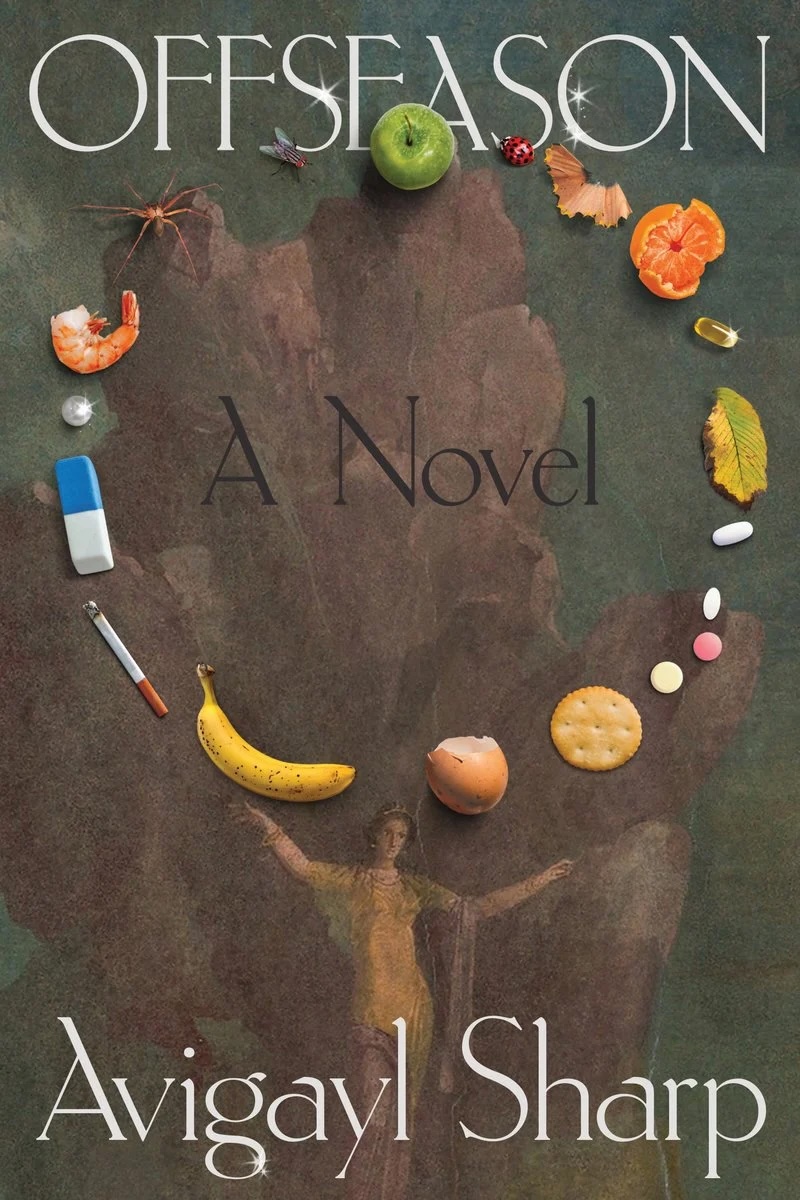
From Offseason by Avigayl Sharp. Copyright © 2026 by Avigayl Sharp. Published on May 5, 2026 by Astra Publishing House. Reprinted by permission.